The 3,000-Hour Requirement at a Glance
Every LCSW candidate in California must accumulate 3,000 hours of supervised experience as a registered Associate Clinical Social Worker (ASW), except hours that qualify under the 90-day rule. All 3,000 must be post-degree: unlike the LMFT track, California credits zero pre-degree hours toward LCSW licensure, so your MSW practicum and internship hours do not count, no matter how clinical the work was.
The BBS requires each category and cap, not just the 3,000 total: the clinical minimum, the psychotherapy subset, the non-clinical cap, the weekly supervision requirement, the 104-week minimum, and the LCSW-specific supervision totals. Hours outside the categories and caps do not count toward licensure.
The sections below cover each requirement with worked examples. For a personalized projection of your finish date, run the LCSW hours calculator first, then come back for the details. If you want the full path from MSW to license, including exams, that lives in our ASW to LCSW timeline guide.
The LCSW Hours Breakdown by Category
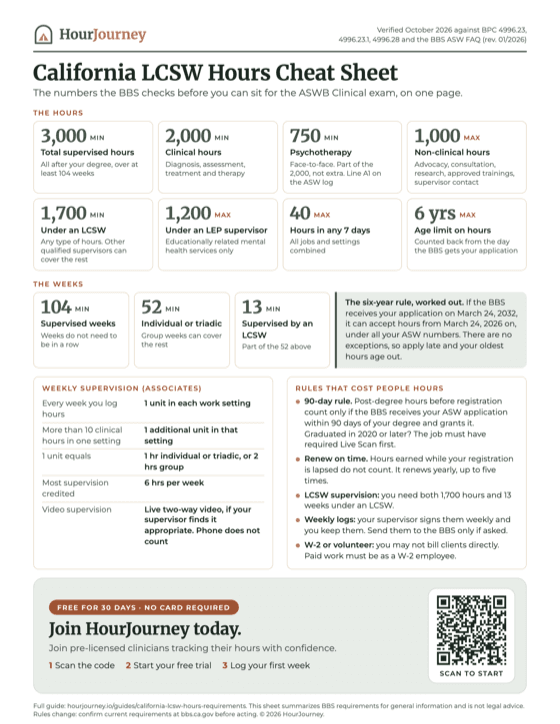
Here is the entire requirement as one table, using the BBS categories exactly as they appear on the LCSW experience chart. Each row gets its own section below.
| Category | Hours | Detail |
|---|---|---|
| Clinical psychosocial diagnosis, assessment, and treatment | 2,000 minimum | No maximum; includes the psychotherapy subset below |
| Face-to-face individual or group psychotherapy | 750 minimum | Subset of the 2,000, not additional hours |
| Non-clinical experience | 1,000 maximum | Advocacy, consultation, evaluation, research, supervisor-approved trainings directly related to clinical social work, supervisor contact |
| Hours supervised by an LCSW (any type) | 1,700 minimum | Cuts across both categories above |
| Total | 3,000 | All post-degree, across a minimum of 104 supervised weeks |
Notice the arithmetic: 2,000 clinical minimum plus 1,000 non-clinical maximum equals exactly 3,000. The clinical category has no maximum, so extra clinical hours keep counting. The 750-hour psychotherapy subset and the 1,700-hour LCSW rule are covered next.
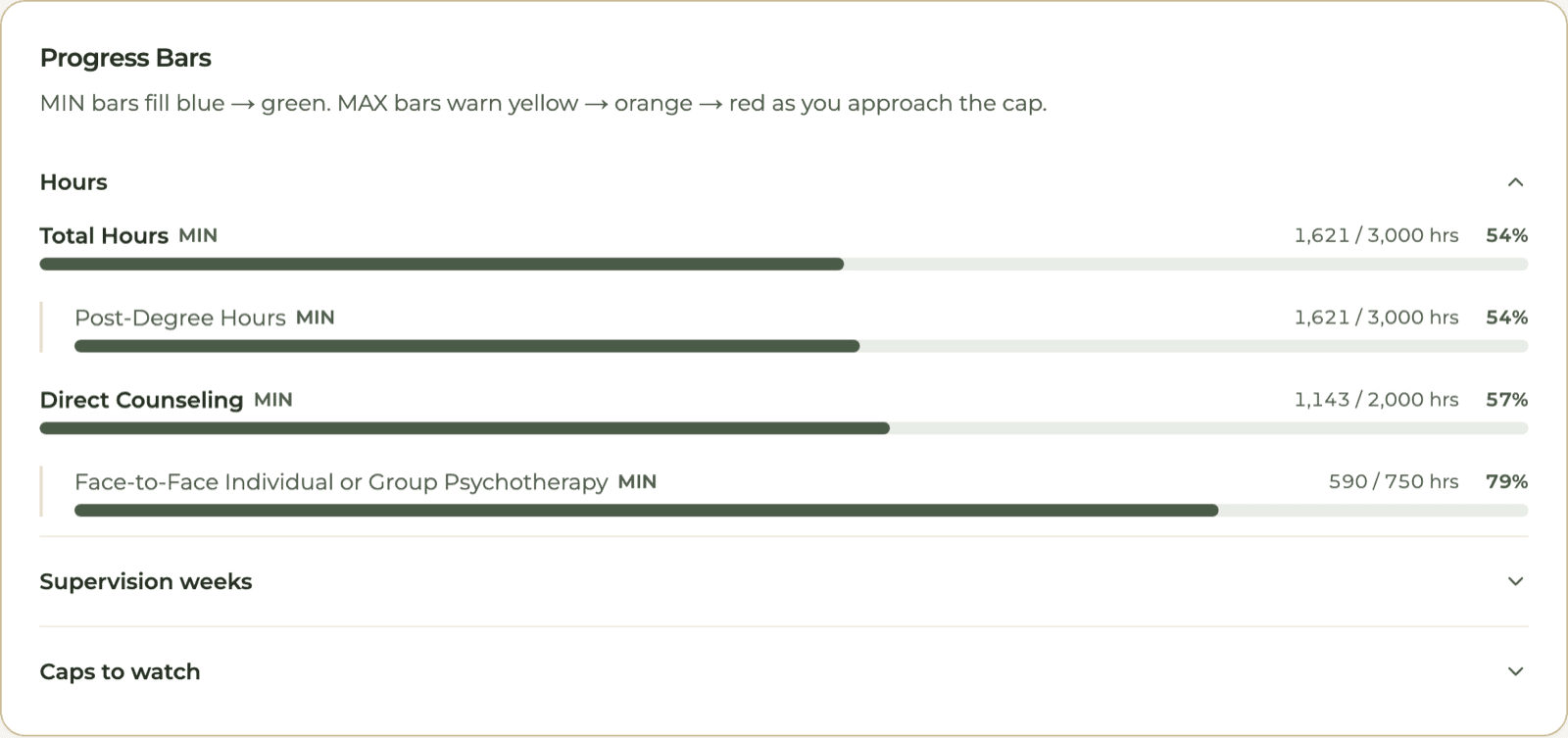
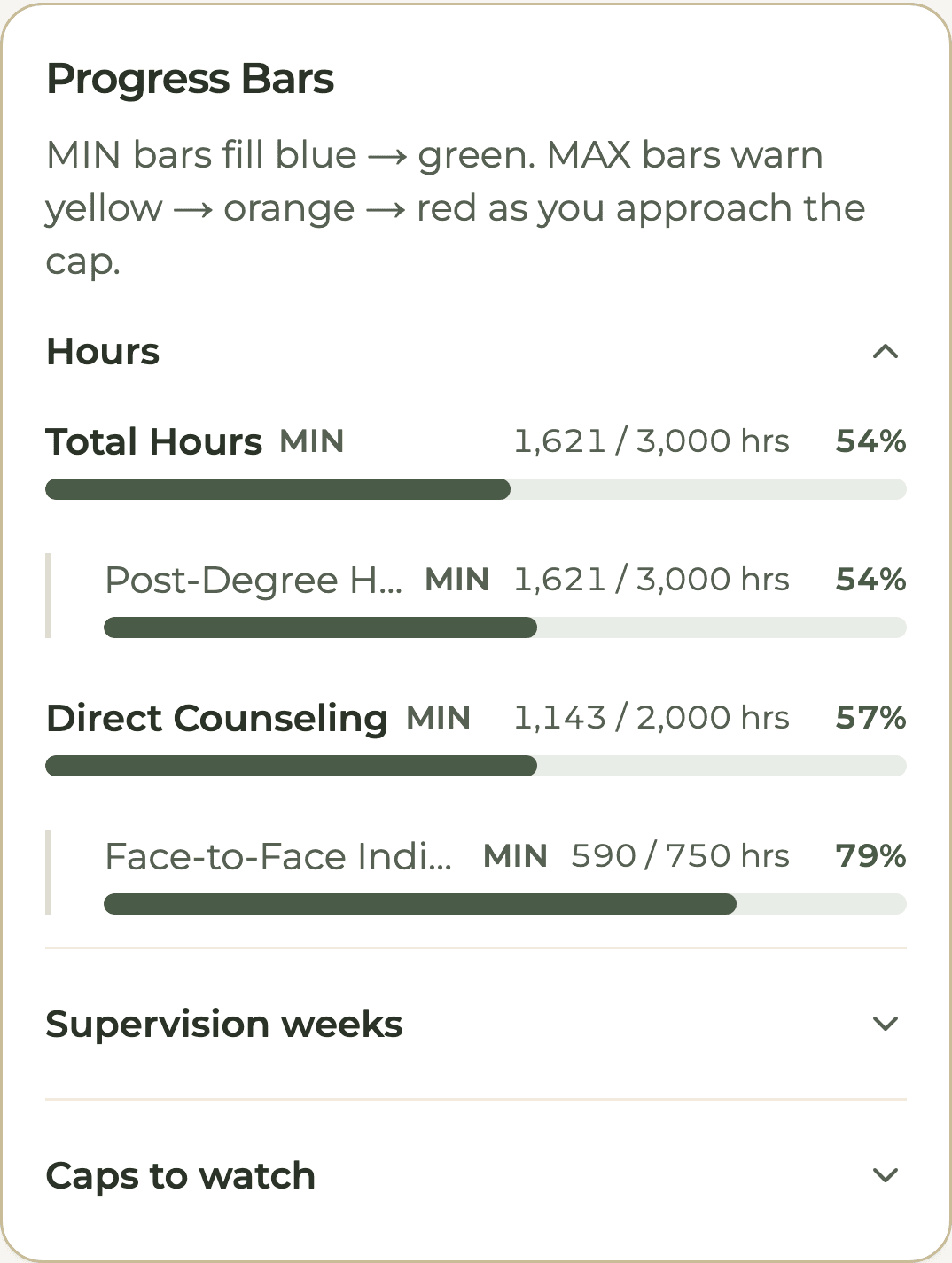
HourJourney tracks every line of this table for you
Your dashboard shows total hours toward 3,000, clinical hours toward 2,000 and psychotherapy toward 750, from the weeks you log.
The 2,000-Hour Clinical Minimum
At least 2,000 of your hours must be clinical psychosocial diagnosis, assessment, and treatment, including psychotherapy and counseling. This is a higher clinical bar than the LMFT and LPCC tracks, which require 1,750. Telehealth hours count, with no limit. The category is recorded on the ASW Weekly Log of Experience Hours each week.
The clinical versus non-clinical line is a common question, especially around case management, documentation, and collateral contacts. We keep a dedicated breakdown of what counts as clinical hours for LCSW licensure and how to ask your supervisor about borderline activities; this page stays focused on the numeric requirements.
The 750-Hour Face-to-Face Psychotherapy Requirement
At least 750 of your 2,000 clinical hours must be face-to-face individual or group psychotherapy, performed in the context of clinical social work services. Like the LMFT track's couples-and-families subset, it is a floor inside a floor: the 750 do not stack on top of the 2,000, they must be inside it.
Your clinical total can reach 2,000 before the psychotherapy subset reaches 750, so check the subset separately. An ASW logging 20 clinical hours a week with only 3 of psychotherapy accumulates the 2,000 clinical minimum in 100 weeks but needs 250 weeks for the psychotherapy subset. The fix is structural, not effort: ask for a standing therapy caseload early, and if your site cannot offer one, add a second site that can. Our guide to choosing your first ASW job ranks settings by how well they feed this subset.
Watch the subset, not the total. Your clinical total will look healthy long before the 750 psychotherapy hours are on pace. Check the subset monthly. HourJourney shows it on its own progress bar, separate from the clinical total.
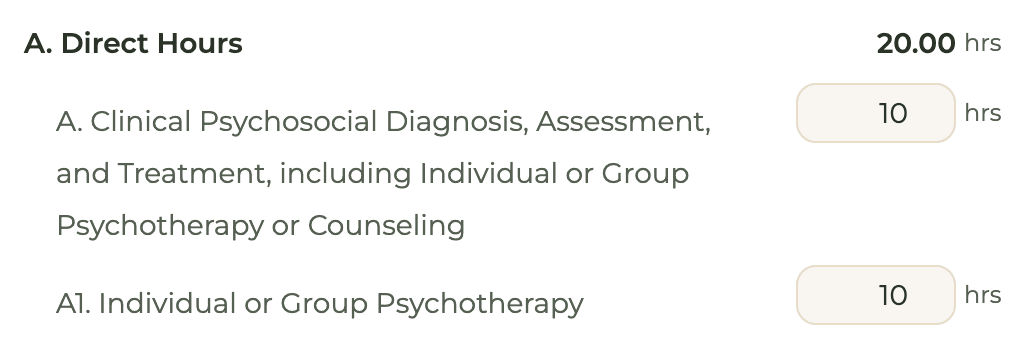
HourJourney tracks your 750 psychotherapy hours
Each week you enter clinical hours and the psychotherapy part of them separately, so the 750 is counted on its own.
The 1,000-Hour Non-Clinical Cap
Non-clinical experience is capped at 1,000 hours, tighter than the 1,250 allowed on the LMFT and LPCC tracks. The BBS list of creditable non-clinical activities for the LCSW track is: client-centered advocacy, consultation, evaluation, research, and workshops, seminars, training sessions, or conferences directly related to clinical social work and approved by your supervisor, plus direct supervisor contact. Supervisor contact is further capped at 6 credited hours in any single week.
Note what is not on that list: progress notes and clinical documentation are not named in the LCSW non-clinical list (BPC 4996.23(d)(3)), unlike the AMFT and APCC lists. Ask your supervisor how documentation time is treated.
Hours past the 1,000 cap are not penalized; they just stop counting. If your role is so administrative that non-clinical hours dominate your week, the cap becomes the least of your problems, because the clinical minimum stalls. We cover that scenario, and how to fix it, in earning LCSW hours in a non-clinical job.
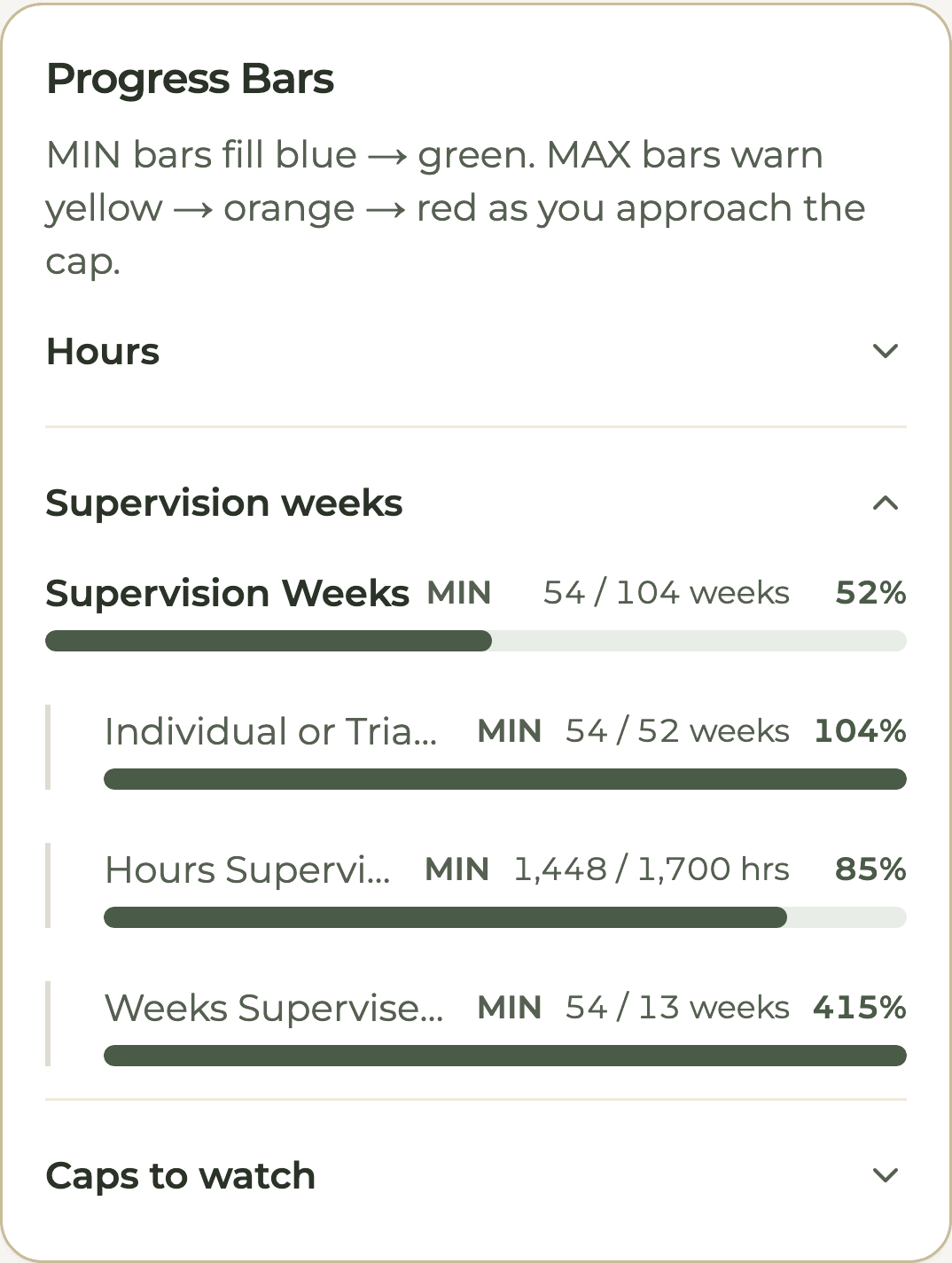
The 1,700-Hour and 13-Week LCSW Supervision Rule
This rule exists on no other California license track: at least 1,700 of your 3,000 hours, of any type, must be gained under the supervision of an LCSW specifically, and at least 13 of your individual or triadic supervision weeks must be with an LCSW. An LMFT, LPCC, licensed psychologist, or board-certified psychiatrist can supervise the remainder, but they can never be your only supervisor for the full journey.
The practical consequence: before you accept a job, confirm who would supervise you and what license they hold. An agency whose only available supervisor is an LMFT can still employ you, but no more than 1,300 of your hours there can move you toward the finish line unless an LCSW enters the picture. Verify license type and status on the Department of Consumer Affairs License Search before your first logged week, and get the supervision relationship documented in the BBS supervision agreement within 60 days.
The full picture of who qualifies, including the narrow Licensed Educational Psychologist option and its 1,200-hour cap, is in who can supervise an ASW in California.
Track hours by supervisor license, not just by category. The BBS checks your 1,700 LCSW-supervised hours across your entire record. If you split time between an LCSW and an LMFT supervisor, you need running totals per license type. HourJourney records each entry against a specific supervisor and license, so your LCSW-supervised hours and weeks are totaled as you log.
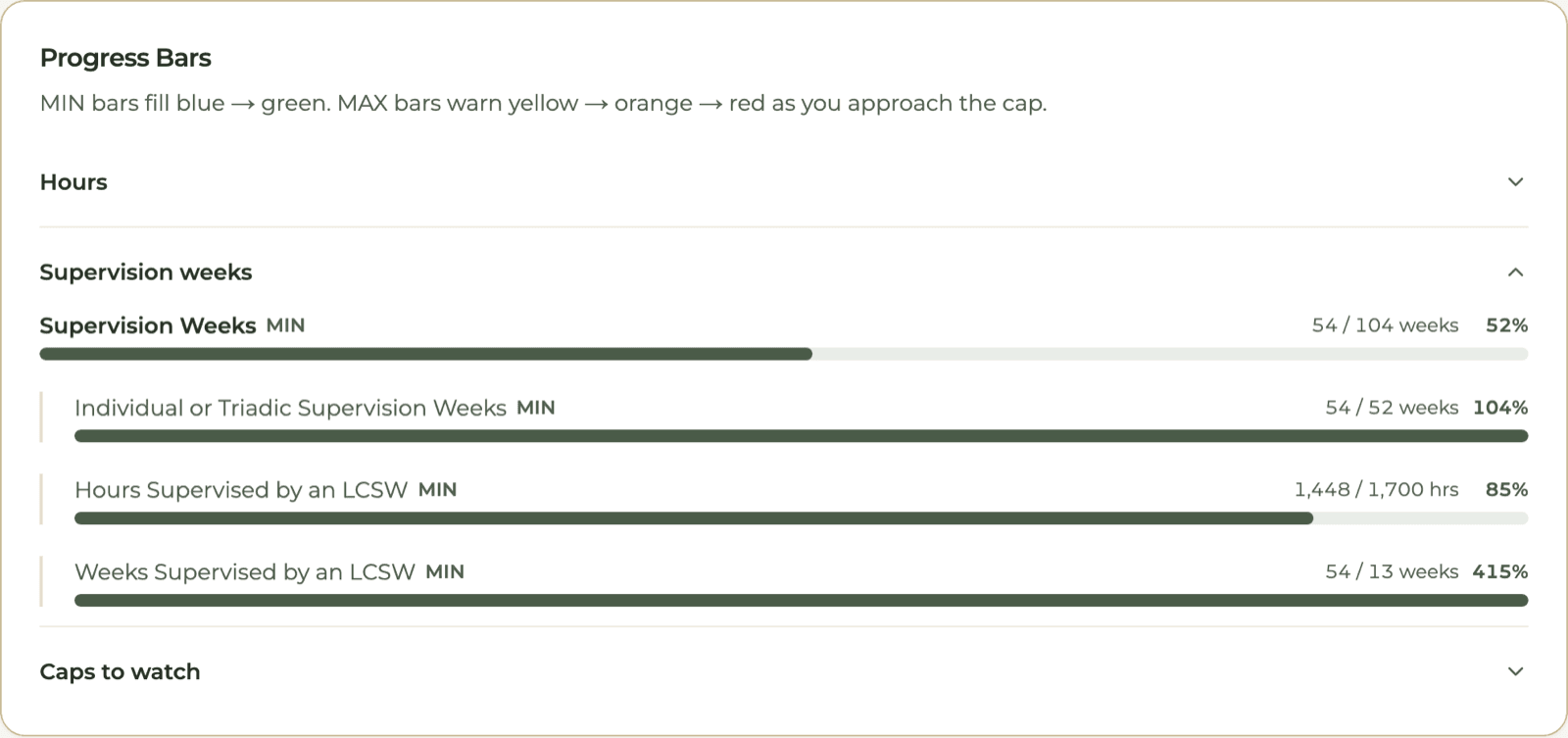
HourJourney counts the hours and weeks under an LCSW
Each entry is tied to a supervisor and their license, so the dashboard totals your LCSW-supervised hours and weeks.
No Pre-Degree Hours, With One 90-Day Exception
Every hour must be earned after your MSW is awarded, and as a registered ASW except hours that qualify under the 90-day rule. Practicum and field placement hours from your program do not count toward the 3,000, full stop. This surprises MSW graduates comparing notes with AMFT friends, who can carry up to 1,300 pre-degree hours into their total.
The one exception is the 90-day rule: hours earned between your degree award date and the issuance of your ASW number can count, provided the BBS receives your application within 90 days of your degree award date, the registration is later granted, and (for 2020 and later graduates) the hours were gained at a workplace that required Live Scan before you started. If you apply later, hours count only from the date your registration is issued. The mechanics, and what to do in week one while you wait, are covered in our 90-day rule guide and the ASW registration walkthrough.
Registration timing is therefore part of your hours math: if the application arrives after the 90 days, hours before your issue date do not count.
The 104-Week Minimum: Why Hours Alone Aren't Enough
Your 3,000 hours must span at least 104 supervised weeks, and a week counts only if you received at least one unit of supervision in it. Weeks you worked without supervision do not advance the counter, and the hours claimed in an unsupervised week are themselves at risk because the ratio was not met.
Inside the 104, two sub-minimums apply: at least 52 weeks must include individual or triadic supervision rather than group alone, and at least 13 of those individual or triadic weeks must be supervised by an LCSW.
Working full time, 104 weeks is almost exactly two years, which is why no amount of overtime produces an LCSW in less. An ASW logging 35-hour weeks reaches 3,000 hours in roughly 86 weeks and then spends 18 more weeks logging supervised experience purely to satisfy the week count. Plan for the two-year floor from the start.
Weekly Supervision Requirements
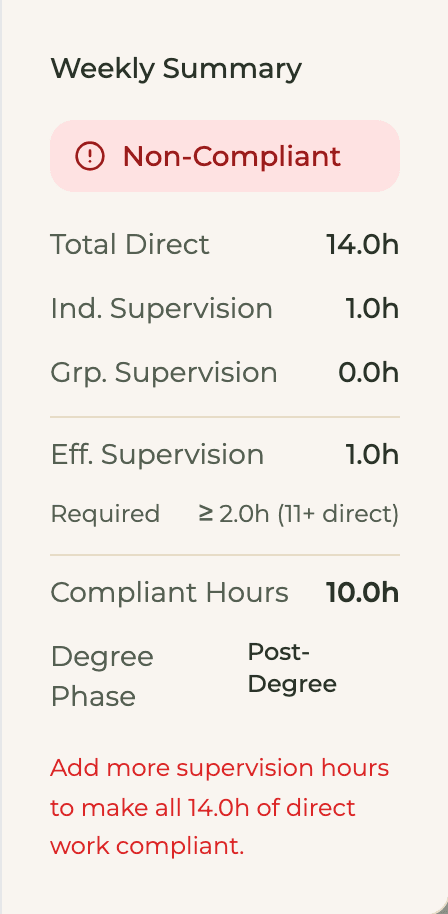
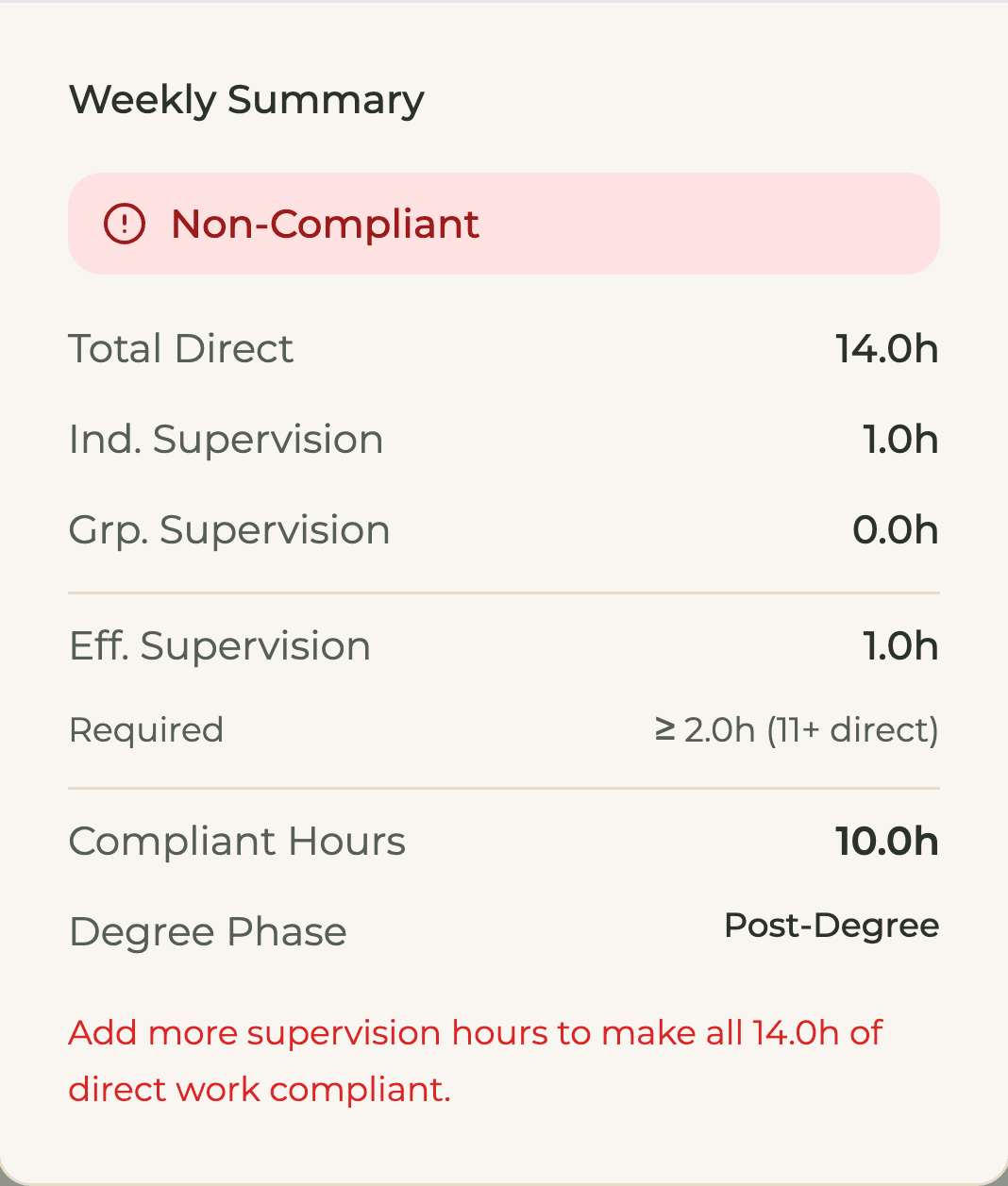
Supervision compliance is checked week by week. The BBS uses the same unit system across the three Associate tracks (AMFT, APCC, ASW), with the trigger tied to your clinical hours in the week in each setting:
| Condition | Units Required | Definition of 1 Unit |
|---|---|---|
| Any week you gain experience, in each work setting | 1 unit minimum | 1 hr individual/triadic or 2 hrs group |
| More than 10 clinical hours in the week in a setting | 2 units minimum | Same definition per unit |
| Maximum supervision credit | 6 hrs/week | Counts inside the 1,000-hour non-clinical cap |
| LCSW-supervised weeks | 13 minimum | Individual/triadic weeks under an LCSW |
One hour of individual or triadic supervision equals one unit; group supervision counts at half rate, so two group hours make one unit. The requirement must be met in each work setting in each week you gain experience there. For the full mechanics, including how ratios interact across multiple sites, see BBS supervision hours per week and the broader BBS supervision requirements guide.
HourJourney checks every week's supervision for you
Enter your clinical hours and supervision. The week shows Compliant or Non-Compliant, how many hours count, and what to add.
The Six-Year Window and the 40-Hour Weekly Cap
Your ASW registration is valid for a six-year period with five annual renewals, and hours only count while the registration is current. Renew late and any hours logged during the lapse are invalid. If the six years run out before you finish, a subsequent registration is possible, but only after passing the California Law and Ethics Exam, and under a subsequent registration you cannot work in a private practice or professional corporation. All other settings are allowed. Separately, the BBS only accepts hours gained within the six years before it receives your Application for Licensure (under all ASW numbers), with no exceptions. If the application is closed and you reapply, the six years are counted back from the new receipt date. The details and edge cases are in the six-year rule guide.
Separately, no more than 40 hours may be credited in any 7 consecutive days, combined across all settings. Excess hours are not credited. If you work two jobs, each site's log can look fine on its own while the combined week runs over.
Two sites, one cap. 28 hours at your agency plus 16 at a weekend program is 44 hours; the BBS credits 40 and the other 4 are not credited. If you run multiple sites, watch the combined weekly total in one place rather than per-site.
HourJourney won't let a week go over 40 hours
The app adds up the week across all your sites and stops you saving a logged week above 40 hours.

Common Mistakes That Delay LCSW Licensure
These are common ways to lose or miscount hours, each one preventable with tracking that starts on day one.
Letting the 750-hour psychotherapy subset lag
Your clinical total can reach 2,000 before the psychotherapy subset reaches 750, so check the subset separately.
Missing the 1,700-hour LCSW supervision minimum
Working under an LMFT or LPCC supervisor is allowed, but ASWs who never confirm their supervisor's license type can finish 3,000 hours with too few of them LCSW-supervised.
Assuming MSW practicum hours count
They do not. All 3,000 hours are post-degree on the LCSW track.
Applying for the ASW number late and losing gap hours
The 90-day rule only protects hours if the BBS receives your registration application within 90 days of your degree award date. If it arrives later, hours count only from the date your registration is issued.
Counting documentation time as non-clinical hours
Progress notes and clinical documentation are not named in the LCSW non-clinical list (BPC 4996.23(d)(3)), unlike the LMFT and LPCC tracks. Ask your supervisor how documentation time is treated.
Reaching 3,000 hours before 104 weeks
High-hour weeks finish the hour total early, but the week minimum still stands, along with the 52 individual or triadic supervision weeks and 13 LCSW weeks inside it.
Exceeding the 40-hour cap across two sites
The cap applies to your combined total in any 7 consecutive days, not per site. Hours over the cap are not credited.
Logging hours during a lapsed registration
Renewal is annual and requires the law-and-ethics CE. Hours logged during even a short lapse are invalid, so set reminders well ahead of your expiration date.
FAQ: California LCSW Hours Requirements
How many supervised hours do you need for LCSW licensure in California?▾
You need 3,000 hours of supervised post-degree experience, earned as a registered ASW except hours that qualify under the 90-day rule. Of those, at least 2,000 must be clinical psychosocial diagnosis, assessment, and treatment, and at least 750 of the 2,000 must be face-to-face individual or group psychotherapy. Non-clinical experience is capped at 1,000 hours. The 3,000 hours must span at least 104 supervised weeks, with no more than 40 hours credited in any 7 consecutive days.
How many hours of supervision do you need for LCSW?▾
Two numbers matter. First, supervision you receive counts toward your hours as direct supervisor contact, capped at 6 credited hours in any single week and included in the 1,000-hour non-clinical maximum. Second, week by week you need at least 1 supervision unit in each work setting in any week you gain experience there (1 hour of individual or triadic supervision, or 2 hours of group), plus 1 more unit for any setting where you do more than 10 clinical hours that week. Across the whole journey, at least 52 of your 104 supervised weeks must include individual or triadic supervision, and at least 13 of those weeks must be supervised by an LCSW.
What is the LCSW hours breakdown in California?▾
3,000 total hours split into a clinical minimum and a non-clinical maximum. Clinical psychosocial diagnosis, assessment, and treatment: minimum 2,000 hours, of which at least 750 must be face-to-face individual or group psychotherapy. Non-clinical experience (client-centered advocacy, consultation, evaluation, research, workshops and trainings, direct supervisor contact): maximum 1,000 hours. The clinical category has no maximum, so extra clinical hours keep counting.
What is the 1,700-hour LCSW supervision rule?▾
At least 1,700 of your 3,000 hours (any type) must be gained under the supervision of an LCSW specifically, and at least 13 of your individual or triadic supervision weeks must be with an LCSW. An LMFT, LPCC, psychologist, or psychiatrist can supervise you for the rest, but never for all of it. This rule exists only on the LCSW track; LMFT and LPCC candidates have no equivalent requirement.
Do MSW practicum or internship hours count toward the 3,000?▾
No. All 3,000 hours must be earned after your degree is awarded. California does not credit pre-degree hours on the LCSW track, unlike the LMFT track where trainees can bank up to 1,300 pre-degree hours. The one narrow exception is the 90-day rule: post-degree hours earned before your ASW registration is issued can count if the BBS receives your registration application within 90 days of your degree award date, the registration is later granted, and (for 2020 and later graduates) the hours were gained at a workplace that required Live Scan before you started.
What is the 750-hour psychotherapy requirement for LCSW?▾
At least 750 of your 2,000 clinical hours must be face-to-face individual or group psychotherapy performed in the context of clinical social work services. It is a subset of the clinical minimum, not an extra bucket. Your clinical total can reach 2,000 before the psychotherapy subset reaches 750, so check the subset separately.
How many weeks of supervised experience does an ASW need?▾
A minimum of 104 supervised weeks. A week counts only if you received at least one unit of supervision that week. At least 52 of the 104 weeks must include individual or triadic supervision (not just group), and at least 13 of those must be supervised by an LCSW. Weeks are counted independently of hours: hitting 3,000 hours in fewer than 104 weeks does not finish the requirement.
What is the 40-hour weekly cap for ASW hours?▾
No more than 40 hours of experience may be credited in any 7 consecutive days, combined across all of your work settings. Hours over the cap are not credited. If you work at two sites, coordinate schedules so the combined weekly total never crosses 40.
How long do ASWs have to finish their hours?▾
There is no set deadline for finishing, but the BBS can only accept hours gained in the six years before it receives your Application for Licensure, with no exceptions. Your first ASW registration lasts six years (five renewals). A subsequent registration lets you keep earning hours, but you must first pass the California Law and Ethics Exam and cannot work in a private practice or professional corporation under it.
Requirements verified against the BBS ASW FAQ (revised January 2026) and the BBS LCSW experience chart (rev. 10/2023). Statutes and regulations can change. Always confirm current requirements at bbs.ca.gov before making decisions about your licensure path. This guide is for informational purposes only and does not constitute legal or professional advice.