Why LCSW Hour Tracking Is Different from LMFT
If you are coming from an MSW program, you may assume that LCSW hour tracking works the same way as LMFT tracking. It does not. Four structural differences set the LCSW path apart.
First: no pre-degree credit. LMFT candidates can count up to 1,300 hours earned during their degree program. LCSW candidates get zero pre-degree credit. Every one of your 3,000 hours must be earned after your degree, as a registered ASW. Practicum and fieldwork hours from your MSW program do not count, no matter how clinical they were. Your timeline starts when your ASW registration is issued, except hours that qualify under the 90-day rule.
Second: a higher clinical minimum. LMFT requires 1,750 direct client hours. LCSW requires 2,000 hours of clinical psychosocial diagnosis, assessment, and treatment, including psychotherapy or counseling.
Third: the 750-hour psychotherapy subset. Within your 2,000 clinical hours, at least 750 must be face-to-face individual or group psychotherapy. LMFT has a different sub-minimum (500 hours with couples, families, and children); LPCC has none. You can reach 2,000 clinical hours and still be short on the 750, so track it separately. Ask your supervisor how borderline activities such as assessments are categorized.
Fourth: the LCSW-supervised minimum. At least 1,700 of your 3,000 hours must be supervised by a Licensed Clinical Social Worker. LMFT and LPCC have no such license-specific supervisor requirement. If your primary supervisor holds an LMFT license, most of your hours will not count toward this 1,700 minimum, even though they count toward the 3,000 total. For every minimum, maximum, and deadline in one place, see our California LCSW hours requirements guide, which covers how many supervised hours you need for the LCSW and how the categories fit together; this page stays focused on the tracking workflow.
Tracking errors to avoid: (1) assuming pre-degree hours count, (2) not tracking the 750 psychotherapy subset separately from the 2,000 clinical total, (3) not tracking which hours were supervised by an LCSW, and (4) going over 40 hours in any 7 consecutive days across multiple sites.
For a detailed side-by-side comparison of LMFT and LCSW requirements, see our LMFT vs LCSW comparison for California. For a deep dive into supervision requirements across all license types, see BBS supervision requirements in California.
What You Need to Track Every Week
Every week that you log hours, you need to capture the following data points. These map directly to the columns on the BBS ASW Weekly Log of Experience Hours, which says to use a separate log for each supervisor and for each work setting.
- ✓Date range (week start and end)
- ✓Work setting name and address
- ✓Supervisor name, license type, and license number
- ✓Clinical hours: clinical psychosocial diagnosis, assessment, and treatment, including psychotherapy or counseling
- ✓Psychotherapy subset: face-to-face individual or group psychotherapy (subset of clinical)
- ✓Non-clinical hours: client-centered advocacy, consultation, evaluation, research, direct supervisor contact, and supervisor-approved workshops or trainings
- ✓Weekly total: clinical + non-clinical (no more than 40 credited in any 7 consecutive days)
- ✓Supervision received: individual/triadic and/or group (hours and type)
- ✓Supervisor signature (electronic accepted per BBS)
One weekly log per supervisor per setting. If you see clients at two agencies under different supervisors, you need two weekly logs for that week. If you see clients at two agencies under the same supervisor, you still need two logs because the work settings differ. No more than 40 hours are credited in any 7 consecutive days across all of them.
The most important habit to build is tracking your psychotherapy hours as a separate line item every single week, so you do not have to reconstruct it from supervisor records later. For a column-by-column walkthrough of the weekly log itself, see our ASW weekly log guide.
The 2,000-Hour Clinical Requirement
The BBS requires a minimum of 2,000 hours of clinical psychosocial diagnosis, assessment, and treatment, including psychotherapy or counseling (BPC 4996.23(d)(2)). Telehealth hours count with no limit.
The critical nuance is that psychotherapy is a subset of this 2,000-hour requirement, not a separate addition to it. When you conduct a psychotherapy session, that hour counts toward both your 2,000 clinical total and your 750 psychotherapy minimum simultaneously. Clinical work that is not psychotherapy counts only toward the 2,000. Ask your supervisor how assessments and treatment planning are categorized.
This means you must track clinical hours and psychotherapy hours as two separate numbers every week. If your role involves a lot of clinical work that is not psychotherapy, your 2,000 clinical hours can accumulate faster than your 750 psychotherapy hours.
| BBS category | Counts toward 2,000? | Counts toward 750? |
|---|---|---|
| Face-to-face individual or group psychotherapy | Yes | Yes |
| Other clinical psychosocial diagnosis, assessment, and treatment, including counseling | Yes | No |
| Non-clinical experience (advocacy, consultation, evaluation, research, supervisor contact, approved trainings) | No | No |
For a complete breakdown of how LMFT clinical hour categories compare, see our California LMFT hours requirements guide. For the full boundary between the 2,000-hour clinical total and the 750-hour psychotherapy subset, see what counts as clinical hours for LCSW.
The 750-Hour Psychotherapy Subset
The 750-hour psychotherapy requirement is a sub-minimum that sits inside the 2,000 clinical requirement, meaning these hours are counted twice: once toward the 2,000 clinical total and once toward the 750 psychotherapy minimum.
The statute defines it as "face-to-face individual or group psychotherapy" (BPC 4996.23(d)(2)). It does not list which other activities fall outside it, so ask your supervisor how assessments, intakes, and similar work are categorized.
The math: to reach 750 psychotherapy hours by the time you reach 2,000 clinical hours, about 37.5% of your clinical work must be psychotherapy. Below that share, you finish the 2,000 before the 750.
Check your ratio early. Divide your psychotherapy hours by your total clinical hours. If the ratio is consistently below 37.5%, you will finish your clinical hours before your psychotherapy hours. Talk to your supervisor about adjusting your caseload to include more therapy cases before you fall too far behind.
The practical implication is that you should monitor your psychotherapy-to-clinical ratio every month, not just at the end. If you notice the ratio dropping below 37.5%, that is the time to have a conversation with your supervisor about shifting your caseload toward more therapy and fewer assessments. Waiting until you have 1,800 clinical hours and only 500 psychotherapy hours means months of additional work that could have been avoided.
The LCSW Supervision Requirement
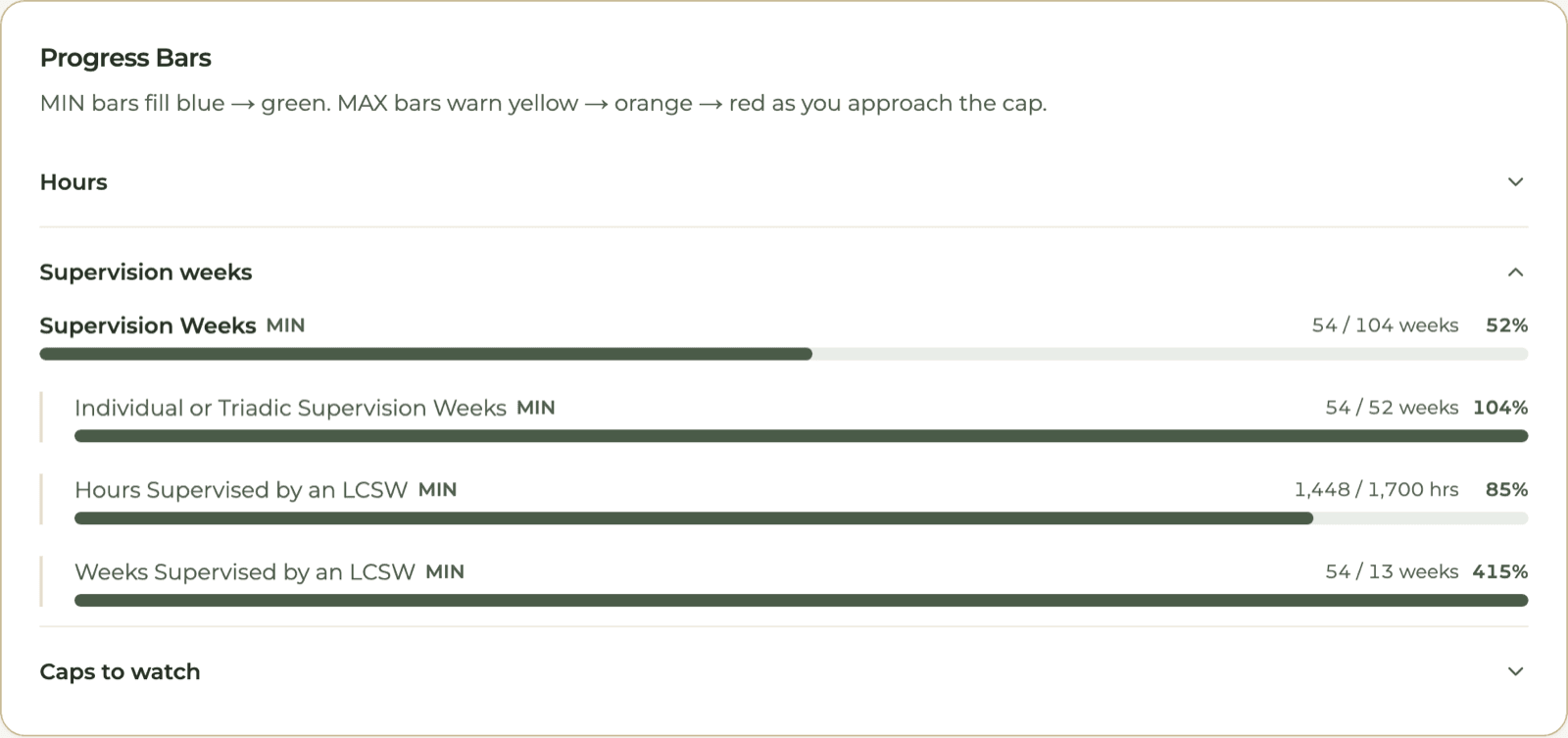
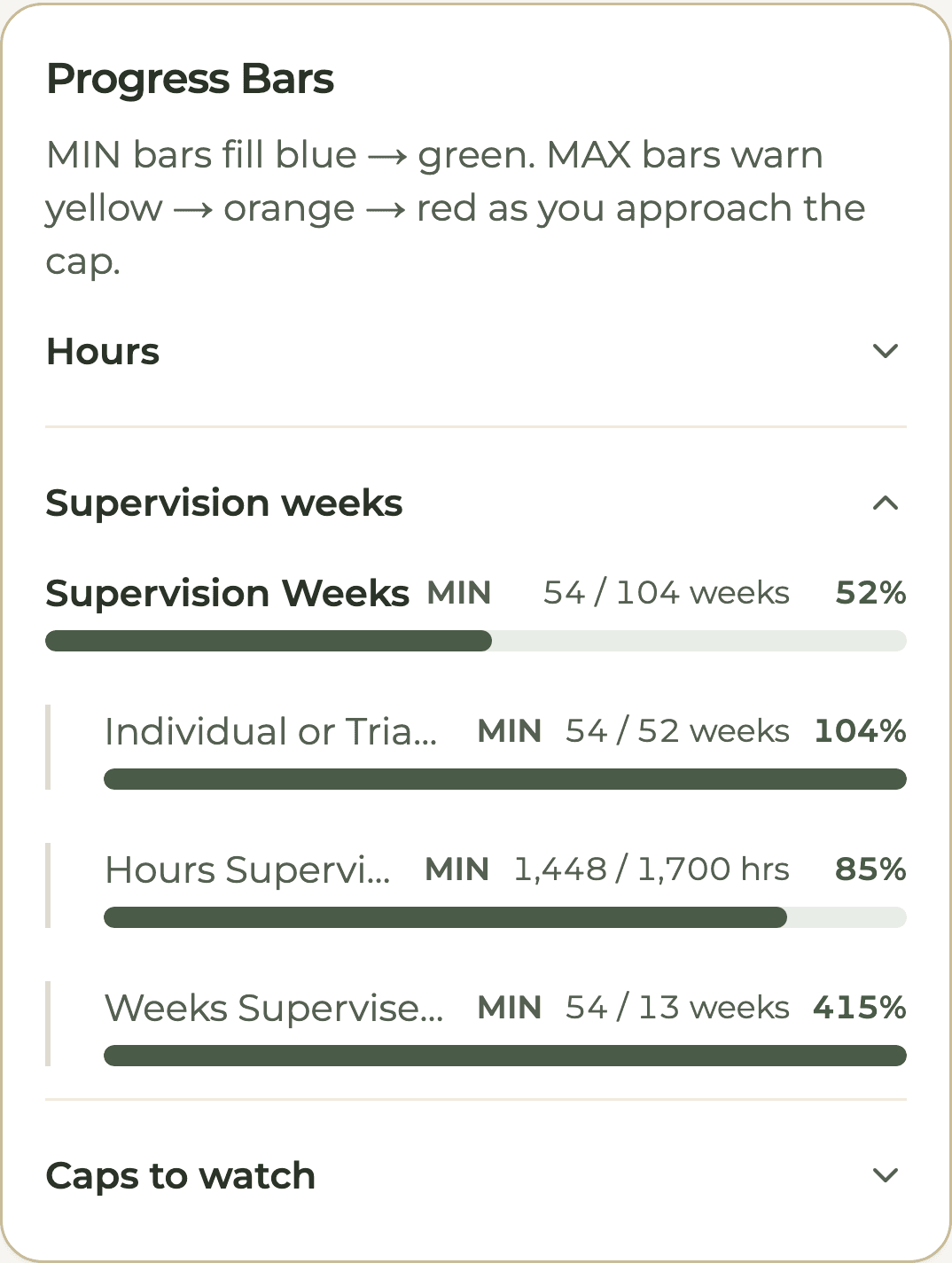
This is the requirement that has no parallel in LMFT or LPCC tracking. The BBS requires that at least 1,700 of your 3,000 total hours be supervised by a Licensed Clinical Social Worker. Additionally, at least 13 of your 52 required individual or triadic supervision weeks must be supervised by an LCSW (BPC 4996.23.1(g)).
The remaining 1,300 hours can be supervised by other BBS-qualified professionals: an LMFT, LPCC, licensed psychologist, or psychiatrist. Supervision by a Licensed Educational Psychologist (LEP) is permitted but capped at 1,200 hours. Plan for at least 1,700 hours and 13 weeks under an LCSW.
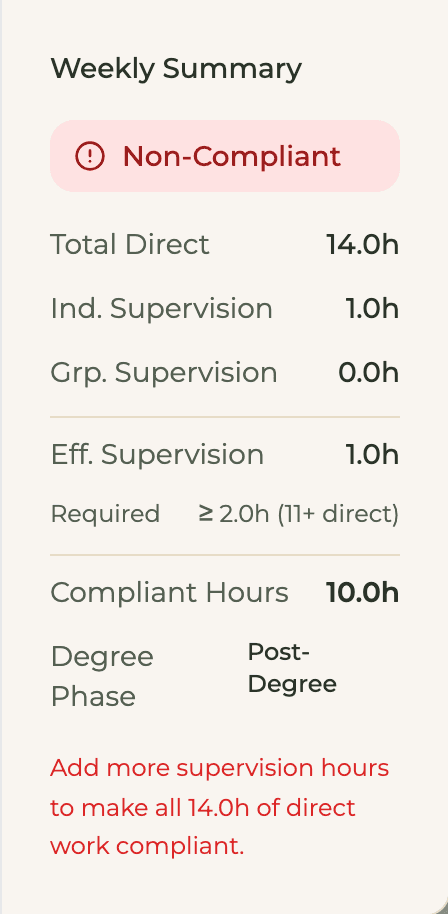
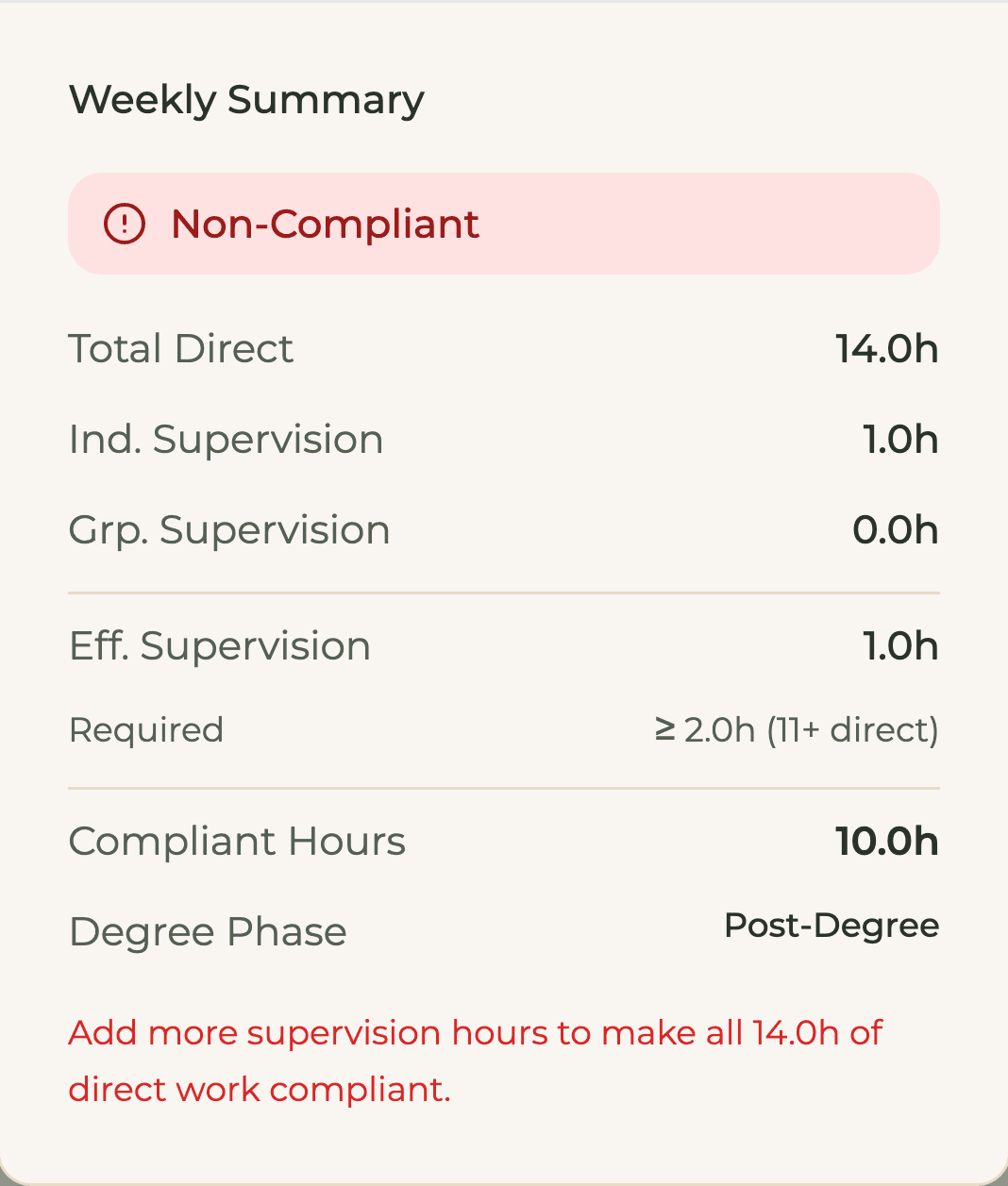
The supervision ratio rules are the same as for AMFTs and APCCs: you need at least one unit of supervision per work setting per week (one hour of individual/triadic or two hours of group). If you log more than 10 hours of clinical diagnosis, assessment, or treatment in a week at any single setting, you need one additional supervision unit for that setting. The weekly supervision cap is 6 hours. Your total supervised experience must span a minimum of 104 weeks, with at least 52 weeks including individual or triadic supervision.
HourJourney checks every week's supervision for you
Enter your clinical hours and supervision. The week shows Compliant or Non-Compliant right away, how many hours count, and what to add.
Choose your primary supervisor carefully. If your main supervisor is an LMFT rather than an LCSW, you will need to arrange at least 1,700 hours of LCSW oversight separately. At 30 hours per week, that is roughly 57 weeks of work under an LCSW. Plan for this from the start, not after you have accumulated hundreds of hours under a non-LCSW supervisor.
Track your LCSW-supervised hours as a running total separate from your overall total. At any point, you should be able to answer two questions: "How many of my total hours were supervised by an LCSW?" and "How many of my individual supervision weeks were with an LCSW?" If you cannot answer both, your tracking system is incomplete. For more on supervision requirements, see our BBS supervision requirements guide.
HourJourney counts the hours and weeks under an LCSW for you
Each supervisor's license is on file, so the dashboard keeps a running total of the hours and weeks supervised by an LCSW next to your 104 and 52 weeks.
The ASW Weekly Log: Column Structure
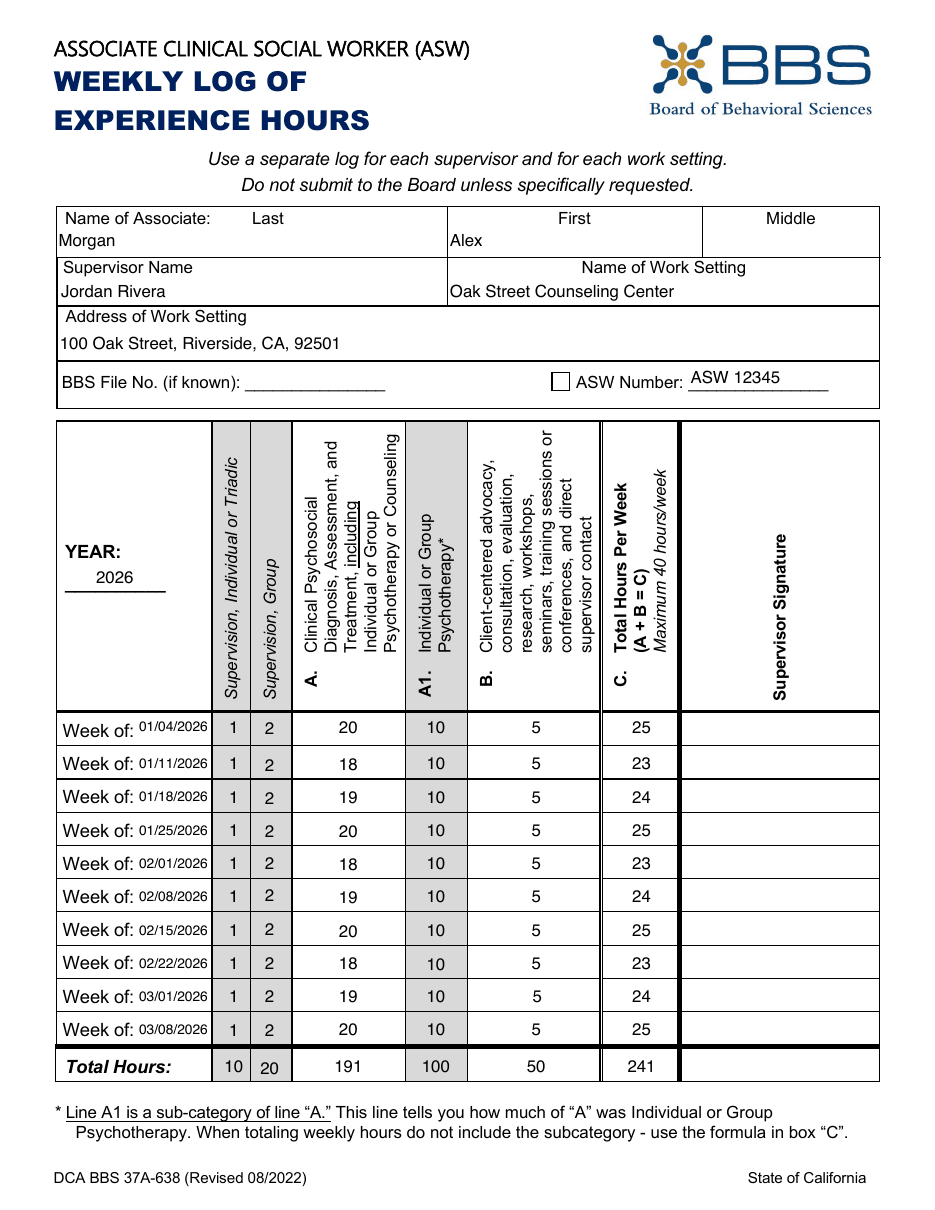
The ASW Weekly Log of Experience Hours is the BBS weekly log for ASW supervised experience. Your tracking system should mirror its columns so filling it in is straightforward.
| Column | What It Captures | Min / Max |
|---|---|---|
| Supervision, Individual or Triadic | Hours of individual or triadic supervision that week | Weekly |
| Supervision, Group | Hours of group supervision that week | Weekly |
| A. Clinical | Clinical psychosocial diagnosis, assessment, and treatment, including psychotherapy or counseling | Min 2,000 |
| A1. Psychotherapy | Individual or group psychotherapy (subset of A) | Min 750 |
| B. Non-clinical | Client-centered advocacy, consultation, evaluation, research, approved trainings, direct supervisor contact | Max 1,000 |
| C. Weekly Total | A + B for that week | Max 40 (any 7 consecutive days) |
| Supervisor Signature | Weekly verification by your supervisor (electronic accepted) | Weekly |
The psychotherapy sub-column is the most important structural element for ASWs. Unlike LMFT Form 37A-525 where the A1 subcategory (couples/families/children) is a breakdown of direct hours by client type, the LCSW psychotherapy sub-column is a breakdown by service type. This means you classify hours based on what you did (therapy vs. assessment), not who you did it with.
You keep your signed weekly logs and send them only if the BBS asks (the form says "Do not submit to the Board unless specifically requested"). With your Application for Licensure you submit the LCSW In-State Experience Verification. Your supervisor must still sign each weekly log at the time the hours are earned. If your supervisor is leaving their position, get all outstanding logs signed before their last day.
HourJourney fills in your ASW Weekly Log for you
Your logged weeks fill in the BBS ASW Weekly Log of Experience Hours for each supervisor and setting, with every column and the page totals, ready for your supervisor's signature.
Tracking Across Multiple Sites
Some ASWs work at two or more agencies at the same time. The BBS permits it, but it adds tracking work. Three rules govern multi-site tracking.
The 40-hour combined cap. Your total experience hours across all work settings in any seven consecutive days cannot exceed 40. This is not per site; it is a combined total. If you log 22 hours at Agency A and 22 hours at Agency B in the same 7 days, only 40 of those 44 hours count. The 4 excess hours are not credited. Total your hours across all sites every week to catch this.
Separate logs per site. The log says to use a separate log for each supervisor and for each work setting. If you have one supervisor at two agencies, that is two logs because the work settings differ. If a second supervisor at the same setting gives you some of your supervision, the BBS recommends recording all of your hours under your primary supervisor; only the supervision hours the second supervisor gave go on separate logs that supervisor signs (BBS ASW FAQ).
LCSW supervision tracked across all sites. The 1,700 LCSW-supervised hour requirement applies to your total hours, not per site. If you work at Site A under an LCSW and Site B under an LMFT, only your Site A hours count toward the 1,700 minimum. This means multi-site ASWs need to be especially deliberate about how their hours are distributed between LCSW-supervised and non-LCSW-supervised settings.
Multi-site math trap: If 60% of your hours are at a non-LCSW-supervised site, you will accumulate 3,000 total hours long before reaching 1,700 LCSW-supervised hours. At that split, you would need approximately 4,250 total hours to satisfy the LCSW-supervised minimum. Rebalance your site distribution early.
For ASWs considering the 90-day registration rule when first registering, note that hours earned between graduation and ASW registration issuance can count if the BBS receives your registration application within 90 days of your degree award date and, for 2020 and later graduates, the hours were gained at a workplace that required Live Scan first. Hours at each site still need a valid supervisor and a signed weekly log for that period.
How HourJourney Tracks ASW Hours
HourJourney is a BBS hours tracking app for California pre-licensed therapists. For ASWs pursuing LCSW licensure, it keeps these totals for you.
- ✓Tracks progress toward the 2,000 clinical minimum and shows a projected completion date.
- ✓Shows progress toward the 750-hour psychotherapy subset on its own bar.
- ✓Counts the 1,700 LCSW-supervised hours, with a running total of hours and weeks supervised by an LCSW.
- ✓Stops you saving a week over 40 hours across your supervisors and sites.
- ✓Counts supervised weeks: your 104 weeks, 52 individual or triadic weeks, and 13 weeks supervised by an LCSW, as separate running counts.
- ✓Exports the ASW Weekly Log of Experience Hours as a PDF, ready for your supervisor's signature.
You can also use the LCSW hours calculator to estimate your projected completion date based on your current weekly averages and the hours you have already accumulated.