Can a Non-Clinical Job Get You Licensed? Mostly No, and Here Is Why
LCSW licensure in California is built around a clinical core. Of your 3,000 total supervised hours, a minimum of 2,000 must be clinical psychosocial diagnosis, assessment, and treatment, including psychotherapy or counseling, and at least 750 of those must be face-to-face individual or group psychotherapy, all under a qualified supervisor. Those are the two numbers a non-clinical job can never reach.
Non-clinical experience is a separate, capped category: a maximum of 1,000 hours, covering client-centered advocacy, consultation, evaluation, research, direct supervisor contact, and workshops, seminars, training sessions or conferences directly related to clinical social work that your supervisor has approved. It counts toward your 3,000 total, but never toward the 2,000 clinical minimum or the 750 psychotherapy hours.
The load-bearing sentence: a purely non-clinical or macro job cannot get you to LCSW licensure on its own, because you will never accrue the 2,000 clinical or 750 psychotherapy hours there, and non-clinical hours can never substitute for the clinical minimum, no matter how many of them you log.
But the BBS sorts hours by category, not by job title (BPC 4996.23(d)(2)-(3)), and your supervisor signs off on which category each hour belongs in. Plenty of “non-clinical-sounding” jobs contain a real clinical component. A case manager who also does supervised assessment or therapy is earning clinical hours during that portion of the week. The rest of this guide helps you figure out which category your actual work falls into. For the underlying definitions, start with what counts as clinical hours for LCSW.
It Is the Category of Work, Not the Job Title
Your job title does not decide how an hour counts. The BBS sorts hours by category (BPC 4996.23(d)(2)-(3)), your supervisor signs off on each week, and only experience gained in the position you are employed or volunteer in counts (BPC 4996.23.2(d)). Two people with the identical title of “Case Manager” can have completely different hour profiles: one spends the week coordinating housing and benefits, the other spends half the week doing supervised psychosocial assessment and therapy (clinical) and half coordinating services.
This cuts both ways. A “Therapist” title does not automatically make every hour clinical: time in that role that is not clinical psychosocial diagnosis, assessment, or treatment is either non-clinical (if it fits a category BPC 4996.23(d)(3) names) or does not count, and your supervisor decides. And a “Case Manager” or “Program Coordinator” title does not automatically disqualify you: the supervised assessment and treatment you do inside that role still counts.
Ask the right question. Do not ask “does my job count?” Ask “which of my weekly activities are clinical psychosocial diagnosis, assessment, and treatment, including psychotherapy or counseling, under a qualified supervisor?” That set of hours, and only that set, builds toward your 2,000. Everything else is either the capped non-clinical category or does not count at all.
If your role is more macro than clinical, it is worth understanding where the line between the two sits. Our guide on clinical vs. macro social work in California breaks down which kinds of positions produce clinical hours and which do not.
What at a Mixed Job Counts, and What Does Not
Here is how the activities in a typical “non-clinical-sounding” job sort into three categories: hours that count toward the 2,000 clinical minimum, hours that are non-clinical (the capped 1,000), and time that does not count toward any hour total at all. Assume throughout that the work is done under a qualified supervisor; without that supervision, even clinical activity does not count. Your supervisor makes the final call on how each hour is categorized.
| Activity at Your Job | Clinical (2,000)? | Non-Clinical (1,000)? | Doesn't Count? |
|---|---|---|---|
| Psychosocial assessment | Yes | No | No |
| Individual or group psychotherapy | Yes* | No | No |
| Crisis work that is assessment or treatment | Yes | No | No |
| Case management / service coordination | No | Ask your supervisor** | Ask your supervisor** |
| Client-centered advocacy | No | Yes | No |
| Consultation; workshops or trainings directly related to clinical social work and approved by your supervisor | No | Yes | No |
| Program admin / policy / pure macro work | No | Ask your supervisor** | Ask your supervisor** |
| Progress notes and documentation | Not named** | Not named** | Ask your supervisor** |
| Unsupervised clinical work (no qualified supervisor) | No | No | Yes |
*Psychotherapy counts toward both the 2,000 clinical minimum and the 750 psychotherapy hours. Assessment counts toward the 2,000 but not the 750. **The BBS non-clinical list (BPC 4996.23(d)(3)) names client-centered advocacy, consultation, evaluation, research, direct supervisor contact, and supervisor-approved workshops directly related to clinical social work. It does not name case management, program administration, policy work, or progress notes. Some case management tasks may fall under client-centered advocacy; your supervisor decides whether a given task fits (BBS ASW FAQ).
For the exact definitions behind the non-clinical column, and what the BBS does and does not allow into it, see non-direct hours under the BBS.
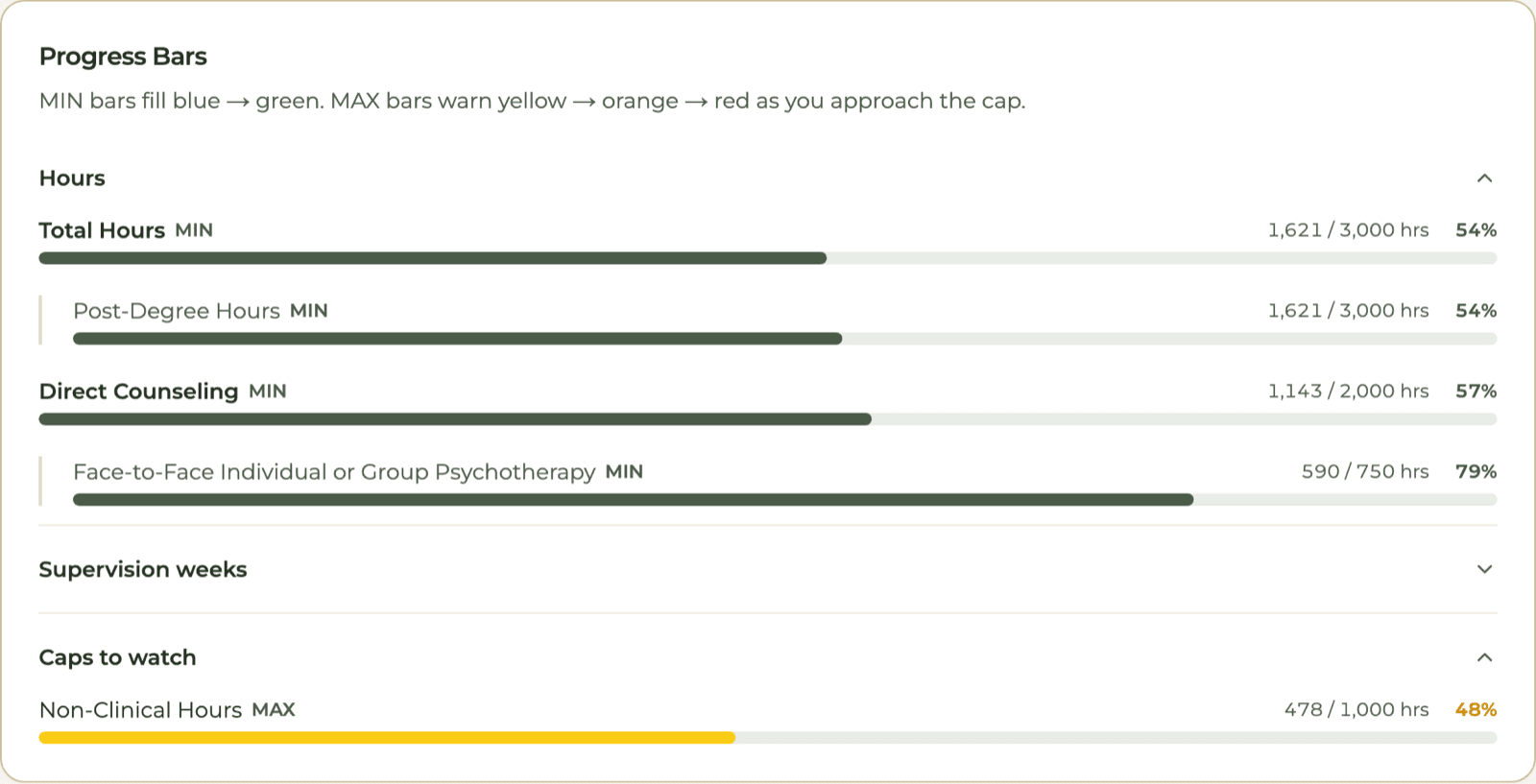
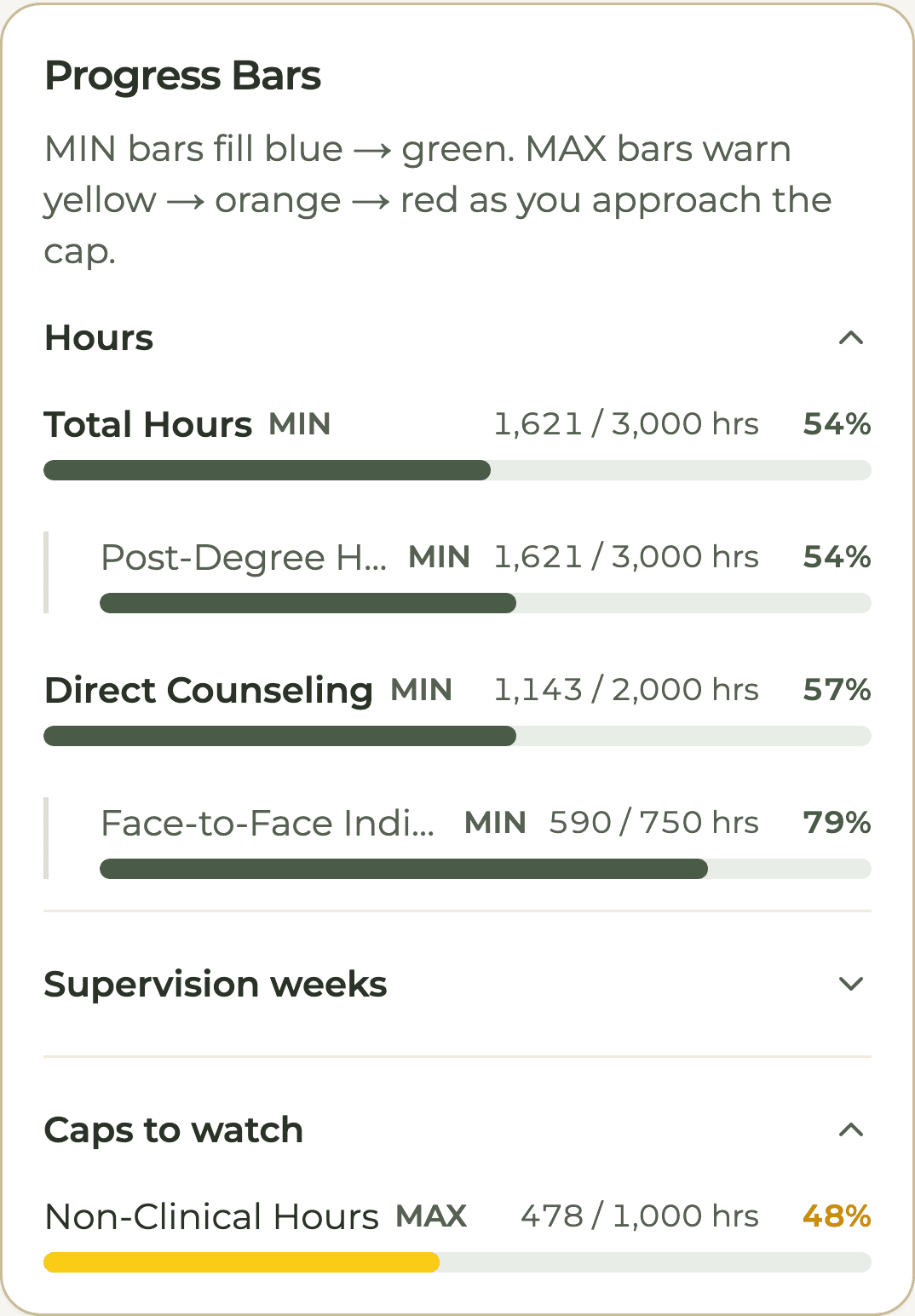
HourJourney shows where you stand on the 2,000, the 750 and the 1,000 cap
Log clinical, psychotherapy and non-clinical hours in their own fields. Your dashboard shows each total against its BBS minimum or cap, so you can see early whether your job is building clinical hours.
Case Management: A Gray Area
Case management covers a wide range of work. Coordinating services, making referrals, linking clients to resources, and following up on benefits are not clinical, so they never count toward your 2,000 clinical minimum. Some of those tasks may fall under client-centered advocacy, which the BBS lists as non-clinical experience capped at 1,000 hours (BPC 4996.23(d)(3)). Your supervisor decides whether a given task fits that category.
But many jobs with “case manager” in the title also ask you to do clinical work: a psychosocial assessment at intake, crisis work that is assessment or treatment, or short-term therapy. Done under a qualified supervisor, those activities are clinical and count toward the 2,000. The job does not become clinical or non-clinical as a whole: each activity is categorized on its own.
Split the week, log the categories. If your case-manager role includes a clinical component, the fix is not to relabel the job. Log the clinical portion separately from the coordination portion, every week, and confirm the split with your supervisor. That way your assessment and therapy hours build toward the 2,000, and any coordination time your supervisor counts as advocacy fills the capped 1,000.
The trap to avoid is logging the whole role as clinical because the title includes client contact. Client-centered advocacy is non-clinical experience even when it is with the client, because it is not psychosocial diagnosis, assessment, or treatment. Log the split every week so your supervisor can sign each week's log. For the full definitional boundary, our what counts as clinical hours guide walks through every category.
Even Clinical Hours Need a Qualified Supervisor
There is a second gate that catches ASWs at non-clinical-leaning jobs: the setting and the supervision. Experience counts only in a setting that lawfully and regularly provides clinical social work, mental health counseling, or psychotherapy, and that provides oversight to ensure your work meets the experience and supervision requirements (BPC 4996.23.2(c)). If your macro or case-management job has no qualified supervisor, the clinical activities you do there may not count, because the supervision structure is not in place.
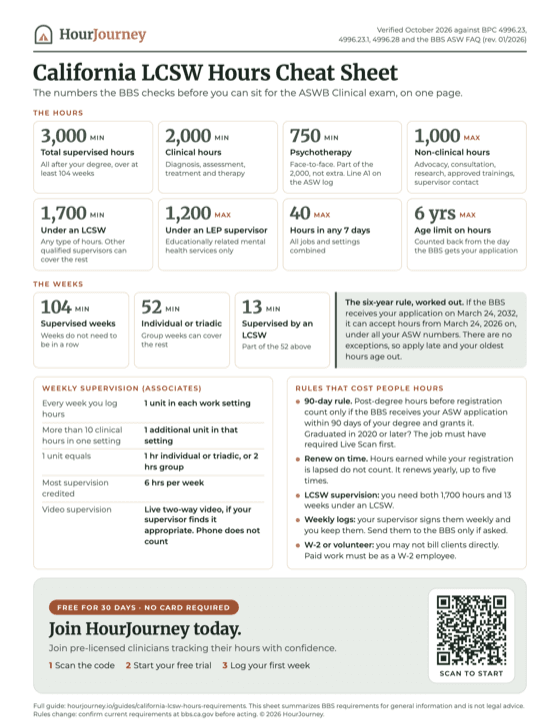
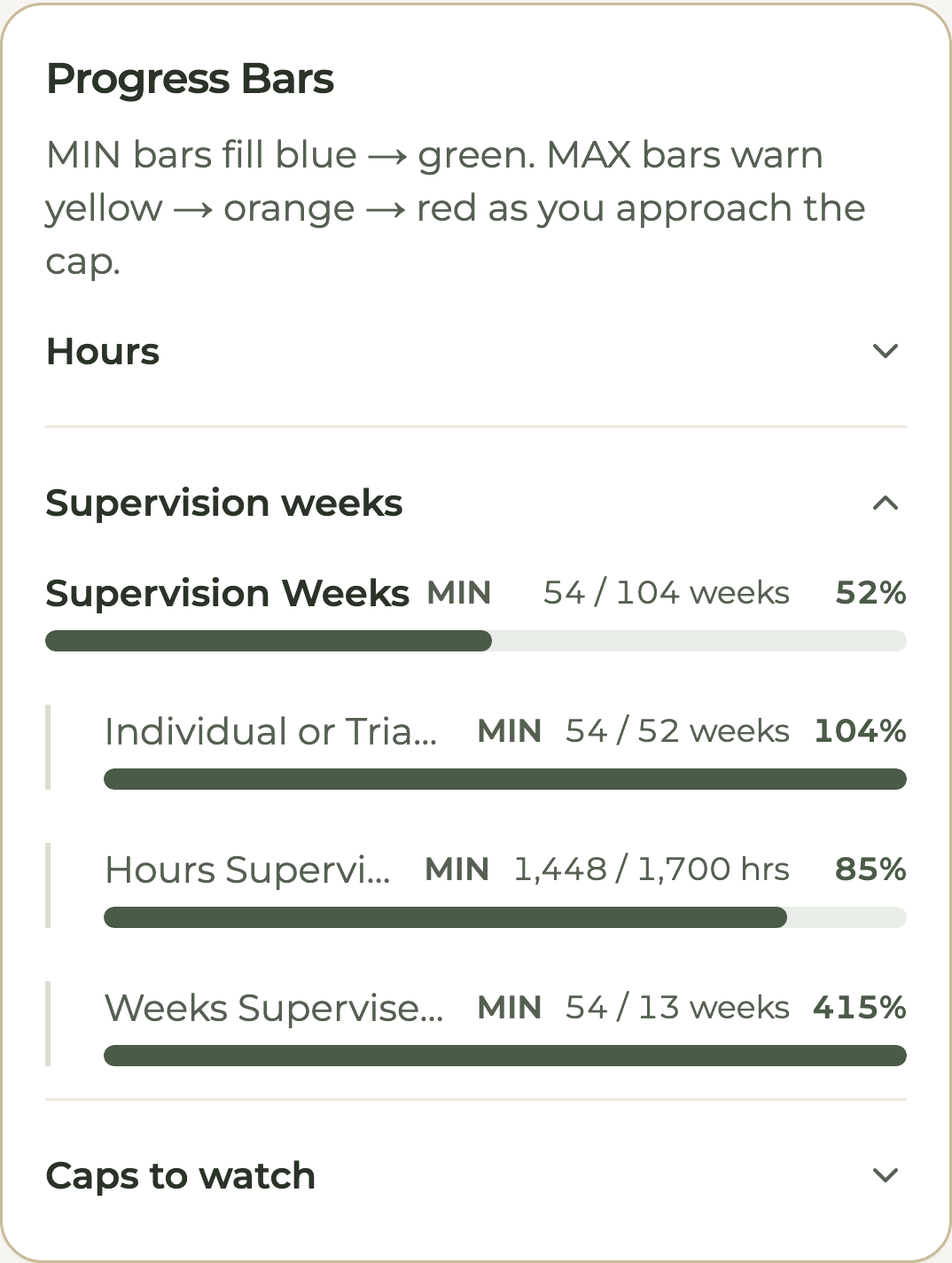
The LCSW path also carries supervision requirements: at least 1,700 of your 3,000 hours must be supervised by an LCSW, 52 of your 104 weeks must include individual or triadic supervision (13 of those under an LCSW), and each week you gain experience in a setting you need at least one hour of individual or triadic supervision or two hours of group supervision there, with one more unit in any week you do more than 10 hours of clinical psychosocial diagnosis, assessment, and treatment (BPC 4996.23.1). A job that cannot provide qualified supervision cannot satisfy these, regardless of what you do there.
No qualified supervisor, no countable clinical hours. Before you count on a role for LCSW hours, confirm that a qualified supervisor is signing off on your clinical work in a setting that provides clinical services.
For who qualifies and how the 1,700 LCSW-supervised minimum works, see who can supervise an ASW and the broader BBS supervision requirements.
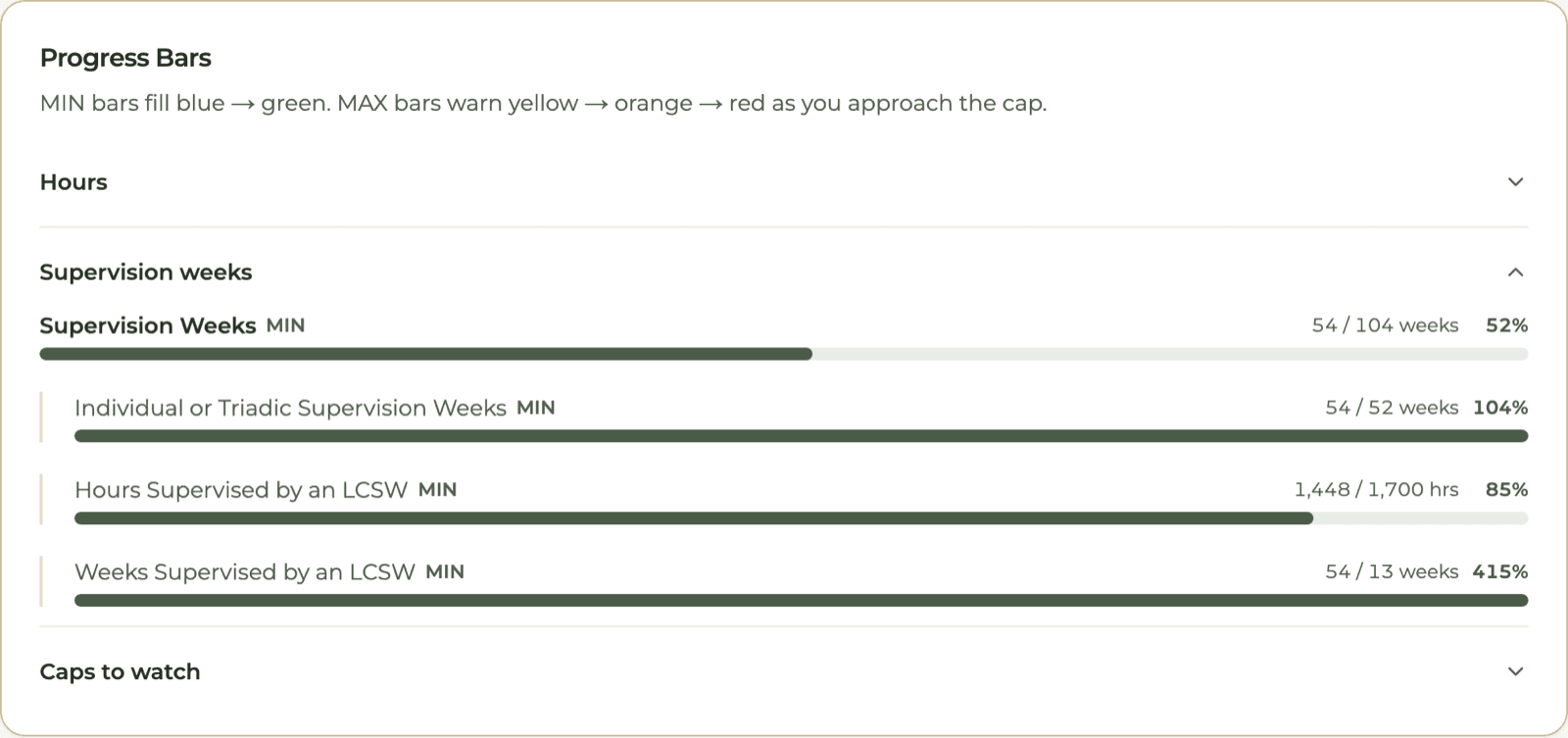
HourJourney counts the hours and weeks under an LCSW for you
Each supervisor's license type is on file, so your dashboard counts the hours and weeks supervised by an LCSW toward the 1,700 hours and 13 weeks, next to your 104 supervision weeks.
What to Change If Your Job Can't Get You There
Run the arithmetic honestly. If your current role produces zero clinical hours, or fewer than you need to reach 2,000 clinical and 750 psychotherapy within your timeline, the job alone will not get you licensed. That is not a dead end; it is a signal to restructure. Here are the moves, in rough order of least to most disruptive:
- ✓Add a clinical component to your existing role. Ask your supervisor and employer whether a supervised clinical caseload can be added to your role. This is the lowest-friction fix.
- ✓Confirm you have a qualified supervisor. If your setting lacks one, ask your employer about arranging one. Hours gained before supervision is in place do not count, because supervisor contact must happen within the same week as the hours claimed (BPC 4996.23.1(e)).
- ✓Take a second position that is clinical. You can gain hours across multiple sites (subject to the 40-hours-in-any-seven-consecutive-days cap across all settings combined), so a part-time clinical role can supply the clinical hours your main job cannot.
- ✓Move to a setting that provides clinical work. The most decisive option if your current job is purely macro or administrative with no path to a clinical component.
Whatever you choose, the constant is that the 2,000 clinical and 750 psychotherapy hours can only come from supervised clinical work with clients, so at least part of your week has to be spent doing exactly that. For the full route from MSW graduate to licensure, see ASW to LCSW in California.
How HourJourney Keeps Your Categories Straight
When your job mixes clinical and non-clinical work, the hard part is keeping the two separated correctly, every week, across every site. HourJourney is a BBS hours tracker for California pre-licensed therapists.
- ✓Separate fields for clinical, psychotherapy, and non-clinical hours, so you log each in its own category.
- ✓A dashboard bar for the 1,000-hour non-clinical cap, so you can see when non-clinical hours stop helping and clinical hours are the only thing moving you forward.
- ✓Dashboard progress against the 2,000 clinical and 750 psychotherapy minimums, so you know early whether your current job is getting you there.
- ✓Logs hours by week, per supervisor and per site, and flags weeks where individual plus half of group supervision falls short of the ratio. Useful when you add a second, clinical position to supplement a non-clinical job.
- ✓Fills your ASW Weekly Log of Experience Hours as a PDF, ready for your supervisor's signature.
You can also estimate whether your current mix reaches the finish line with the LCSW hours calculator, and read the full week-by-week tracking method in how to track LCSW hours in California.