The 3,000-Hour Requirement at a Glance
Under BPC section 4980.43, every LMFT candidate in California must accumulate 3,000 hours of supervised professional experience. These hours are split across two broad categories: Category A (direct clinical counseling) and Category B (non-clinical experience). Each category has its own minimum or maximum, and several sub-requirements sit inside them.
The 3,000-hour total is not simply a counter you fill and forget. You keep your signed weekly logs, and the BBS can ask to see them. Your experience verification forms go in with your application, and you cannot be approved for the clinical exam until you have all 3,000 hours and 104 supervised weeks. Falling short on any single requirement holds you up, even if your grand total exceeds 3,000.
The rest of this guide walks through every category, cap, ratio, and deadline one by one. If you prefer a quick estimate first, try the LMFT hours calculator and come back here for the details.
BBS MFT Hours Breakdown by Category
Here is the same 3,000-hour requirement laid out as a single table, drawn from the BBS MFT licensing FAQ. Each row is covered in more detail in the sections below; this is the quick version.
| Category | Hours | Detail |
|---|---|---|
| Category A: direct clinical counseling | 1,750 minimum | Includes the CFC subset below |
| A1: couples, families, and children | 500 minimum | Subset of Category A, not additional hours |
| Category B: non-clinical experience | 1,250 maximum | Supervision, testing, notes, workshops |
| Pre-degree hours (all types) | 1,300 maximum | Optional, earned as a trainee before graduation |
| Post-degree hours | 1,700 minimum | Earned after your degree is awarded, regardless of pre-degree hours |
| Total | 3,000 | Across a minimum of 104 supervised weeks |
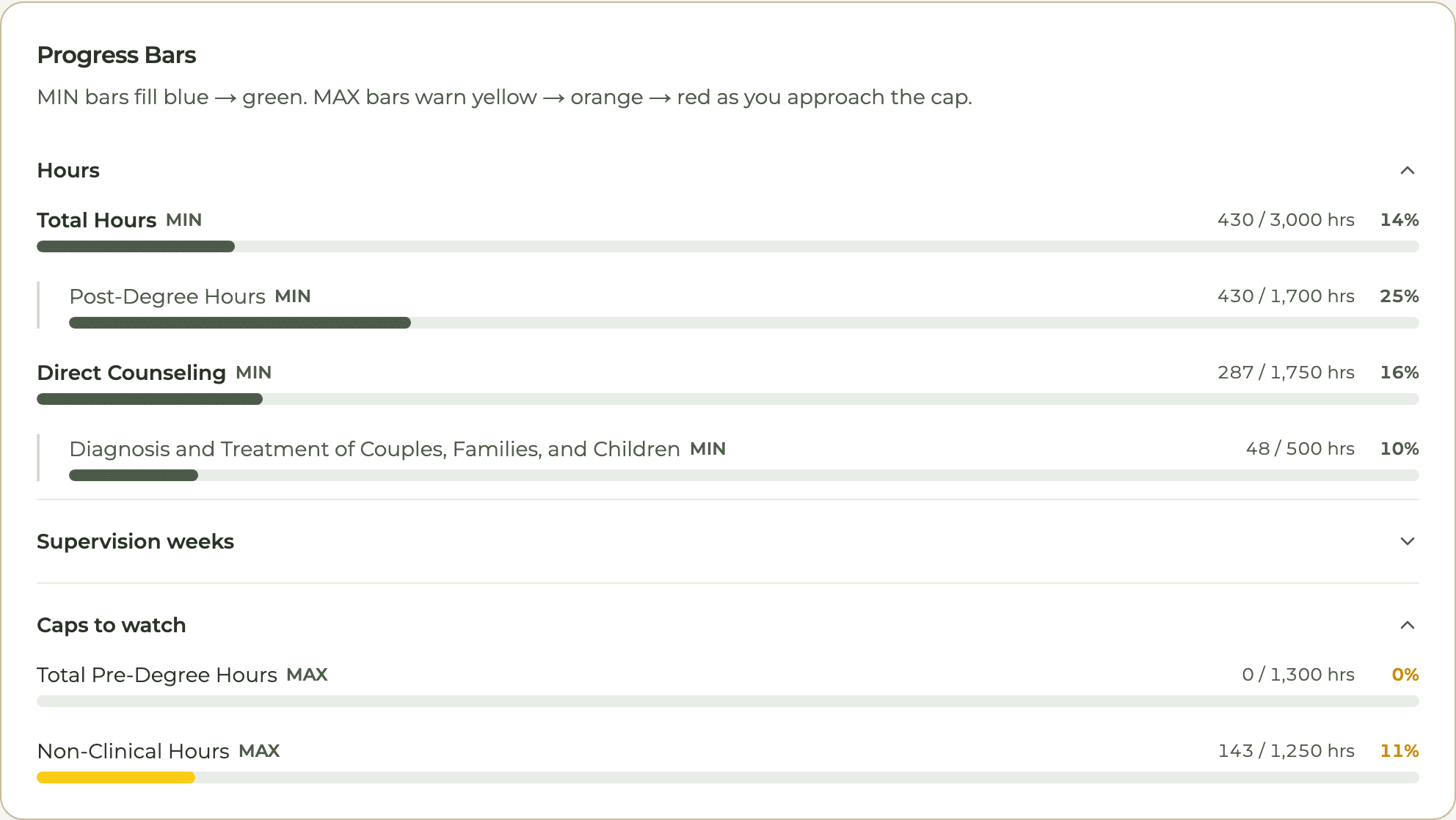
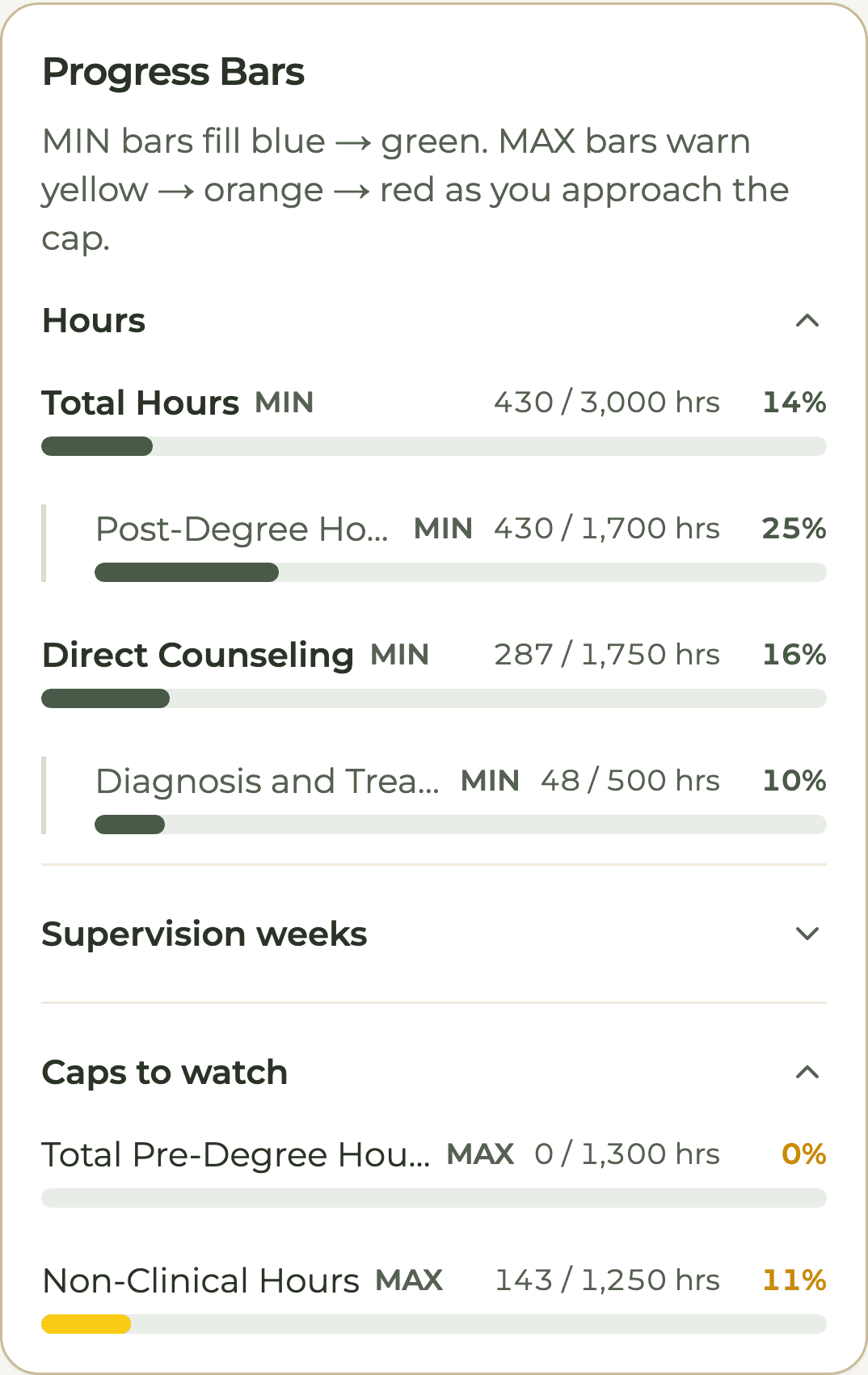
HourJourney tracks each of these categories automatically as you log hours week to week, including the 500-hour CFC subset and the pre-degree versus post-degree split.
HourJourney tracks every line of this table for you
Log each week once. HourJourney counts your progress toward the 3,000 total, 1,700 post-degree, 1,750 direct and 500 couples, families and children hours, and warns you as you near the 1,300 pre-degree and 1,250 non-clinical caps.
Category A: Direct Clinical Counseling Hours
Direct clinical counseling is the core of your supervised experience. You need a minimum of 1,750 hours in this category. These hours are logged in Column A on Form 37A-525 and represent direct clinical counseling with individuals, groups, couples, or families.
What counts as Category A: direct clinical counseling with individuals, groups, couples, or families, including sessions delivered by telehealth. There is no limit on telehealth hours. If you are unsure whether an activity counts, check with your supervisor.
What does not count as Category A: writing progress notes (that is Category B), scheduling calls, staff meetings, and reviewing files without the client. Category B only covers the activities the law lists below, so check with your supervisor before counting anything else.
Most associates find Category A straightforward to accumulate because it is the work they do every day. The real danger lies in the subcategory requirement buried within it: the 500-hour couples, families, and children minimum described below.
The 500-Hour Couples, Families, and Children Requirement
At least 500 of your 1,750 direct clinical hours must involve the assessment, diagnosis, and treatment of couples, families, and children (CFC). These hours are logged in subcategory A1 on your weekly log and are a subset of your Category A total, not a separate bucket on top of it.
The risk is simple: if your site assigns mostly individual adult clients, these hours build slowly. If you see 20 clients per week and only two are couples or families, you are accumulating CFC hours at roughly 10% of your direct hours. At that rate, you would need to log 5,000 direct hours before reaching the 500 CFC minimum, far more than the 1,750 Category A requirement. The math catches people off guard.
Plan your caseload early. Ask your supervisor to assign you couples, families, or child clients intentionally. If your primary site does not offer those populations, consider adding a second site that does. Track your CFC hours every month, not just at the end, so you can course-correct while there is still time. HourJourney tracks your couples, families and children hours automatically and shows a running count on your dashboard.
The A1 trap in real numbers: An associate logging 25 direct hours per week with only 2 CFC hours per week will take 250 weeks (nearly 5 years) to reach 500 CFC hours. Meanwhile, they will hit 1,750 total direct hours in just 70 weeks. The gap between finishing Category A and finishing A1 can be enormous if you do not plan ahead.
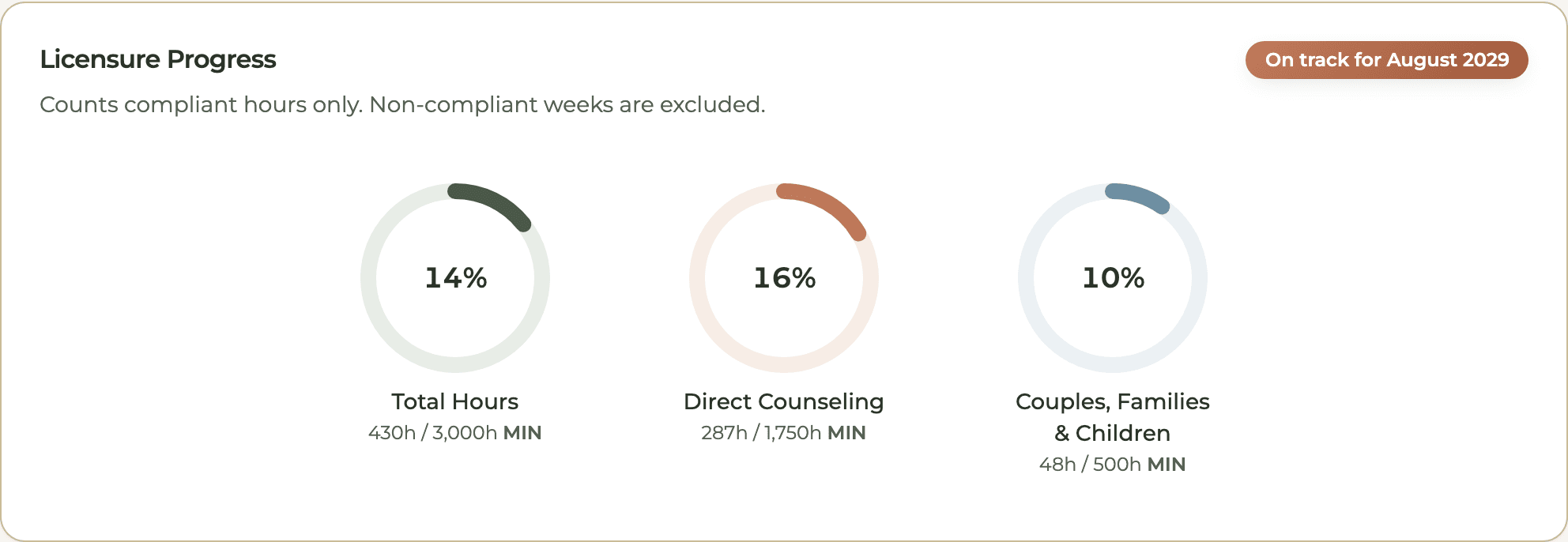
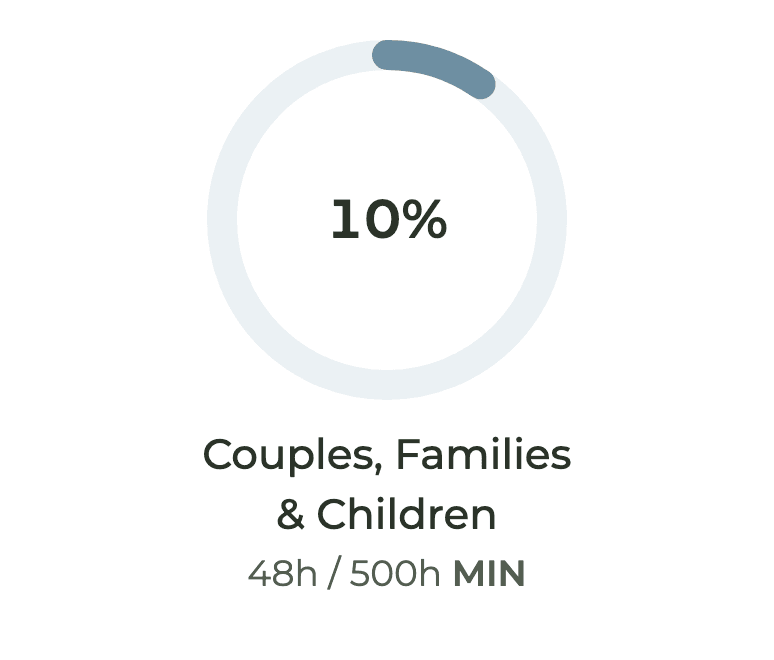
HourJourney tracks your progress toward the 500 couples, families and children hours
Your dashboard shows how close you are to 500 next to your total and direct hours, so you see a gap early and can ask your supervisor for those cases while there is time.
Category B: Non-Clinical Experience Hours
Non-clinical experience is everything you do in your clinical role that is not direct client contact. The BBS caps Category B at 1,250 hours. Hours above this cap will not count toward your 3,000-hour total, though they will not disqualify you either. They simply vanish from the ledger.
What counts as Category B: direct supervisor contact (individual, triadic, and group supervision), administering and evaluating psychological tests, writing clinical reports, writing progress or process notes, client-centered advocacy, and workshops, seminars, training sessions, or conferences directly related to marriage and family therapy that your supervisor has approved. Supervision is also capped at 6 hours of credit per week.
What does not count: anything outside that list. Administrative tasks, personal therapy, and studying for the licensing exam are not on it.
Because Category B is capped rather than required at a minimum, you do not need to worry about reaching 1,250. You only need to make sure you do not go over it. If you log 30 non-clinical hours per week, you will exhaust the cap in about 42 weeks and still have well over half your associate period remaining. Knowing the cap exists prevents surprises at application time.
Pre-Degree (Trainee) Hours: What Counts and What Doesn't
If you gained clinical experience during your graduate program as an MFT Trainee, those hours can count toward the 3,000-hour total, subject to strict limits. The BBS allows a maximum of 1,300 pre-degree hours. Within that 1,300, no more than 750 hours can be direct counseling plus supervision combined. The remaining pre-degree hours can come from other non-clinical activities.
Critically, at least 1,700 of your 3,000 hours must be earned after your degree is awarded. This means that even if you log the full 1,300 pre-degree hours, you still need 1,700 more after graduation. The post-degree requirement ensures the majority of your supervised experience occurs after you hold a qualifying degree and have registered with the BBS.
Trainee hours need signed weekly logs, a qualified supervisor, and at least one unit of supervision each week in each work setting. Your practicum or fieldwork supervisor must hold a current California license and meet BBS supervisor qualifications. For a complete breakdown of what qualifies and what does not, read our guide on pre-degree hours and BBS rules in California.
One important nuance: hours earned between your graduation date and your AMFT registration date may still count under the 90-day rule. If the BBS receives your AMFT application within 90 days of your degree being granted, and later grants the registration, post-degree hours earned during that gap can count. If you finished graduate study on or after January 1, 2020, those hours must also be at a workplace that required Live Scan fingerprinting before you started. Miss the 90-day window and those interim hours do not count.
The 104-Week Minimum: Why Hours Alone Aren't Enough
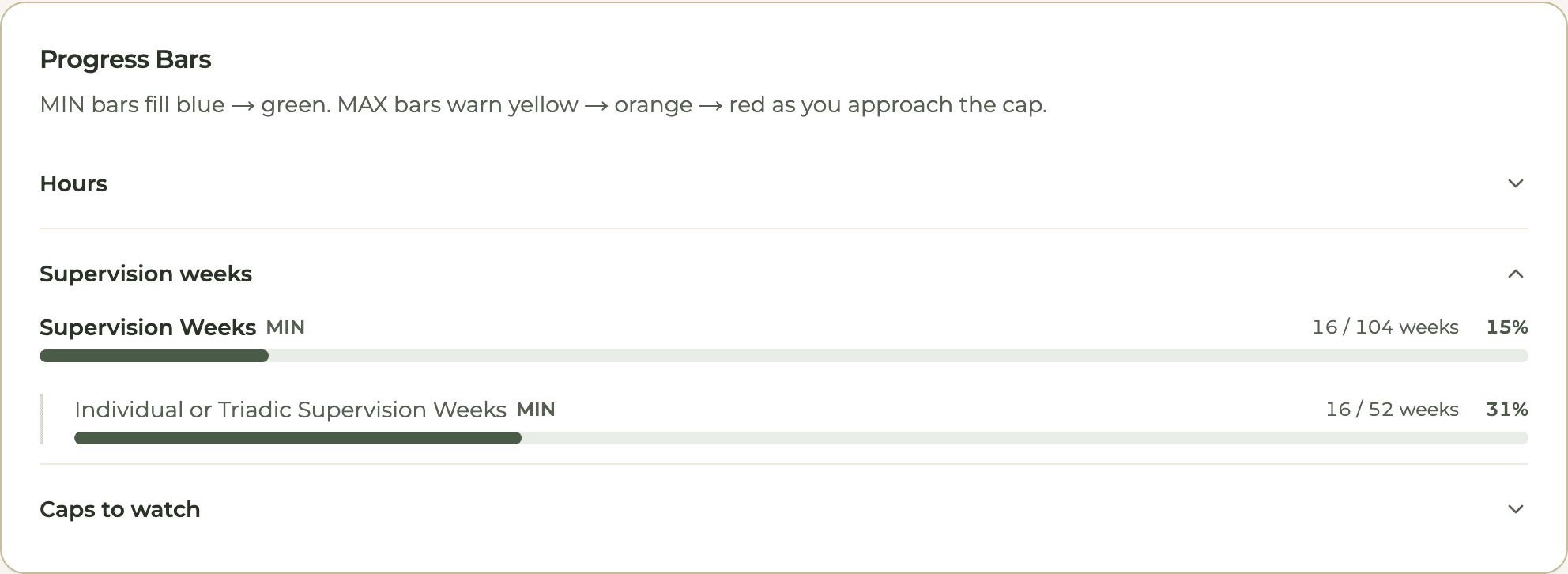
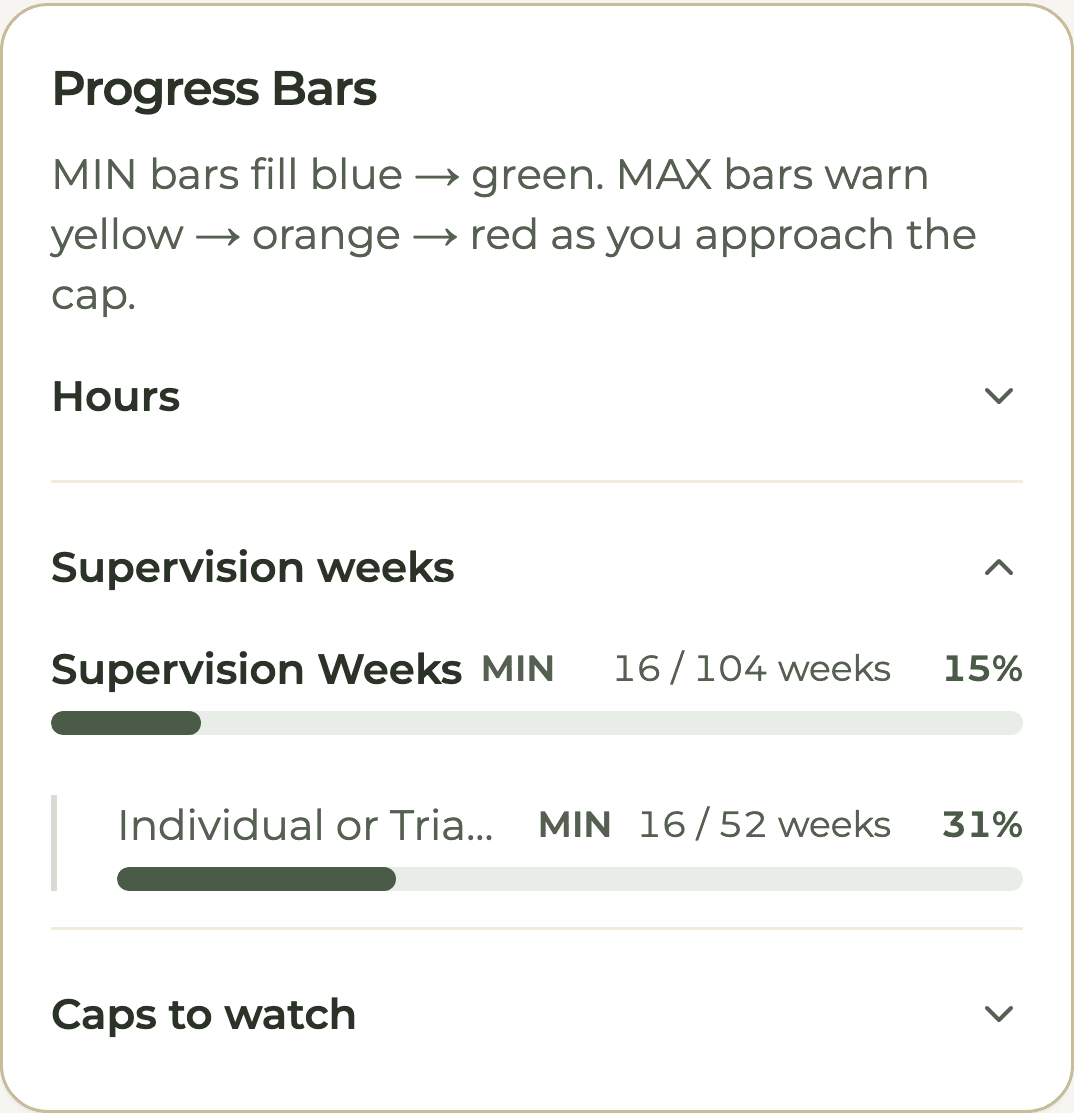
Accumulating 3,000 hours is necessary but not sufficient. The BBS also requires that your supervised experience span a minimum of 104 weeks (two full years). A week only counts toward this requirement if you received at least one unit of supervision during that week. Weeks where you worked but did not receive supervision are not counted.
Within the 104-week minimum, at least 52 weeks must include individual or triadic supervision, not just group. This means you cannot satisfy the entire 104-week requirement through group supervision alone, even if you receive group supervision every single week for two years. At least half of those weeks need to include one-on-one or triadic sessions with your supervisor.
Weeks are tracked independently of hours. If you log 40 hours in a week but have no supervision meeting, that week does not count toward the 104 minimum and the hours themselves are also jeopardized because the supervision ratio was not met. Conversely, gaps in your timeline are acceptable: you do not need 104 consecutive weeks. Time off does not reset your week count, but the six-year limit on the age of your hours and your registration's six-year limit keep running during gaps.
The practical implication is that you cannot sprint through the hour total and then apply early. Even if you averaged 40 hours per week and reached 3,000 hours in 75 weeks, you would still need to continue logging supervised weeks until you hit 104. Plan for this from the start.
HourJourney counts your supervised weeks, not just your hours
Every week you log with supervision moves you toward 104, and weeks with individual or triadic supervision count toward the 52 you need.
Weekly Supervision Requirements
Supervision is tracked week by week, not averaged over time (for AMFTs; trainees may average only their additional units). The BBS uses a tiered system based on how many hours of direct clinical counseling you provide in a week in each work setting. Here is the full breakdown, as described in BBS supervision requirements for California:
| Condition | Units Required | Definition of 1 Unit |
|---|---|---|
| Any week with logged hours | 1 unit minimum | 1 hr individual/triadic or 2 hrs group |
| More than 10 direct counseling hours in one work setting | 2 units minimum | Same definition per unit |
| Trainee ratio | 1 unit per 5 direct hrs | 1 unit every week in each setting; the extra units may be averaged |
| Maximum supervision credit | 6 hrs/week | Excess supervision is not credited toward licensure |
| Telehealth supervision | If your supervisor finds it appropriate | Live two-way video; phone supervision does not count |
The distinction between individual and group supervision matters. Individual or triadic supervision counts minute-for-minute: one hour equals one unit. Group supervision counts at half rate: two hours of group equals one unit. You can mix individual and group in the same week. For example, one hour of individual plus two hours of group in the same week gives you two units.
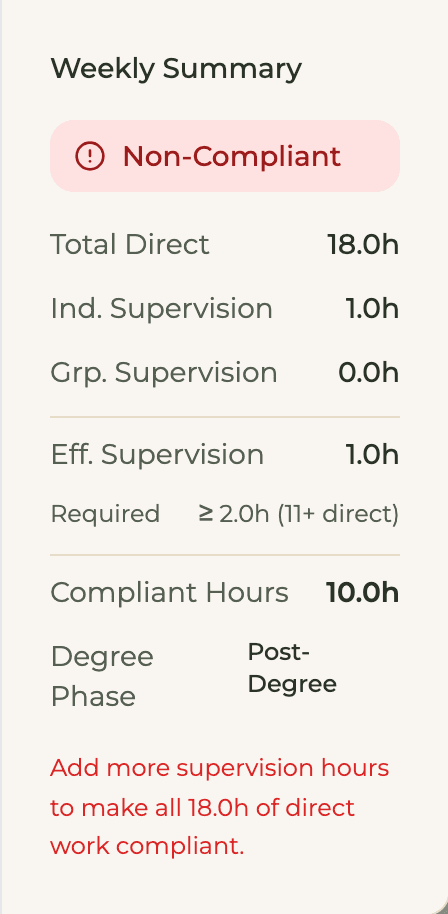
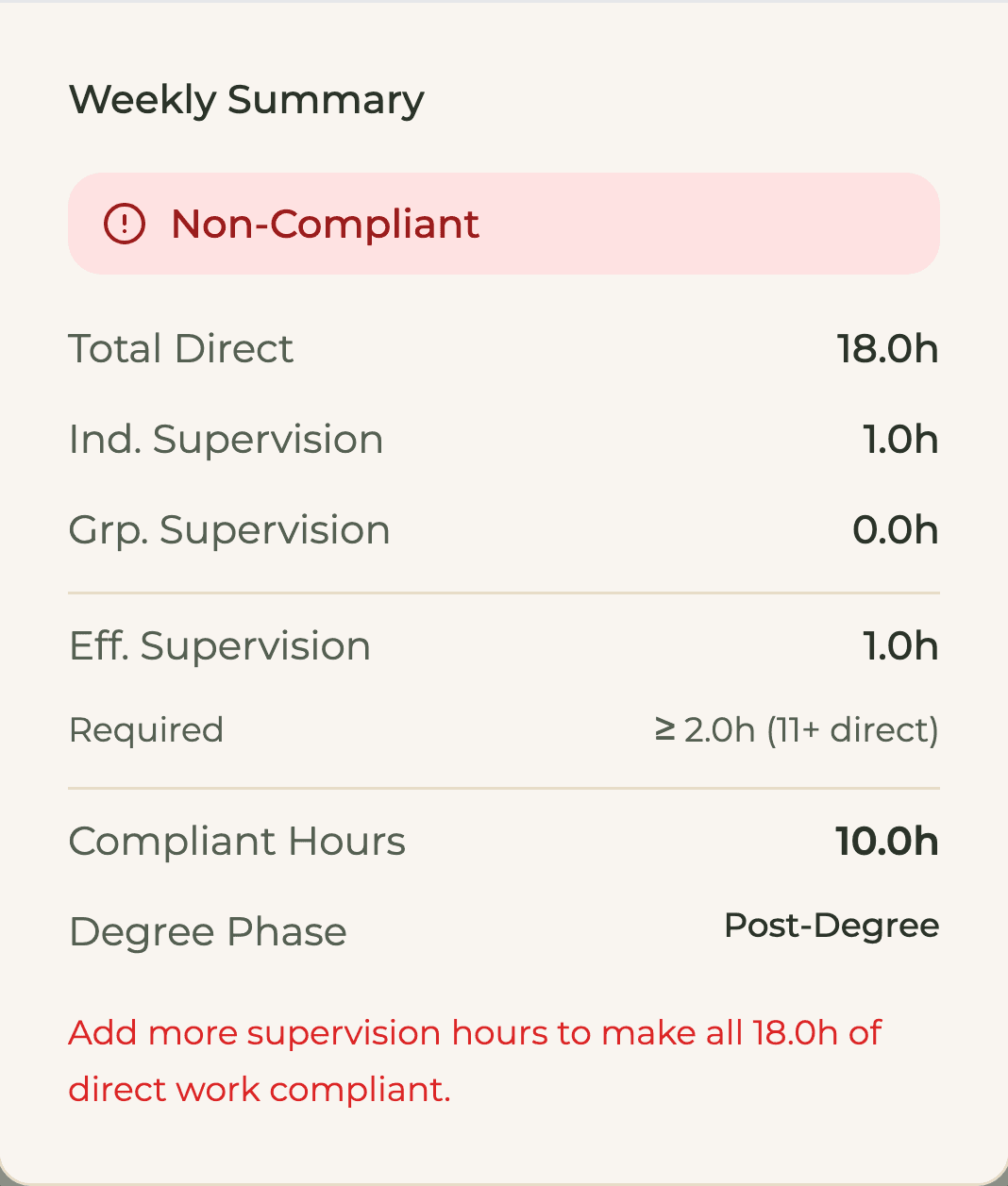
Associates cannot average supervision ratios across weeks. If you needed two units in a given week and only received one, that week is non-compliant regardless of how much supervision you received the week before or after. HourJourney flags non-compliant weeks automatically so you can address gaps before they become permanent.
HourJourney checks every week's supervision for you
Enter your direct hours and supervision. The week shows Compliant or Non-Compliant right away, how many hours count, and what to add to fix it.
The Six-Year Rule
The BBS cannot accept any hour of experience that is more than six years old on the date it receives your Application for Licensure. The only exception is up to 500 hours of counseling and supervision earned as a trainee in practicum. Separately, post-degree hours earned before your registration date do not count unless the 90-day rule covers them.
Example: If the BBS receives your Application for Licensure on March 24, 2032, it can only accept hours you earned between March 24, 2026 and March 24, 2032, plus up to 500 practicum hours. Every month you wait to apply, your oldest hours get closer to the limit.
Your AMFT registration is valid for one year and must be renewed annually. You can renew up to five times, and no renewal can go beyond six years from the last day of the month it was issued. Hours earned during any period where your registration has lapsed (expired and not yet renewed) do not count. Even a one-day lapse means any hours logged during that gap are lost. Set reminders well before your renewal date.
If you do not finish within six years, you may apply for a subsequent AMFT registration. A subsequent registration extends your ability to accrue hours, but it comes with a significant restriction: you can no longer gain experience in a private practice or professional corporation setting. You must also have already passed the California Law and Ethics Exam before the BBS will issue a subsequent number. These constraints make the initial six-year window critically important to manage.
The 40-Hour Weekly Cap
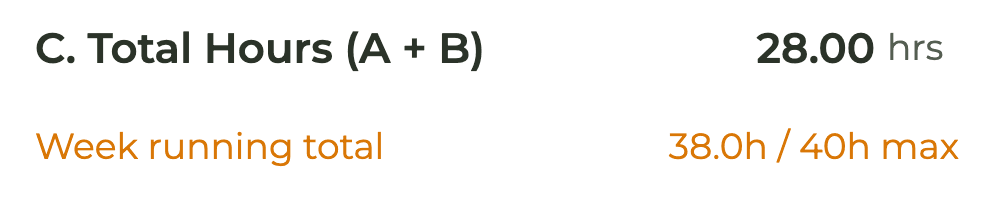
No more than 40 hours of supervised experience may be credited in any seven consecutive days, regardless of how many hours you actually worked. This cap applies to the combined total across all employment settings, not per site. Hours over 40 are not credited.
Example with two sites: Suppose you work at a community mental health clinic Monday through Thursday and log 30 hours that week (20 direct, 10 non-clinical). On Friday, you work at a private practice and log 15 hours (12 direct, 3 non-clinical). Your combined total is 45 hours. The BBS will only credit 40. The 5 excess hours are not credited.
The easiest way to avoid this problem is to track your weekly total across all settings in real time. If you work at multiple sites, coordinate your schedule so you never exceed 40 combined hours in any seven consecutive days. HourJourney shows your weekly total across all sites and won't let you save a week over 40 hours.
Hours over the cap are not credited. Unlike the non-clinical cap (where excess hours simply do not count), going over 40 hours in seven consecutive days means you did clinical work the BBS will not credit. Prevention is the only remedy.
HourJourney won't let a week go over 40 hours
It adds up every site and supervisor in the week, turns amber as you get close, and won't save a week over 40, so no hours are lost.
Common Mistakes That Delay Licensure
These are eight easy-to-make errors that can delay LMFT licensure in California. Every one of them is preventable with proper tracking.
Falling short on the 500-hour CFC requirement
Associates with mostly individual adult clients may not realize their CFC hours are lagging until it is too late to adjust their caseload.
Not reaching the 104-week minimum
Associates who log high hours per week sometimes reach 3,000 hours in under two years but have not completed 104 supervised weeks. They must continue logging for months with no new hours to count.
Exceeding the 40-hour weekly cap
Working at multiple sites without coordinating weekly totals leads to hours that are not credited. Going over 40 hours in any seven consecutive days means some legitimate clinical work will never be credited.
Letting AMFT registration lapse
Registration must be renewed annually. Any hours logged during even a brief lapse period are invalid. Set calendar reminders 60 days before your renewal date.
Forgetting the multi-site 40-hour cap is combined
Some associates assume the 40-hour cap applies per setting. It does not. The cap is your combined total across every site, every supervisor, every hour category for the week.
Averaging supervision ratios as an AMFT
Trainees can average only their additional supervision units within a work setting. Associates cannot average at all. Each individual week must meet the supervision minimum for the direct hours logged that week.
Missing the 52-week individual supervision minimum
Of the 104 required supervised weeks, at least 52 must include individual or triadic supervision. Group supervision alone is not sufficient for more than half of your weeks.
LEP supervisees exceeding the 1,200-hour cap
If you are supervised by a Licensed Educational Psychologist, no more than 1,200 hours under LEP supervision can count, and only for educationally related mental health services within the LEP scope of practice.
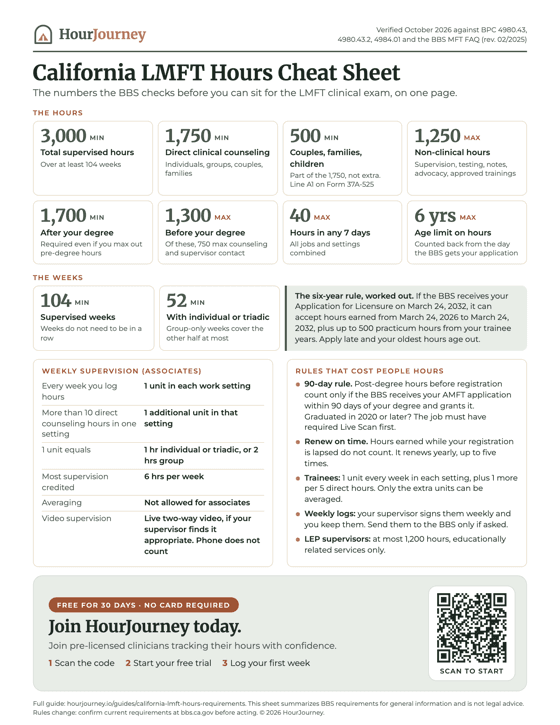
For a step-by-step look at logging these hours, read how to track LMFT supervised hours. For the whole path from degree to license, see how to become an MFT in California, the 7-step guide that includes these hour requirements as one stage.
FAQ: California LMFT Hours Requirements
What are the 3,000 hours for MFT licensure in California?▾
The 3,000 hours are the total supervised professional experience California requires to become an LMFT. They split into Category A (direct clinical counseling, minimum 1,750 hours) and Category B (non-clinical experience, maximum 1,250 hours). Within Category A, at least 500 hours must involve couples, families, and children. The 3,000 hours must span at least 104 supervised weeks, no hour can be more than six years old on the date the BBS receives your application for licensure (up to 500 practicum hours are exempt), and no more than 40 hours can be credited in any seven consecutive days.
How many hours do you need for LMFT licensure in California?▾
You need 3,000 hours of supervised professional experience. Of those, at least 1,750 must be direct clinical counseling (Category A), at least 500 must involve couples, families, and children (a subset of Category A), and no more than 1,250 can be non-clinical experience (Category B). No hour can be more than six years old on the date the BBS receives your application for licensure, except up to 500 practicum hours earned as a trainee.
What is the breakdown of the 3,000 hours?▾
The 3,000 hours are divided into Category A (direct clinical counseling, minimum 1,750 hours) and Category B (non-clinical experience, maximum 1,250 hours). Within Category A, at least 500 hours must involve couples, families, and children (CFC). Up to 1,300 hours can come from pre-degree trainee work, but at least 1,700 must be earned after your degree is awarded. No more than 40 hours can be credited in any seven consecutive days.
What is the 500-hour requirement for LMFT?▾
At least 500 of your 1,750 direct clinical hours must involve the assessment, diagnosis, and treatment of couples, families, and children. These are logged in subcategory A1 on Form 37A-525. The 500 hours are not separate from the 1,750 minimum; they are a subset. If your caseload is mostly individual adults, check this number monthly so you can ask for couple, family, or child cases in time.
What counts as non-clinical experience for LMFT?▾
Non-clinical experience (Category B) includes supervision received, administering and evaluating psychological tests, writing clinical reports and progress notes, client-centered advocacy, and workshops, seminars, trainings, or conferences directly related to marriage and family therapy that your supervisor has approved. The total is capped at 1,250 hours, and supervision credit is capped at 6 hours per week.
What is the six-year rule for California LMFT?▾
No hour of supervised experience can be more than six years old on the date the BBS receives your application for licensure. The only exception is up to 500 hours of counseling and supervision earned as a trainee in practicum. Separately, an AMFT registration can be renewed up to five times and cannot be renewed beyond six years from the last day of the month it was issued. If you need more time after that, you can apply for a subsequent AMFT registration, but you cannot work in a private practice or professional corporation under it.
Can trainee hours count toward LMFT licensure?▾
Yes. Up to 1,300 hours earned as a pre-degree MFT Trainee can count toward the 3,000-hour total. Within that 1,300, no more than 750 can be counseling and direct supervisor contact combined. However, at least 1,700 of your total hours must be earned after your degree is awarded, so trainee hours alone are never sufficient.
What is the 40-hour weekly cap for LMFT hours?▾
No more than 40 hours of supervised experience may be credited in any seven consecutive days, regardless of how many hours you actually worked. This cap applies across all employment settings combined. Hours over the cap are not credited.
How many supervised weeks do you need for LMFT?▾
You need a minimum of 104 supervised weeks. A week only counts if you received at least one unit of supervision during that week. Within the 104 weeks, at least 52 must include individual or triadic supervision (not just group). Weeks are tracked independently from hours; reaching 3,000 hours in fewer than 104 weeks does not satisfy this requirement.
What supervision ratio is required for AMFTs?▾
The minimum is one unit of supervision for any week you log experience hours. If you provide more than 10 hours of direct clinical counseling in a week in one work setting, you need one additional unit in that setting. One unit equals one hour of individual or triadic supervision, or two hours of group supervision. The maximum supervision credit per week is 6 hours. Associates must meet the ratio each week and cannot average over time; trainees can average only their additional units within a work setting.
What is the BBS MFT hours breakdown?▾
The BBS splits the 3,000 hours into Category A (direct clinical counseling, minimum 1,750 hours) and Category B (non-clinical experience, maximum 1,250 hours). At least 500 of the Category A hours must involve couples, families, and children. Up to 1,300 hours can be pre-degree, but at least 1,700 must be earned after your degree is awarded.
Requirements verified against the BBS MFT FAQ (revised February 2025) and BPC section 4980.43. Statutes and regulations can change. Always confirm current requirements at bbs.ca.gov before making decisions about your licensure path. This guide is for informational purposes only and does not constitute legal or professional advice.