What Is the BBS 90-Day Rule?
The BBS 90-day rule is a rule in the Business and Professions Code (BPC 4980.43(b), 4996.23(b), 4999.46(b)) that lets recent graduates count post-degree supervised experience hours earned between their degree award date and the date their associate registration number is issued. Without it, hours gained during that gap before your AMFT, APCC, or ASW registration is issued would not be credited.
The rule is codified in California Business and Professions Code (BPC) sections 4980.43 (for MFTs), 4996.23 (for LCSWs), and 4999.46 (for LPCCs). In practical terms, it works like this: if the BBS receives your associate registration application within 90 days of your degree award date and the Board then grants the registration, qualifying post-degree hours you gained before your registration issue date are credited toward licensure. If you completed graduate study on or after January 1, 2020, those hours must also have been gained at a workplace that required completed Live Scan fingerprinting before you started (BPC 4980.43(b)(1)(B)).
This is not automatic. If the BBS does not receive your application within 90 days, or a 2020+ graduate's workplace did not require Live Scan first, hours gained before your registration is issued are not credited. Before your registration is issued you also may not be employed by or volunteer in a private practice or professional corporation.
Official BBS resource
The BBS publishes a 90-Day Rule FAQ under Applicant > Forms/Pubs on bbs.ca.gov. Review it alongside this guide to confirm the current requirements.
Who Does the 90-Day Rule Apply To?
The 90-day rule applies to all three associate registration types issued by the California BBS. It is not limited to AMFTs. If you are pursuing any of the three license types below and have recently completed your qualifying degree, the 90-day rule is relevant to you.
| Registration Type | 90-Day Rule Applies? | Notes |
|---|---|---|
| AMFT (Associate Marriage and Family Therapist) | Yes | Per BPC 4980.43(b). |
| APCC (Associate Professional Clinical Counselor) | Yes | Per BPC 4999.46(b). APCCs cannot count pre-degree hours but benefit from the 90-day rule for post-degree hours. |
| ASW (Associate Clinical Social Worker) | Yes (applied on or after Jan 1, 2019) | Per BPC 4996.23(b). Applies to ASW applicants who applied on or after January 1, 2019 (ASW FAQ Q2). ASWs cannot count pre-degree hours but all three registration types benefit from the 90-day rule for post-degree supervised experience. |
It is important to note that while APCCs and ASWs cannot count pre-degree practicum hours toward licensure (unlike AMFTs, who can count limited pre-degree hours under specific conditions), all three registration types benefit equally from the 90-day rule when it comes to protecting post-degree hours earned during the application processing gap. For a detailed breakdown of all hour requirements, see our guide on complete LMFT hour requirements. If you are still deciding between paths, our guide on comparing the LMFT and LCSW paths in California covers how hours, supervision and exams differ between the LMFT and LCSW paths.
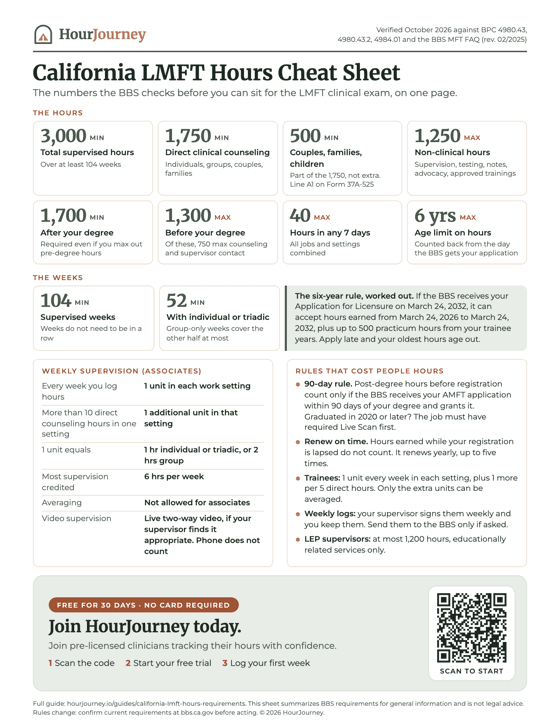
How the 90-Day Window Is Calculated
The clock begins on your degree award date, the term the BBS uses (the statute says "the granting of the qualifying master's degree or doctoral degree"). Ask your registrar which date that is for your degree before you count the 90 days.
Day 0
Degree award date (the clock starts)
Your degree is awarded and the 90-day window opens. Begin preparing your registration application right away.
Days 1-14
Early submission window
Submit your registration application as early as you can. An early submission leaves time to fix anything the BBS flags before day 90.
Days 15-60
Application in processing
The BBS is reviewing your application. The BBS does not publish an average time to issue your number. 16 CCR 1805.1 sets a maximum of 30 business days, from the date the Board receives your application, to notify you that it is complete or deficient. You can keep gaining hours in an eligible setting during this time.
When the Board grants it
Registration number issued
Once your AMFT, APCC, or ASW registration is granted, qualifying post-degree hours from your degree award date forward are credited, subject to the Live Scan condition for 2020+ graduates. You may now also work in a private practice.
Day 90
Window closes
If the BBS has not received your application by this date, hours gained between your degree award date and the date your registration is issued are not credited.
Do not confuse "sent" with "received." The 90-day deadline is based on when the BBS receives your application, not when you send it. If you mail an application on day 87 and it arrives on day 93, you have missed the window. Check the BBS AMFT page for current ways to submit.
We recommend treating day 60 as your personal deadline. That leaves a 30-day buffer for any corrections or missing documents before day 90.
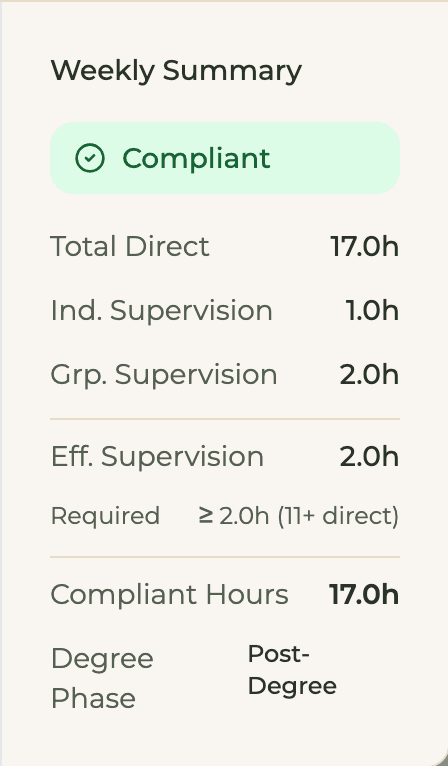
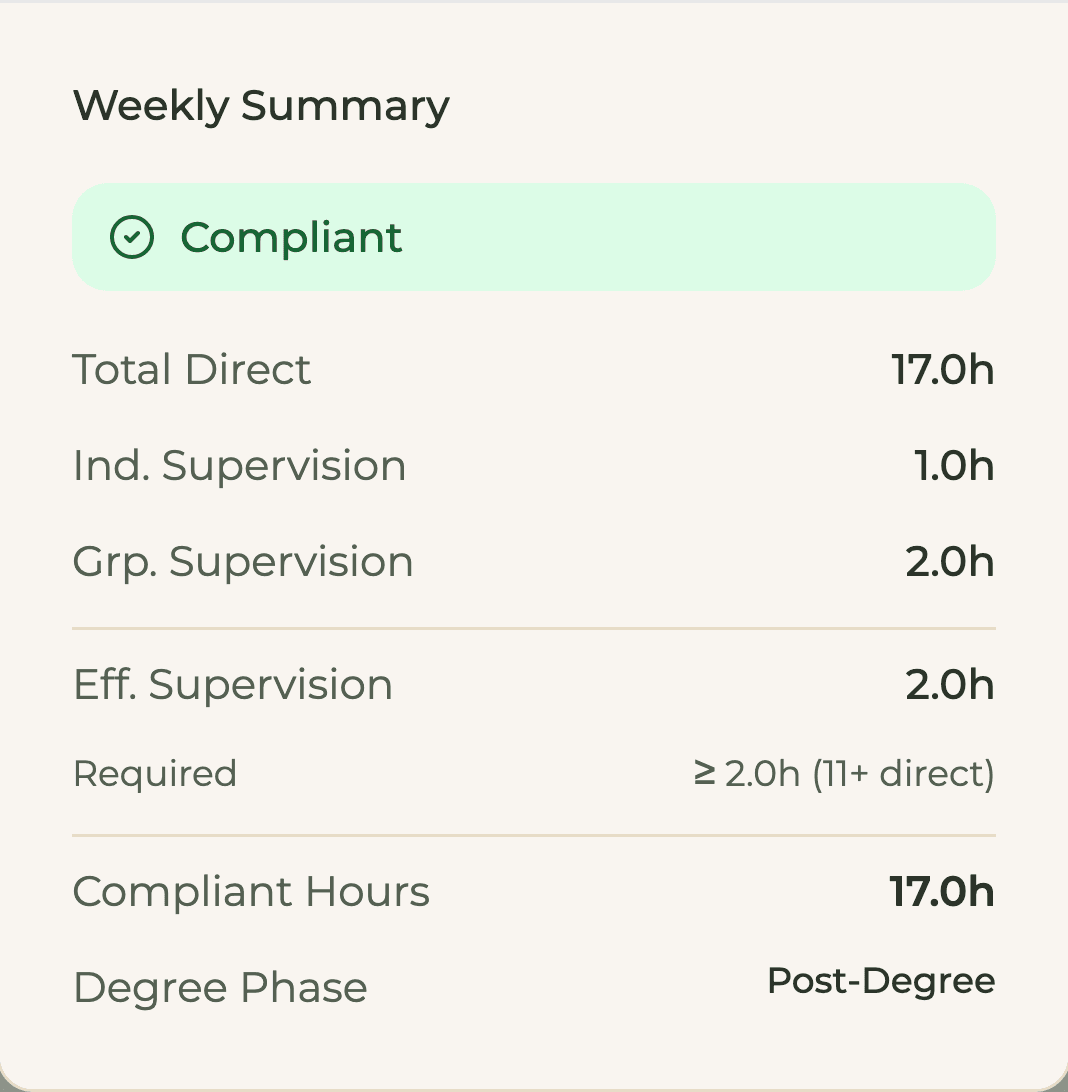
HourJourney sorts every week by your degree date
Enter your degree date once. Each week you log is labeled pre-degree or post-degree, so your post-degree weeks are clear from the start.
The Live Scan Fingerprinting Requirement
For people who completed graduate study on or after January 1, 2020, the 90-day rule has an added condition: the workplace must have required completed Live Scan fingerprinting before you gained hours there (BPC 4980.43(b)(1)(B)). That is separate from the fingerprints you submit with your registration application.
Two different fingerprint items can apply:
1. Workplace Live Scan (2020+ graduates, pre-registration hours)
If you completed graduate study on or after January 1, 2020, hours gained before your registration is issued count only if the workplace required completed Live Scan before you gained them. The processed Request for Live Scan Service form goes with your Application for Licensure.
2. BBS Registration Live Scan (part of your application)
You also complete fingerprinting as part of your AMFT, APCC, or ASW registration application submitted to the BBS. This is the background check for the registration itself and is a different step from the workplace Live Scan above.
Keep the processed workplace Live Scan form. If you graduated on or after January 1, 2020 and cannot provide the processed Request for Live Scan Service form, your hours count only from the date your registration is issued (MFT FAQ Q12).
What if I was already fingerprinted as a Trainee at the same site?
The Board does not require trainees to be fingerprinted. If you graduated on or after January 1, 2020 and want hours to count immediately after graduation, the workplace must have required completed Live Scan before you gained them (MFT FAQ Q8). Ask the BBS whether an earlier Live Scan at the same workplace satisfies this.
Save your processed Live Scan form
Keep a copy of each processed workplace Live Scan form until you apply for licensure. It goes with your Application for Licensure. Without a copy, hours gained before registration count only from the date your registration is issued.
What Happens If You Miss the 90-Day Window?
The Board must receive the application within 90 days of the degree award date. If it does not, hours you gained between your degree award date and the date your registration is issued are not credited.
However, it is important to understand what is not lost. Once your registration number is issued, all hours you gain from that date forward count normally toward licensure. The damage from missing the 90-day window is limited to the gap period. The sooner your registration is issued, the sooner your hours count again.
Scenario
You graduated June 1, submitted your application June 30 (day 29). The BBS takes 40 days to process it. Your number is issued on August 9, which is day 69.
Result
Post-degree hours from June 1 forward can be credited, subject to the Live Scan condition for 2020+ graduates. The rule looks at when the BBS received your application, not how long it took to process.
Scenario
You graduated May 15 and were busy moving. You submitted your application on August 18, 95 days after your degree award date.
Result
Hours from May 15 through the date your registration is issued are not credited. Hours after the issue date count.
Scenario
You graduated in 2025, the BBS received your application on day 20, and your workplace did not require Live Scan before you started.
Result
Hours gained before your registration is issued are not credited under the 90-day rule. Hours count from the date your registration is issued.
Scenario
You graduated in 2025, your workplace required completed Live Scan before you started, and the BBS received your application on day 40.
Result
Once the Board grants the registration, hours from your degree award date can be credited. Keep the processed Live Scan form for your Application for Licensure.
If you have already missed the window, apply now. Hours count from the date your registration is issued, so the sooner it is issued, the sooner your hours count.
Private Practice Under the 90-Day Rule
You may not be employed by or volunteer in a private practice or professional corporation until your associate registration is issued (BPC 4980.43(b)(2)). The 90-day rule does not change this, even if the BBS received your application on day one after graduation.
During the gap you may work in an exempt setting (a governmental entity, a school, a college, a university, or a nonprofit charitable 501(c)(3) institution; MFT FAQ Q15) or in another nonexempt setting that is not a private practice or professional corporation (BPC 4980.06(b)(2)). If your supervisor invites you to see clients at their private practice after graduation, wait until your registration is issued.
Once your registration number is issued, you can begin working in private practice. Plan accordingly. If you want to transition to a private practice setting, have the arrangement ready so you can begin immediately upon receiving your number rather than losing additional time.
Plan your setting transition
If you intend to work in private practice after registration, use the gap period in an eligible setting to keep building hours, then move to the private practice once your registration is issued.
Step-by-Step: How to Protect Your 90-Day Hours
These steps cover the conditions in the statute plus practical advice for the gap period.
Confirm your degree award date
Ask your registrar which date is your degree award date. Your 90-day window opens on it.
If you graduated in 2020 or later, confirm the workplace requires Live Scan first
Pre-registration hours count only if the workplace required completed Live Scan before you gained them. Confirm this before your first post-degree shift.
Get a copy of the processed Live Scan form
The processed Request for Live Scan Service form goes with your Application for Licensure. Store it safely.
Complete fingerprinting for your registration application
This is part of your AMFT, APCC, or ASW registration application and is separate from the workplace Live Scan. Complete it early.
Gather all application materials before submitting
Gather everything the registration application instructions list, plus the $75 fee (reduced from $150 through June 30, 2030).
Submit so the BBS receives it in time
The rule counts the day the BBS receives your application, not the day you send it. Check the BBS AMFT page for current ways to submit.
Set a personal deadline of day 60, not day 90
A 30-day buffer leaves time for corrections or missing documents before day 90.
Begin logging hours from your degree award date
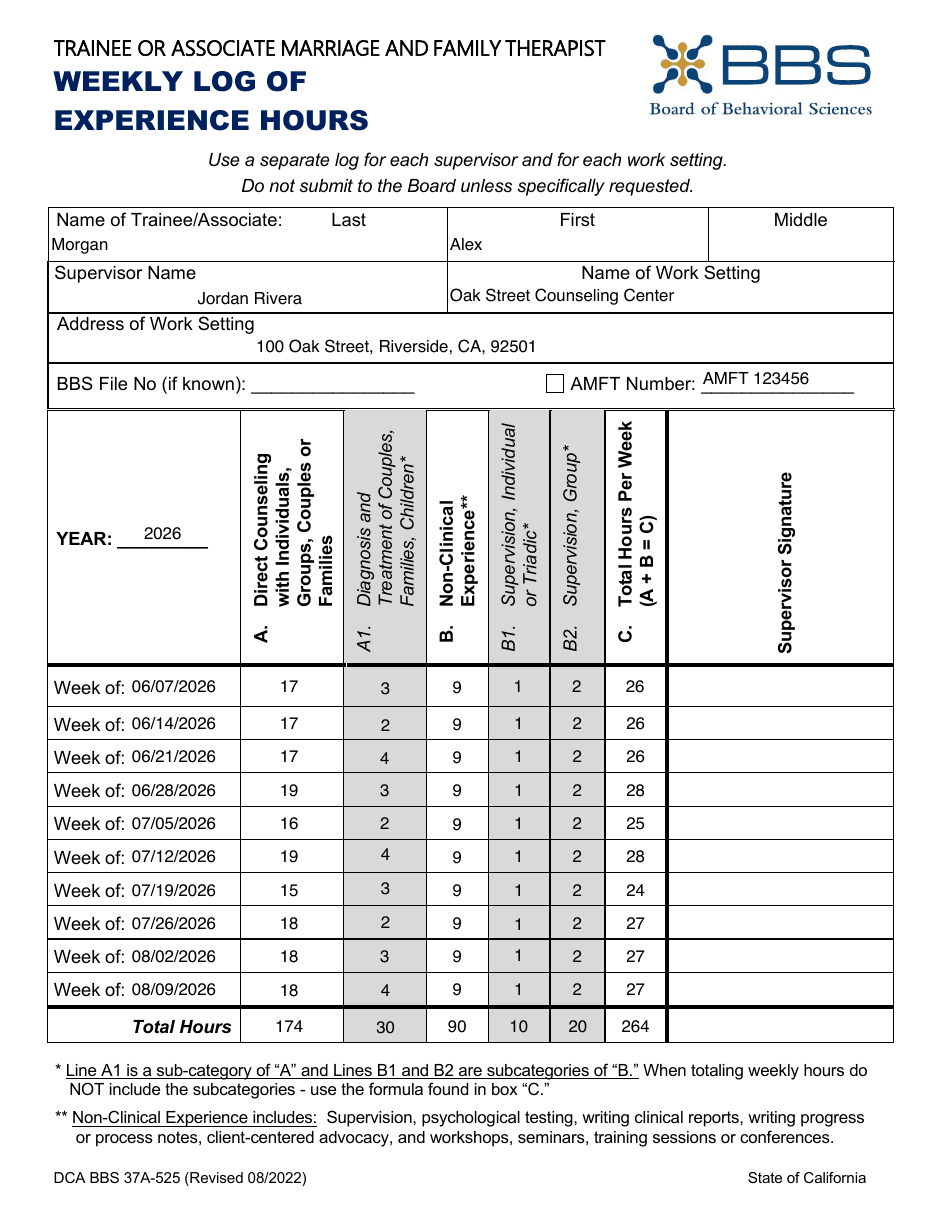
Even before your registration number arrives, log your hours each week on your track's Weekly Log of Experience Hours: 37A-525 for AMFTs, the APCC Weekly Log (37A-638) for APCCs, and the ASW Weekly Log of Experience Hours for ASWs.
Confirm your setting is eligible during the gap period
You may not be employed by or volunteer in a private practice or professional corporation until your registration is issued. Exempt settings are governmental entities, schools, colleges, universities, and nonprofit charitable 501(c)(3) institutions.
Weekly log documentation
AMFTs log hours on the Weekly Log of Experience Hours (37A-525). Keep your signed weekly logs. They are retained, not submitted, unless the BBS requests them.
How HourJourney Helps During the Gap Period
HourJourney logs your hours by week and supervisor and shows your progress toward the totals. For more on setting up your tracking, see our guide on how to track your LMFT supervised hours.
HourJourney fills in your weekly log from the first week you log
Log your hours each week from your degree award date. HourJourney fills in the Weekly Log of Experience Hours for each supervisor and setting, with every page totaled, ready for your supervisor's signature. Whether pre-registration hours count still depends on the 90-day rule conditions above.
FAQ: 90-Day Rule
What is the BBS 90-day rule?+
The BBS 90-day rule lets graduates pursuing AMFT, APCC, or ASW registration in California count post-degree supervised experience hours gained before their registration number is issued. The BBS must receive your registration application within 90 days of your degree award date, and the Board must then grant the registration. If you completed graduate study on or after January 1, 2020, the hours must also have been gained at a workplace that required completed Live Scan fingerprinting before you started (BPC 4980.43(b)(1)).
When does the 90-day window start?+
The window runs from your degree award date, the term the BBS uses (the statute says "the granting of the qualifying master's degree or doctoral degree"). Ask your registrar which date that is for your degree.
Does the 90-day rule apply to ASWs and APCCs?+
Yes. The rule is in the statutes for all three associate types: BPC 4980.43(b) for AMFTs, 4999.46(b) for APCCs, and 4996.23(b) for ASWs. For ASWs it applies to applicants who applied for registration on or after January 1, 2019; for earlier ASW applicants, hours counted only from the date the registration was issued (ASW FAQ Q2).
What is the Live Scan requirement under the 90-day rule?+
If you completed graduate study on or after January 1, 2020, hours gained before your registration is issued count only if the workplace required completed Live Scan fingerprinting before you gained them, and you give the BBS a copy of the processed Request for Live Scan Service form with your Application for Licensure. Without that copy, your hours count only from the date your registration is issued (MFT FAQ Q12). This is separate from the fingerprints you submit with your registration application.
What happens if I miss the 90-day window?+
If the BBS does not receive your application within 90 days of your degree award date, hours gained before your registration is issued are not credited. Hours you gain after your registration is issued count normally, so apply as soon as you can.
Can I work in private practice under the 90-day rule?+
No. Until your associate registration is issued, you may not be employed by or volunteer in a private practice or professional corporation (BPC 4980.43(b)(2)). That applies even if the BBS received your application within 90 days. You may work in an exempt setting (a governmental entity, school, college, university, or nonprofit charitable 501(c)(3) institution) or in another nonexempt setting that is not a private practice or professional corporation (BPC 4980.06(b)(2); MFT FAQ Q15).
How long does BBS take to process an AMFT application?+
The BBS does not publish an average time to issue your number. 16 CCR 1805.1 sets a maximum of 30 business days, from the date the Board receives your application, to notify you that it is complete or deficient. The 90-day rule only requires that the BBS receive your application within 90 days of your degree award date, so processing time after that does not affect whether the rule applies.
If I switch employers, does the 90-day rule still apply?+
Yes. If you are gaining pre-registration hours under the 90-day rule and completed graduate study on or after January 1, 2020, each workplace where you gain those hours must have required completed Live Scan fingerprinting before you gained them there (BPC 4980.43(b)(1)(B)).
Related guides
How Long Does the BBS Take to Issue Your AMFT Number?
The three factors that drive the wait, and how to use the waiting room productively.
How Long Does the BBS Take to Issue Your APCC Number?
The same BBS fingerprint and workload factors, applied to the APCC track.
AMFT Registration Process in California: Step-by-Step
The AMFT registration application, Live Scan, the $75 fee (reduced from $150 through June 30, 2030), and the application steps.
How to Become an MFT in California: Step-by-Step
The complete 7-step path from MFT degree to LMFT license.
California LMFT Hours Requirements: The Complete 2026 Guide
Every hour minimum, maximum, and deadline in plain English.
BBS Form 37A-525: How to Fill It Out Without Losing Hours
A step-by-step walkthrough of the Weekly Log of Experience Hours.
How to Track Your LMFT Supervised Hours in California
The BBS A/B/C structure explained step by step.
LMFT vs. LCSW in California: Which Path Is Right for You?
Education, hours, scope, salary, and clinical fit compared side by side.
This guide is for informational purposes only. Always verify requirements directly with the BBS at bbs.ca.gov.