The 2,000 / 750 Structure, in Plain Terms
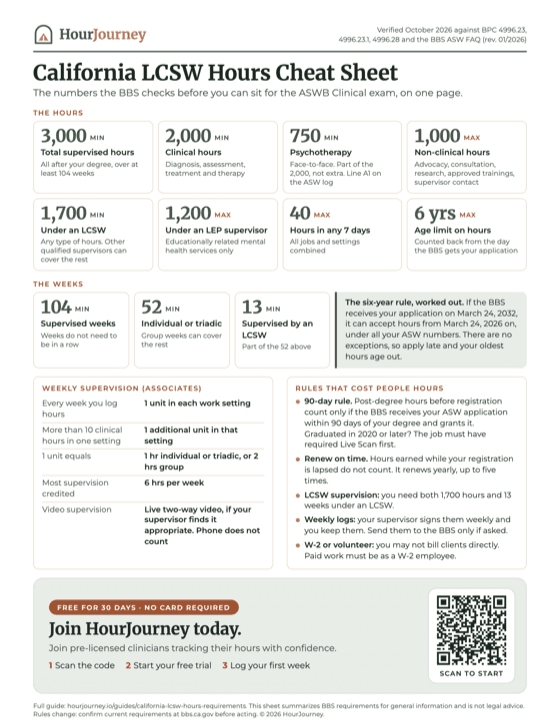
California LCSW licensure requires 3,000 total supervised hours over a minimum of 104 weeks, all earned after your degree is awarded (mostly as a registered ASW; the 90-day rule lets some earlier hours count). Two of those numbers define what counts as clinical:
A minimum of 2,000 clinical hours. The statute defines these as clinical psychosocial diagnosis, assessment, and treatment, including psychotherapy or counseling (BPC 4996.23(d)(2)). There is no maximum on this category, so extra clinical hours always count. Telehealth hours count, with no limit (BBS ASW FAQ).
A minimum of 750 psychotherapy hours, sitting inside the 2,000. Of those 2,000 clinical hours, at least 750 must be face-to-face individual or group psychotherapy provided in the context of clinical social work services. The 750 is a subset of the 2,000, not a separate requirement added on top. Every psychotherapy hour counts toward both numbers simultaneously.
The one sentence to remember: the 750 is carved out of the 2,000. When you run a therapy session, that hour advances the 2,000 clinical total and the 750 psychotherapy subset at the same time. When you log other clinical work that is not psychotherapy, that hour advances only the 2,000.
For the full requirement breakdown and how to log all of this week by week, see the authoritative how to track LCSW hours in California guide.
HourJourney keeps your 750 psychotherapy hours inside your 2,000
You enter clinical hours and psychotherapy hours in separate fields each week. HourJourney totals each one, so the 750 is tracked inside the 2,000 from your first entry. You choose the category; the app keeps the count.
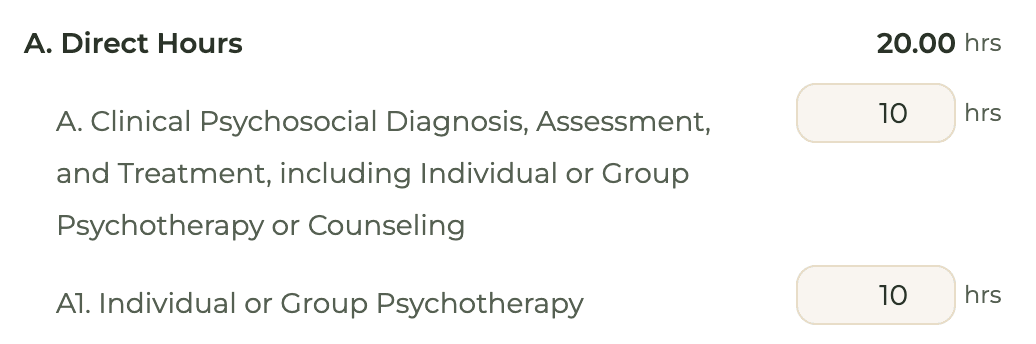
What Fills the Other 1,250?
Here is the arithmetic ASWs ask about. If you need 2,000 clinical hours and at least 750 of them have to be psychotherapy, what fills the rest?
The rest of the 2,000 is any clinical psychosocial diagnosis, assessment, and treatment, including more psychotherapy or counseling. The 1,250 is the arithmetic gap between two minimums, not a separate category. If all 2,000 of your clinical hours are psychotherapy, that works too.
The statute does not sort activities one by one. It names the category: clinical psychosocial diagnosis, assessment, and treatment, including psychotherapy or counseling. Your supervisor signs your weekly log, so ask them how borderline activities such as assessments, crisis work, and treatment planning are categorized.
Do not fill the rest of the 2,000 with non-clinical work. The BBS non-clinical category is a list: client-centered advocacy, consultation, evaluation, research, direct supervisor contact, and workshops, seminars, training sessions, or conferences directly related to clinical social work that your supervisor has approved (BPC 4996.23(d)(3)). It is capped at 1,000 hours, and none of it counts toward the 2,000 clinical minimum or the 750 psychotherapy subset.
In other words, your 2,000 clinical hours are at least 750 hours of psychotherapy plus any other clinical diagnosis, assessment, and treatment. The non-clinical category is limited to the activities the statute lists. Documentation and other administrative time is not named in either category, so ask your supervisor before counting it. For more on the non-clinical bucket, see non-direct hours under the BBS.
Clinical vs. the 750 Psychotherapy Subset vs. Non-Clinical
The clearest way to see the boundary is to place each activity into three columns: does it count toward the 2,000 clinical minimum, does it count toward the 750 psychotherapy subset, and is it instead non-clinical (the capped 1,000 bucket)?
| Activity | Clinical (2,000)? | 750 Psychotherapy? | Non-Clinical (1,000)? |
|---|---|---|---|
| Face-to-face individual psychotherapy | Yes | Yes | No |
| Face-to-face group psychotherapy | Yes | Yes | No |
| Other clinical psychosocial diagnosis, assessment, and treatment, including counseling | Yes | No | No |
| Client-centered advocacy | No | No | Yes |
| Consultation | No | No | Yes |
| Evaluation | No | No | Yes |
| Research | No | No | Yes |
| Direct supervisor contact | No | No | Yes |
| Workshops, seminars, training sessions, or conferences (supervisor-approved) | No | No | Yes |
The first three rows are the clinical category; the 750 column lights up only for face-to-face individual or group psychotherapy. The bottom rows are the statute's non-clinical list, capped at 1,000 hours. Your supervisor signs your log, so ask them how borderline activities such as assessments, crisis work, and evaluations are categorized.
HourJourney shows where you stand on the 2,000, the 750 and the 1,000 cap
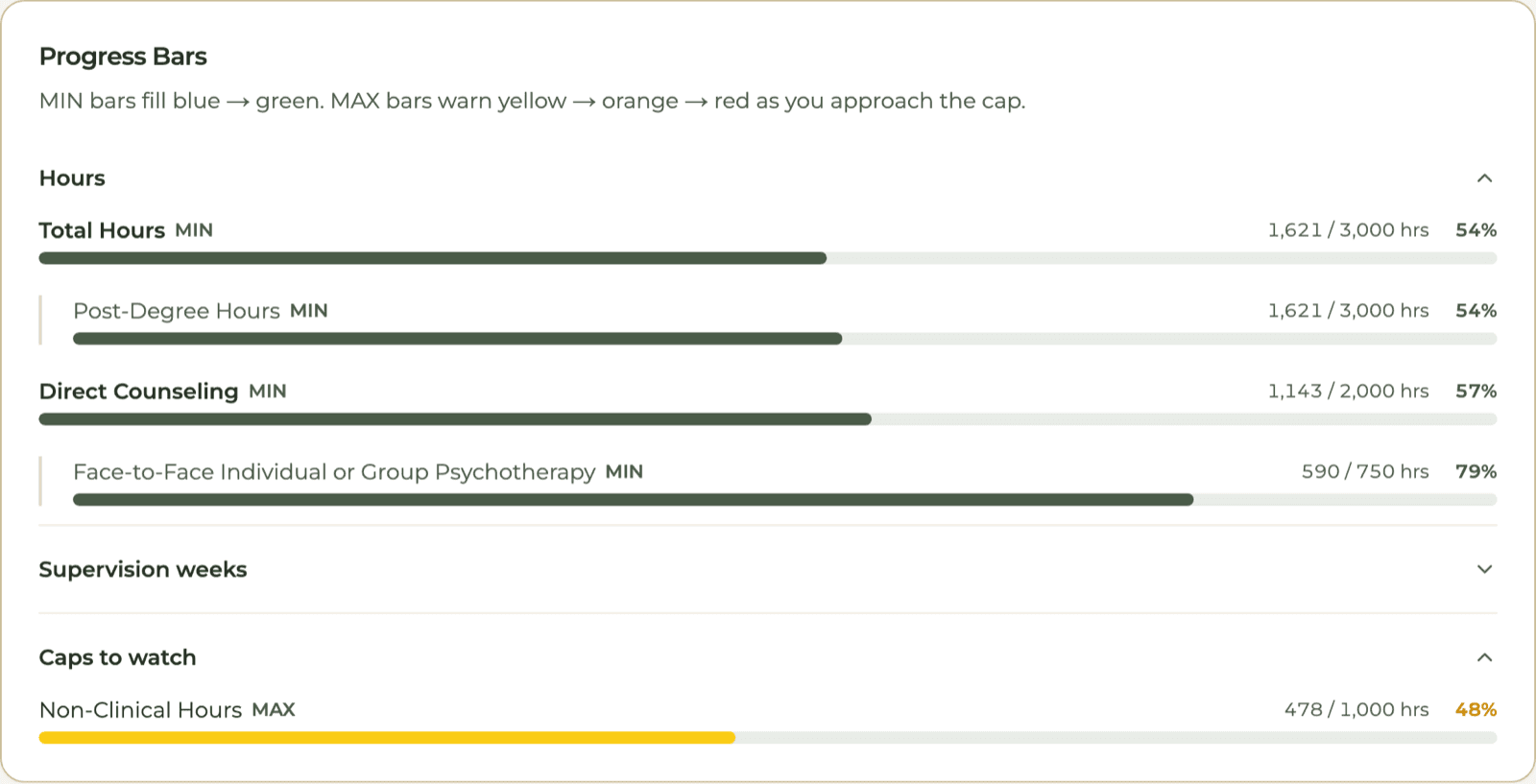
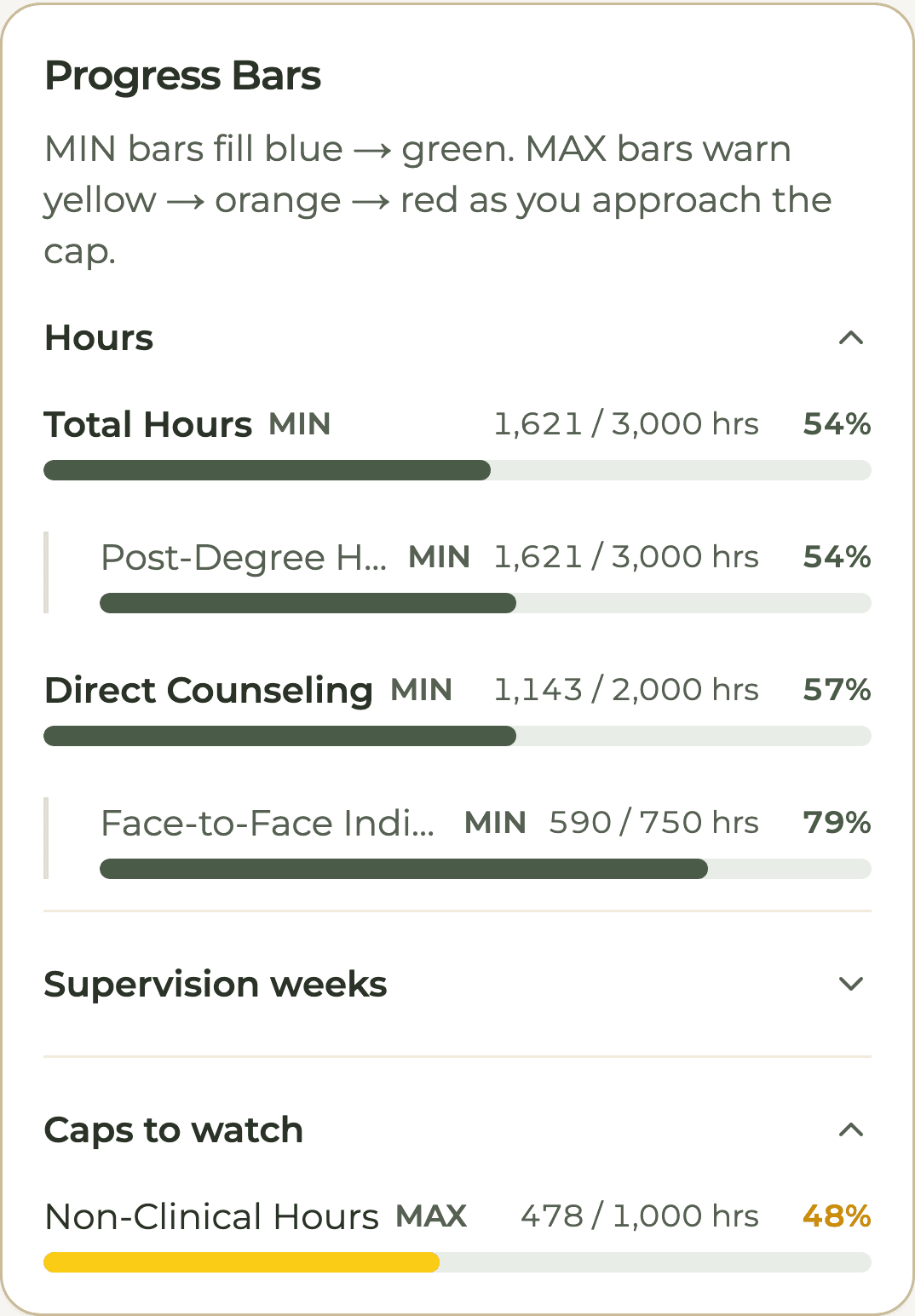
Your dashboard totals clinical hours toward 2,000, the psychotherapy hours inside them toward 750, and non-clinical hours against the 1,000 cap, from the categories you enter.
When It Is Not Obvious, Ask Your Supervisor
Most activities fall cleanly into one column. Some do not. A session that starts as a check-in and becomes therapeutic, a family meeting with a clinical purpose, a case-management contact with a treatment component: these can be hard to categorize.
The BBS gives your supervisor two specific calls: whether hours count as client-centered advocacy (BBS ASW FAQ) and approving the workshops, seminars, training sessions, and conferences you count (BPC 4996.23(d)(3)). Your supervisor also signs your weekly log. For other borderline activities, ask your supervisor at the time, confirm with the BBS when in doubt, and write down the reasoning you agreed on. Categorize the hours the week you log them.
Document the rationale as you go. A one-line note on why a borderline activity was counted as clinical, psychotherapy, or non-clinical, agreed with your supervisor that week, is worth more than a memory two years later. This is practical guidance, not a formal BBS procedure. For the category definitions, check the BBS ASW FAQ and see the LCSW hour-tracking guide.
Common Ways ASWs Miscount Clinical Hours
These five mistakes are all preventable once you know the definitions above.
- ✓Counting non-clinical time as clinical. Logging advocacy, consultation, research, trainings, or supervisor contact toward the 2,000 clinical minimum. Those belong in the BBS non-clinical category, capped at 1,000 hours. Progress notes are not named in either LCSW category, so ask your supervisor before counting documentation time.
- ✓Treating the 750 as separate from the 2,000. Assuming you need 2,000 clinical plus another 750 psychotherapy. The 750 is inside the 2,000: therapy hours are counted in both at once.
- ✓Not tracking psychotherapy separately from day one. Logging only a single “clinical” number and trying to reconstruct the 750 subset later. Assessment-heavy caseloads can hit 2,000 clinical while short on the 750.
- ✓Counting MSW practicum hours. Every clinical hour must be earned after your degree is awarded. Fieldwork from your degree does not count.
- ✓Exceeding the weekly cap. Only 40 hours in any 7 consecutive days can be credited across all settings combined, and no more than 6 hours of supervision per week. Hours above the cap are not credited, clinical or not.
The two categorization errors, counting non-clinical work as clinical and treating the 750 as an add-on, can inflate a total and leave you short of a minimum. Getting the definitions right from the start matters.
How HourJourney Tracks Your Clinical Hours
HourJourney gives ASWs separate fields for clinical, psychotherapy, and non-clinical hours, and totals each one. You decide which category each hour belongs in; the app keeps the totals, shows non-clinical hours against the 1,000 cap, and stops you saving a week over 40 hours across your sites.
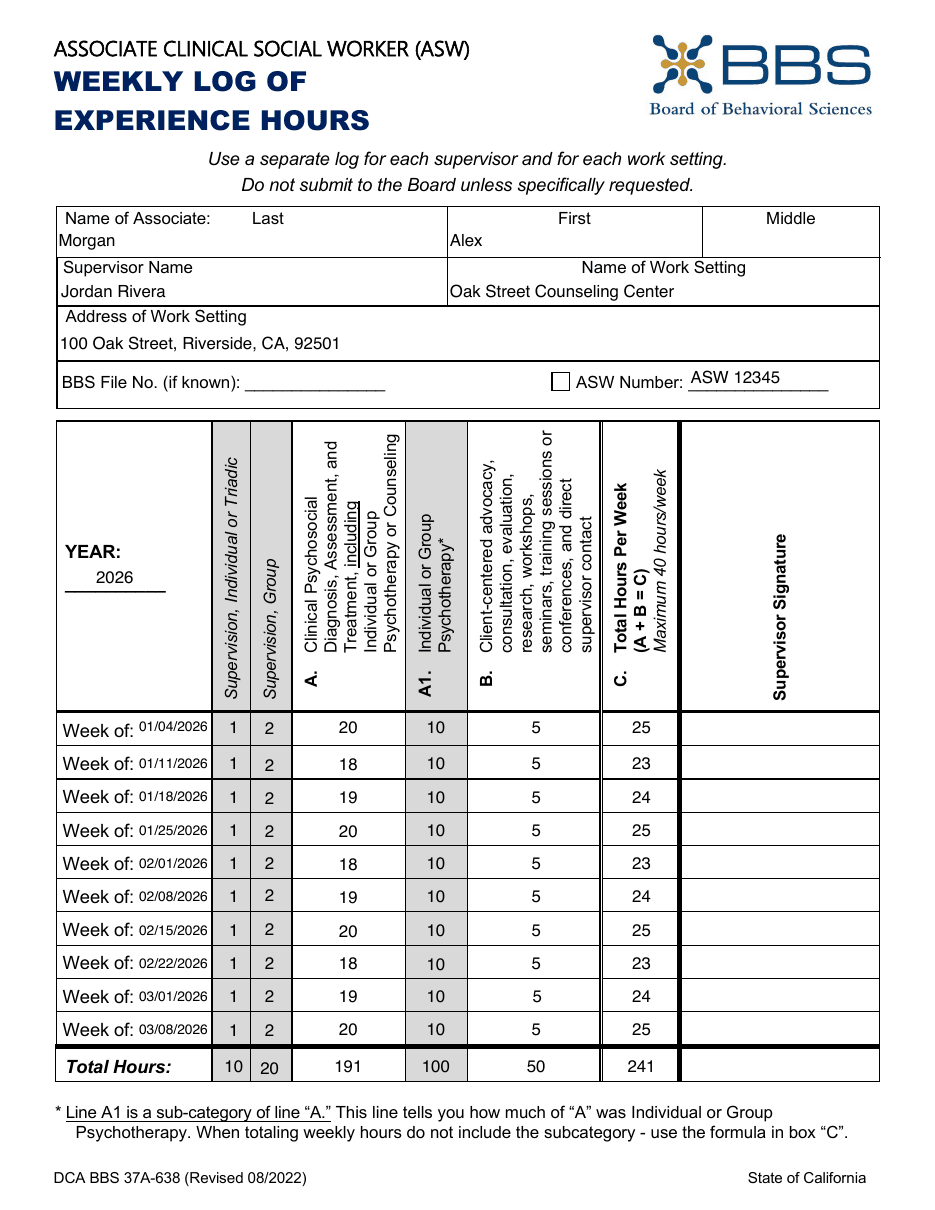
HourJourney fills in your ASW Weekly Log
Your logged weeks fill in the ASW Weekly Log of Experience Hours for each supervisor and setting, with every page totaled, ready for your supervisor's signature.
You can also estimate a finish date with the LCSW hours calculator.