Why Tracking Correctly Matters From Day One
Some associates and trainees start tracking their hours casually. They figure they will clean things up later. The problem is that several BBS rules are retroactive-proof: once you make certain mistakes, you cannot fix them. Hours logged in the wrong category need your supervisor's initials to correct. Hours that exceed the weekly cap are not credited. Weeks without supervision simply do not count toward your 104-week requirement, no matter how many client hours you logged.
If your AMFT registration lapses, every hour you earned while it was expired is gone. These are not hypothetical risks. They are avoidable ways to lose hours before you apply for licensure.
For a full breakdown of every hour requirement, minimum, maximum, and deadline, see our California LMFT hours requirements guide. If you are considering the LCSW path instead, see our LMFT vs LCSW comparison for California to understand how tracking requirements differ.
What You Need to Track Every Week
Each weekly log entry should capture these data points. If you are working at multiple sites or under multiple supervisors, you need a separate log for each supervisor-site combination.
- ✓Date range (week start and end)
- ✓Work setting name and address
- ✓Supervisor name
- ✓Column A total: all direct clinical counseling hours
- ✓Column A1: direct hours with couples, families, and children (subset of A)
- ✓Column B total: all non-clinical experience hours
- ✓Column B1: individual or triadic supervision hours (subset of B)
- ✓Column B2: group supervision hours (subset of B)
- ✓Column C total: A + B (never add subcategories separately)
- ✓Supervisor signature (electronic accepted per BBS)
- ✓Your AMFT number (and BBS file number if known)
One form per supervisor per site. If you see clients at two agencies under different supervisors, you need two weekly logs for that week. If you see clients at two agencies under the same supervisor, you still need two logs because the work settings differ.
The A/B/C Hour Category System Explained
The BBS organizes all supervised experience into two primary categories that combine into a weekly total. Understanding this structure is essential because miscategorizing hours is a tracking mistake that is hard to undo. For a detailed walkthrough of how to fill out each column on the actual BBS form, see our guide on BBS Form 37A-525.
| Column | What It Covers | Min / Max | Add to C? |
|---|---|---|---|
| A | Direct clinical counseling (individuals, groups, couples, families) | Min 1,750 hrs | Yes |
| A1 | Couples, families, and children (subset of A) | Min 500 hrs | No (included in A) |
| B | Non-clinical experience (supervision, testing, reports, advocacy, workshops) | Max 1,250 hrs | Yes |
| B1 | Individual or triadic supervision (subset of B) | - | No (included in B) |
| B2 | Group supervision (subset of B) | - | No (included in B) |
| C | Weekly total = A + B | Max 40 per 7 days | - |
A Column C mistake: Adding A + A1 + B + B1 + B2. This double-counts subcategories. Column C is always A + B only. A1 is already inside A. B1 and B2 are already inside B.
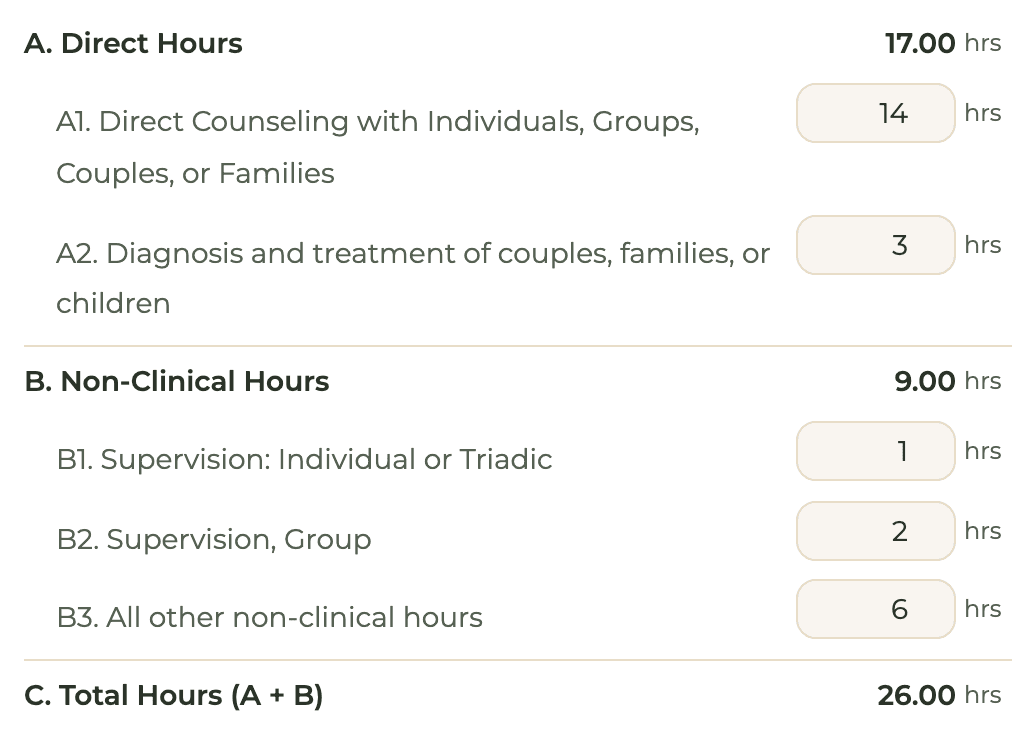
HourJourney adds up your weekly totals for you
Type each line once. HourJourney totals the direct and non-clinical hours and writes the weekly total, the same numbers that go on your weekly log.
Tracking Hours Across Multiple Sites or Supervisors
Some associates work at multiple sites. The tracking rules are straightforward but unforgiving: you maintain one weekly log per supervisor per site, and the 40-hour cap on any seven consecutive days applies across ALL sites combined, not per site.
This is where spreadsheets become dangerous. Each site has its own log. Without a system that aggregates your weekly totals across every log, you will not know you have exceeded 40 hours until it is too late.
Worked example: how 5 hours disappear
Week of March 3, 2026:
- Site A (community clinic): 25 hours logged
- Site B (private practice): 20 hours logged
- Combined total: 45 hours
- BBS-countable hours: 40
- Hours not credited: 5
In a spreadsheet with separate tabs per site, this error is invisible. You would not discover it until assembling your licensure application, possibly years later.
Prevention: At the end of every work week, add up your Column C totals from all sites. If you are consistently close to 40, adjust your schedule before you go over. A tracking app that aggregates across sites does this automatically.
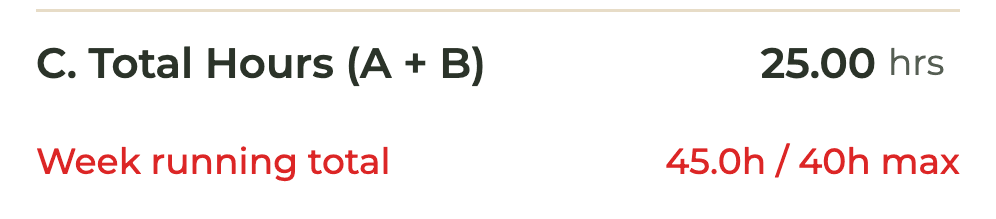
HourJourney won't let a week go over 40 hours
It adds up every site and supervisor in the week, shows the running total as you type, and won't save a week over 40.

The 40-Hour Weekly Cap: How to Stay Under It
The BBS credits a maximum of 40 hours of experience in any seven consecutive days. This is a hard cap, not an average. You cannot log 50 hours one week and 30 the next and call it 40 per week. The excess hours from the 50-hour week are not credited.
The cap applies across all work settings, all supervisors, and all hour categories combined. It does not matter whether the hours are direct clinical counseling or non-clinical experience. If A + B from all your sites in any seven consecutive days exceeds 40, only 40 are credited.
Set a weekly alarm
Every Friday, tally your hours across all sites for the week. If you are approaching 40, stop logging or redistribute to the following week.
Track weekly, not monthly
Monthly totals hide weekly spikes. A 160-hour month could be four perfect 40-hour weeks or two 50-hour weeks and two 30-hour weeks. Only the first scenario gives you full credit.
For the full breakdown of all hour requirements including pre-degree caps and the six-year limit on how old your hours can be, see our California LMFT hours requirements guide.
Tracking Your 104 Supervised Weeks
The 104-week requirement is easy to overlook. It operates independently from your total hour count: you could theoretically hit 3,000 hours in 75 weeks if you worked enough each week, but you would still need to continue until you reached 104 supervised weeks.
What counts as a supervised week
A week counts only if you logged experience hours AND received at least one unit of supervision that same week. Hours without supervision in the same week do not count toward the 104.
52 individual or triadic weeks
At least 52 of your 104 weeks must include individual or triadic supervision (not just group). Track this separately because it has its own minimum.
A week without logged experience and supervision does not count toward the 104. If you take a month off, those weeks simply do not count, and you resume when you return, as long as your registration stays active.
Which will you hit last? At any point in your journey, project both your total hours and your total supervised weeks. If you are on track to hit 3,000 hours before 104 weeks, you know weeks are your bottleneck and can plan accordingly. If weeks are ahead of hours, focus on maximizing weekly productivity within the 40-hour cap.
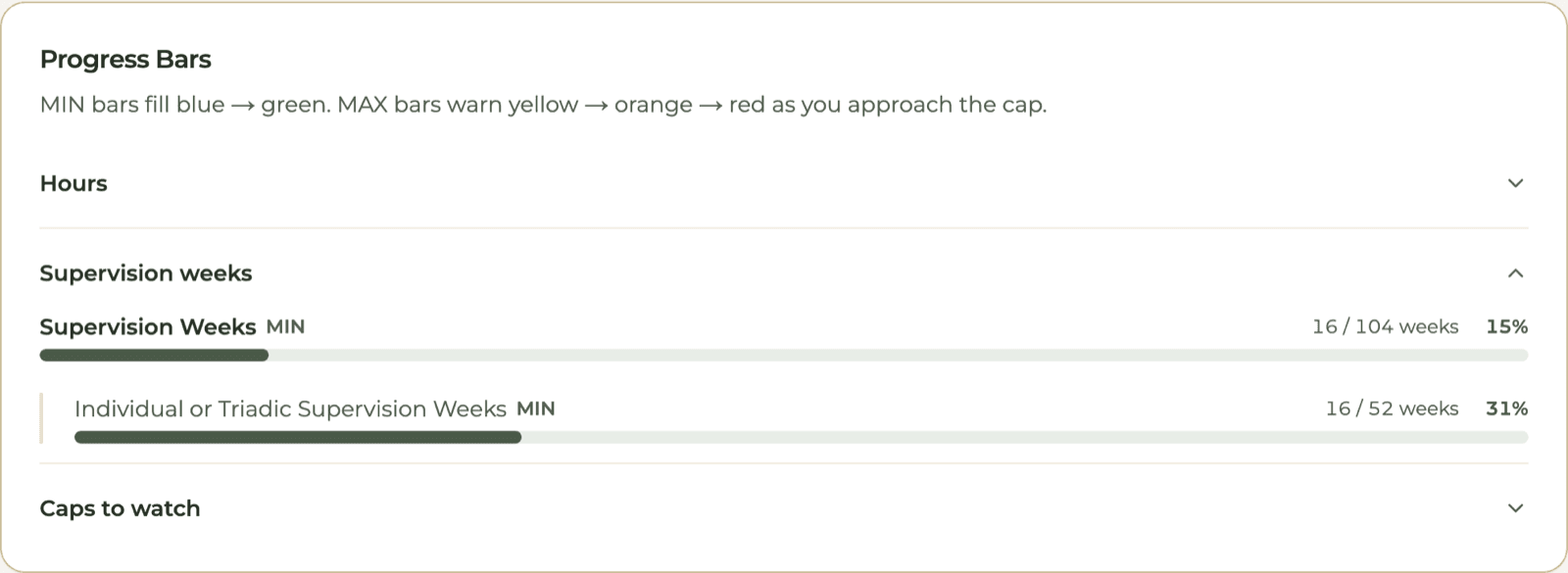
HourJourney counts your 104 supervised weeks for you
Every week you log with supervision moves you toward 104, and weeks with individual or triadic supervision count toward the 52 you need.
Getting Supervisor Signatures: Paper vs Digital
Your supervisor must sign your weekly log each week. This is not optional and it is not something you can batch at the end of the month. The BBS requires weekly supervisor review and attestation of the hours you logged.
The good news: the BBS accepts electronic signatures. Per their 2025 FAQ, signed documents may be original, scanned, or have an electronic signature. This means you do not need to print, sign, scan, and re-file paper logs every week.
Paper signatures
- - Print the weekly log
- - Both parties sign by hand
- - Scan or photocopy for backup
- - Store originals safely for years
Electronic signatures
- - Accepted per BBS 2025 FAQ
- - No printing or scanning required
- - Automatic digital backup
- - Easier to maintain weekly cadence
If your supervisor is leaving: Get every outstanding weekly log signed before their last day. Have them sign your Experience Verification form as soon as supervision ends. The BBS warns that unforeseen issues can arise with obtaining signatures later. Get each weekly log signed every week.
When to Submit Your Logs to the BBS
A common misconception among new associates: you do NOT submit your weekly logs to the BBS on a rolling basis. There is no weekly, monthly, or annual submission requirement while you are accumulating hours.
Your supervisor signs your weekly logs (Form 37A-525) and you keep the originals. You submit them only if the BBS asks. The experience verification forms (Form 37A-301) are what you submit with your Application for Licensure once you have completed all requirements. This means you may be storing two to six years of weekly logs.
Organize now, not later. Keep your logs in chronological order by site and supervisor. If you wait until application time to sort through years of paperwork, you will spend weeks reconstructing your records. A digital system that maintains this order automatically saves significant time at the end.
Both official forms are posted on the BBS LMFT applicant page.
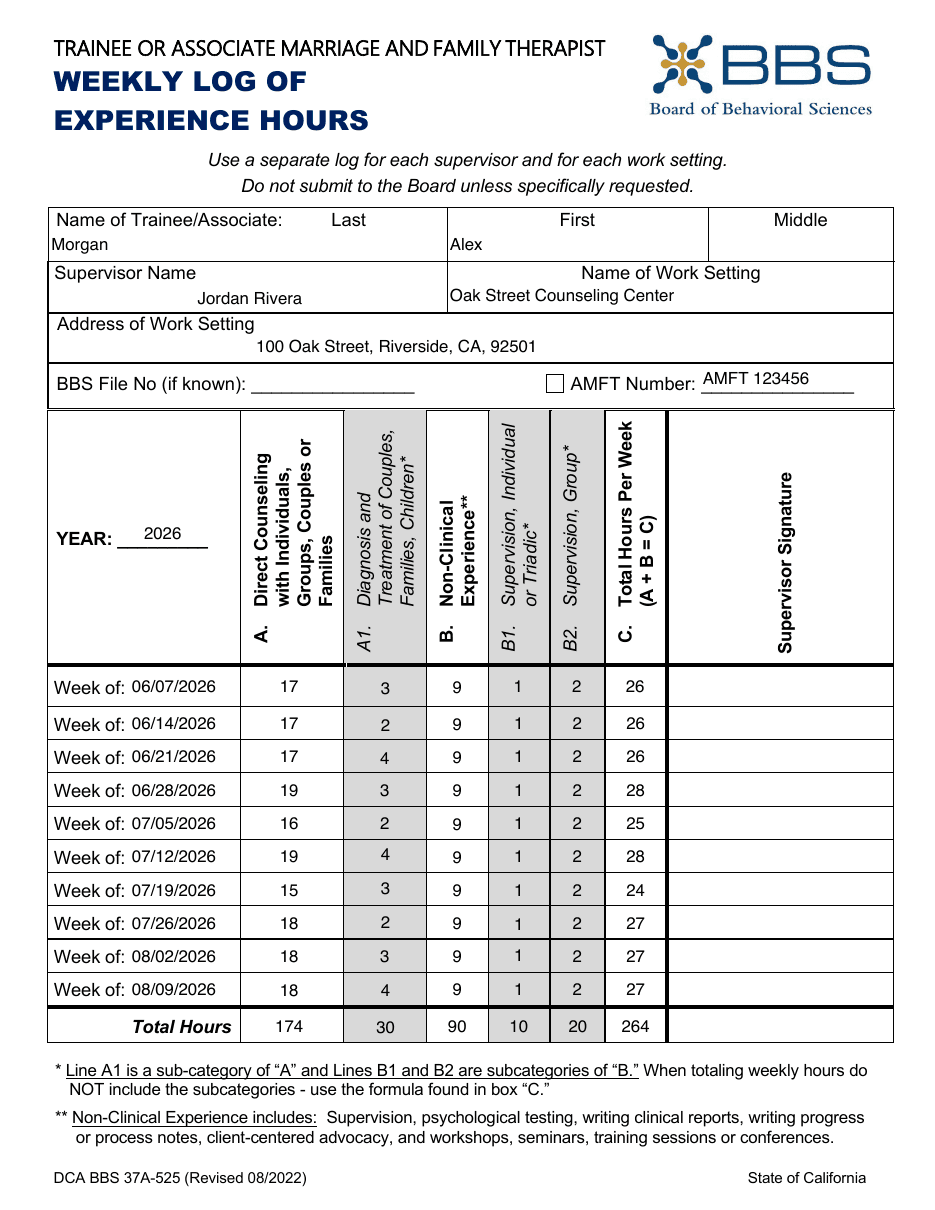
HourJourney can automatically generate your 37A-525 for you
Your logged weeks fill in the BBS weekly log, one per supervisor, site and year, ready for your supervisor's signature.
Spreadsheets vs Purpose-Built Tracking Apps
Spreadsheets are free and flexible. For a single-site associate with one supervisor, they can work fine for the first year. But the BBS requirements are complex enough that spreadsheets fail silently on several critical rules. Here is an honest comparison.
| Capability | Spreadsheet | Tracking App |
|---|---|---|
| Track raw A/B/C hours | Yes | Yes |
| Enforce 40-hr weekly cap | Manual | Automatic |
| Count 104 supervised weeks | Manual | Automatic |
| Track A1 subset progress | If you build it | Built-in |
| Multi-site weekly cap | Cross-reference tabs | Automatic |
| Generate BBS Form 37A-525 | No | Pre-filled PDF |
| Supervisor signature tracking | Manual | Signed and returned tick (Plus) |
| Pre/post-degree separation | Manual | Automatic |
| Cost | Free | $4.95-7.95/mo (or $49-79/yr) |
We are not saying spreadsheets never work. For a simple, single-site case with one supervisor, they are adequate. But they fail silently on complex situations: the multi-site weekly cap, the 104-week count, the A1 sub-requirement ratio, and pre-degree vs post-degree classification. You will not know something is wrong until you apply for licensure.
How HourJourney Tracks Every BBS Requirement
HourJourney was built for California pre-licensed therapists. Each feature below maps to a BBS requirement.
| BBS Requirement | HourJourney Feature |
|---|---|
| A/B/C hour categorization | Guided entry form with direct, couples/families/children, supervision and other non-clinical fields that auto-calculate C |
| 40-hour weekly cap | Real-time warning when your combined weekly total approaches or exceeds 40 |
| 104 supervised weeks | Automatic week counter that only increments when hours + supervision are both logged |
| 52 individual or triadic supervision weeks | Separate tracker for weeks with individual/triadic supervision |
| 500-hour A1 sub-requirement | Live progress bar showing couples/families/children hours vs. target |
| Pre-degree vs post-degree | Auto-classifies entries based on your degree awarded date |
| Form 37A-525 generation | PDF export pre-filled with your data in BBS format |
| Form 37A-301 generation | Experience verification forms generated per supervisor per site |
| Multi-site aggregation | Dashboard shows your combined totals across all sites |
FAQ: Tracking LMFT Supervised Hours
How do I track LMFT hours in California?+
Track your hours weekly using the BBS A/B/C category system. Log Column A (direct clinical counseling), Column B (non-clinical experience), and Column C (the weekly total of A + B, with a maximum of 40 hours credited in any seven consecutive days). Maintain a separate log per supervisor per site, get weekly supervisor signatures, and track your supervised weeks independently of total hours.
Can I track LMFT hours in a spreadsheet?+
You can, but spreadsheets have significant limitations. They cannot automatically enforce the 40-hour weekly cap across multiple sites, count your 104 supervised weeks, flag A1 sub-requirement progress, or generate BBS PDF forms. Spreadsheets work for simple single-site cases but fail silently when your situation becomes more complex.
What is the best app to track LMFT hours?+
HourJourney is a purpose-built BBS hours tracking app for California pre-licensed therapists. It checks your weekly total against the 40-hour cap as you log, shows your progress toward 104 supervised weeks, tracks your couples, families, and children hours, and generates pre-filled BBS PDF forms. Plans start at $4.95/month (or $49/year, save 17%) with a 30-day free trial.
How do I track hours at multiple jobs?+
Maintain a separate weekly log for each supervisor-and-site combination. The critical rule: your combined hours across ALL sites in any seven consecutive days cannot exceed 40. Hours above 40 are not credited toward licensure. A tracking app that aggregates across sites can prevent this; a spreadsheet requires manual cross-referencing each week.
Do I submit my hour logs to the BBS every week?+
No. Keep all signed weekly logs organized in chronological order. You send them to the BBS only if it asks. Your supervisor must still sign the logs weekly, and the signed experience verification forms go in with your Application for Licensure.
How often does my supervisor need to sign my logs?+
Every week. The BBS requires weekly supervisor review and signature. Electronic signatures are accepted per BBS 2025 FAQ guidance. Get the log signed each week. If your supervisor is leaving, get all outstanding logs signed before their last day.
How do I track my 104 supervised weeks?+
Supervised weeks are counted independently from total hours. A week counts only if you logged experience hours AND received supervision that same week. At least 52 of those 104 weeks must include individual or triadic supervision. A week without logged experience and supervision does not count, and your registration must be active while you earn hours. Project whether you will reach 3,000 hours or 104 weeks first to plan accordingly.
What happens if I exceed the 40-hour weekly cap?+
Any hours above 40 in any seven consecutive days are not credited toward licensure. The cap applies across all work settings combined, not per site. For example, 25 hours at Site A plus 20 hours at Site B equals 45 total, but only 40 are credited. The 5 excess hours are not credited.
How do I make sure my couples and family hours are on track?+
You need at least 500 hours of direct experience diagnosing and treating couples, families, and children (the A1 line within Column A). Track A1 separately and check your running total against 500.
Related guides
California LMFT Hours Requirements: The Complete 2026 Guide
Every hour minimum, maximum, and deadline, in plain English.
BBS Form 37A-525: How to Fill It Out Without Losing Hours
A step-by-step walkthrough of the weekly supervision log.
The 90-Day Rule for AMFTs in California
What counts, what doesn't, and how to protect your hours.
Requirements reflect BBS guidance current as of 2025-2026. Always verify at bbs.ca.gov. This guide is for informational purposes only and does not constitute legal or professional advice.