Step 1: Earn a Master of Social Work (MSW)
The foundation of the LCSW pathway is a master's degree in social work. The California Board of Behavioral Sciences (BBS) requires that the degree come from a school of social work accredited by the Council on Social Work Education (CSWE) (BPC 4991.2(a), 4996.18(b)(1)). Graduates of CSWE candidate programs can register but cannot take the clinical exam until the school is accredited (BPC 4996.18(c)). If you are unsure whether a particular program qualifies, confirm directly with the BBS before enrolling or before submitting your registration application.
Unlike the LMFT pathway, the LCSW pathway does not allow pre-degree (trainee) hours to count toward your supervised-experience total. Practicum and field placement hours completed during your MSW are part of your education, not your post-degree experience. That makes the timing of your degree conferral especially important — it is the line that separates "education" from "experience that counts."
Considering social work vs. marriage and family therapy? The two California licenses overlap in clinical scope but differ in coursework, supervised-hour rules, and exams. See our LMFT vs. LCSW in California comparison to weigh the differences before you commit to a degree.
Step 2: Complete the Required Additional Coursework
Beyond the MSW itself, the BBS requires applicants to have completed a set of specific additional courses. The exact list of required courses is published in the "Application Instructions" within the ASW Registration Application packet and again in the Application for LCSW Licensure packet. Because that list is maintained by the BBS and can be updated, this guide does not reproduce it — instead, download the current ASW Registration Application from bbs.ca.gov and read the Application Instructions section carefully.
The additional coursework in the ASW FAQ (Q44) is due before you submit your Application for Licensure, and it may be taken at any time, in person or online. The registration application has its own requirement: California law and professional ethics coursework (BPC 4996.18(b)(3)).
Step 3: Register as an Associate Clinical Social Worker (ASW)
Before you can accrue post-degree supervised experience in California, you must register with the BBS as an Associate Clinical Social Worker (ASW). There is one exception — the 90-day rule (covered below) — but as a general matter, no post-degree clinical hours count until your ASW registration is in place. The in-state registration form is aswapp.pdf, available on the BBS website.
The 90-day rule. Hours count if the BBS receives your registration application within 90 days of your degree being granted and then grants the registration. If you graduated on or after January 1, 2020, the hours must also be at a workplace that required completed Live Scan before you started, and you provide that Request for Live Scan Service form with your Application for Licensure (BPC 4996.23(b)). Otherwise, hours count only from the date your registration is issued. The same 90-day concept exists on the MFT side; see our 90-day rule guide for a closer look at how it works in practice.
A registration can be renewed five times and cannot be renewed beyond six years from the last day of the month it was issued. When no more renewals are possible you may apply for a subsequent registration (BPC 4996.28(c)). Two conditions apply: you must pass the California Law & Ethics Exam before a subsequent registration can be issued, and holders of a subsequent registration cannot work in a private practice or professional corporation setting. Separately, hours must be no more than six years old on the date the BBS receives your Application for Licensure (BPC 4996.23(d)(4); ASW FAQ Q24).
One more ongoing obligation: effective January 1, 2023, all registered Associates (including ASWs) must complete 3 hours of California Law & Ethics continuing education during each renewal period, before renewing, regardless of whether they have already passed the Law & Ethics exam.
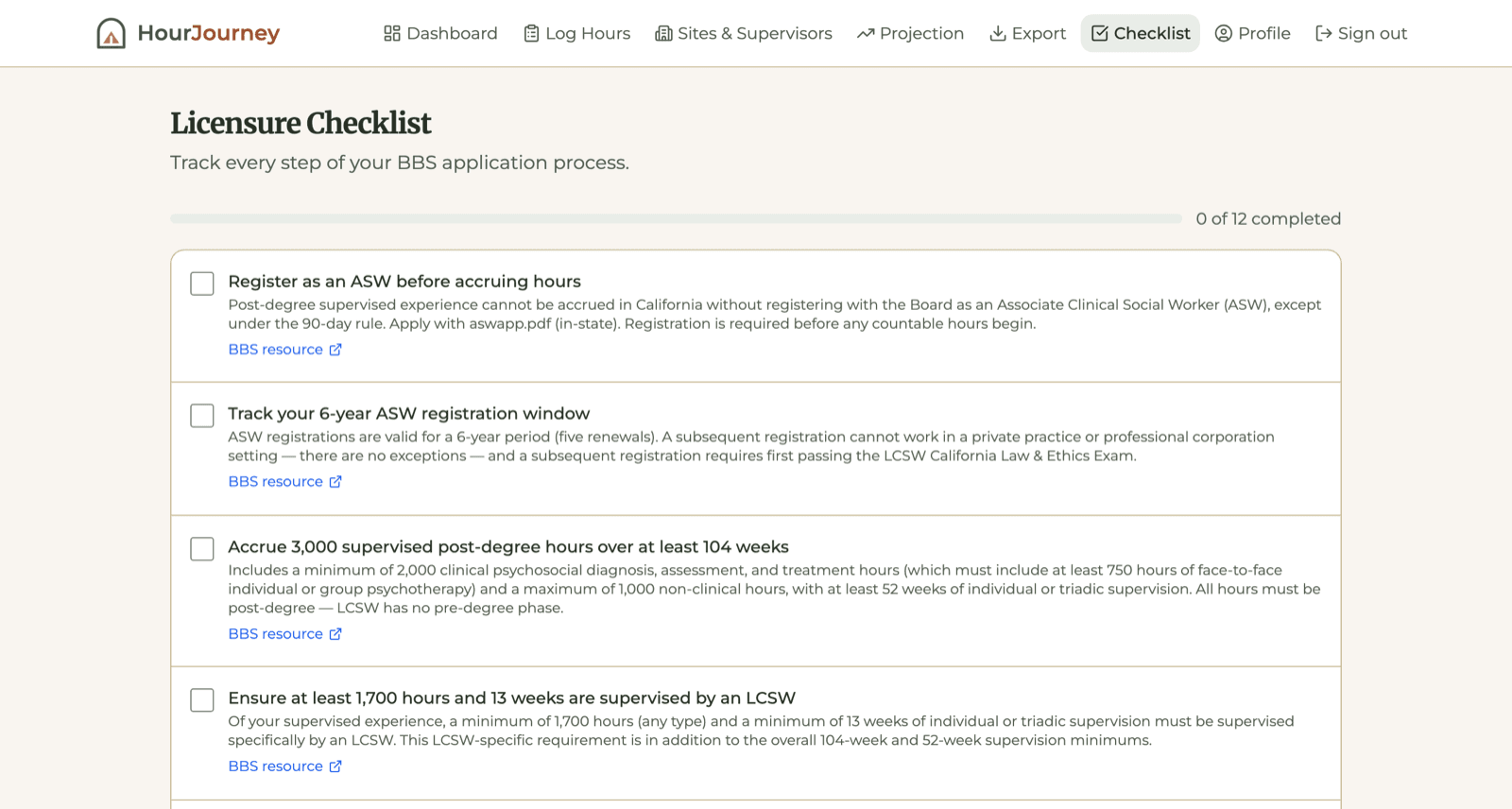
HourJourney keeps your ASW-to-LCSW checklist
The checklist lists each BBS step for your track, from ASW registration to the 1,700 hours under an LCSW, so you can check them off as you go.
Step 4: Satisfy the Fingerprint Requirement
As part of your ASW application, the BBS requires fingerprints so your background can be checked through the California Department of Justice (DOJ) and the FBI. California residents use Live Scan; applicants outside California submit fingerprint hard cards. Either way, the results are transmitted to both the DOJ and the FBI.
There is a $49 processing fee. Live Scan sites may also charge a "rolling fee" that varies by location. Fees are subject to change; check bbs.ca.gov for current fee amounts before you go.
Timing matters here. The Board recommends completing your Live Scan no more than 30 days before you submit your application. And Live Scan results expire after six months if no application is filed — so do not get fingerprinted far in advance of being ready to apply, or you may have to do it again.
Step 5: Pass the Criminal Background Check
The BBS evaluates your criminal history as part of the application process. Grounds for denial are in BPC 480; see the BBS criminal convictions page for how it applies.
Step 6: Take and Pass the California Law & Ethics Exam
The California Law & Ethics Exam is administered by Pearson VUE; exam content is in the Pearson VUE Candidate Handbook. For ASWs, this exam has a built-in deadline structure: you must take the Law & Ethics Exam each year to renew your ASW registration until you pass it, and you must pass it before you can be issued a subsequent ASW registration. Passing it early means the annual attempt is behind you.
For current passing scores, exam content, scheduling, and fees, see the BBS exam pages. Exam details change — always confirm current requirements directly with the BBS at bbs.ca.gov.
Do not let this exam stall your renewal. Taking the exam each renewal cycle is what permits renewal; a failed attempt still satisfies that year's condition. You must pass it before a subsequent registration can be issued (ASW FAQ Q10, Q11). Schedule early, because renewal is blocked if you have not taken it (Q8).
Step 7: Accrue 3,000 Hours of Supervised Experience
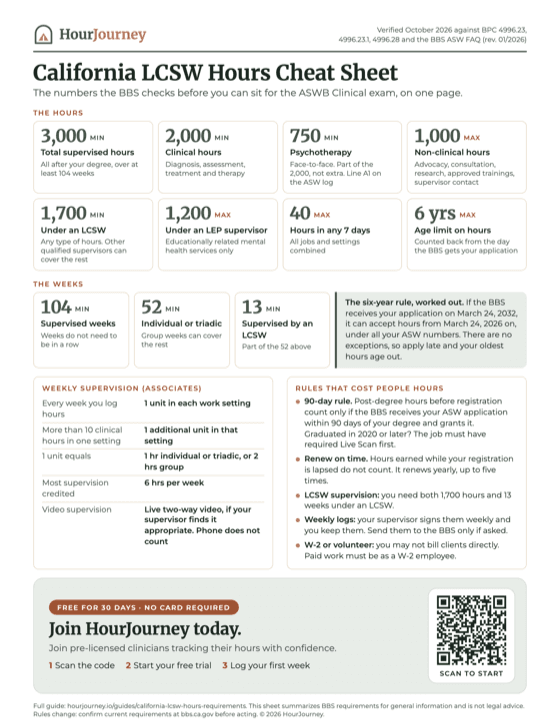
This is the longest stage of the journey. You must accumulate 3,000 total supervised hours over a minimum of 104 weeks, and every one of those hours must be earned post-degree; there are no pre-degree hours on the LCSW pathway. Within that 3,000-hour total, the BBS sets several category minimums, maximums, and supervision rules.
LCSW Hour Breakdown
- ✓3,000 hours total of supervised experience, all post-degree, over a minimum of 104 weeks.
- ✓2,000 hours minimum of clinical psychosocial diagnosis, assessment, and treatment (including psychotherapy and counseling).
- ✓750 hours minimum of face-to-face individual or group psychotherapy in the context of clinical social work services — this is a subset of the 2,000 clinical hours, not additional to them.
- ✓Up to 1,000 hours of non-clinical experience: client-centered advocacy; consultation, evaluation, and research; workshops, seminars, training sessions, and conferences directly related to clinical social work and approved by your supervisor; and direct supervisor contact.
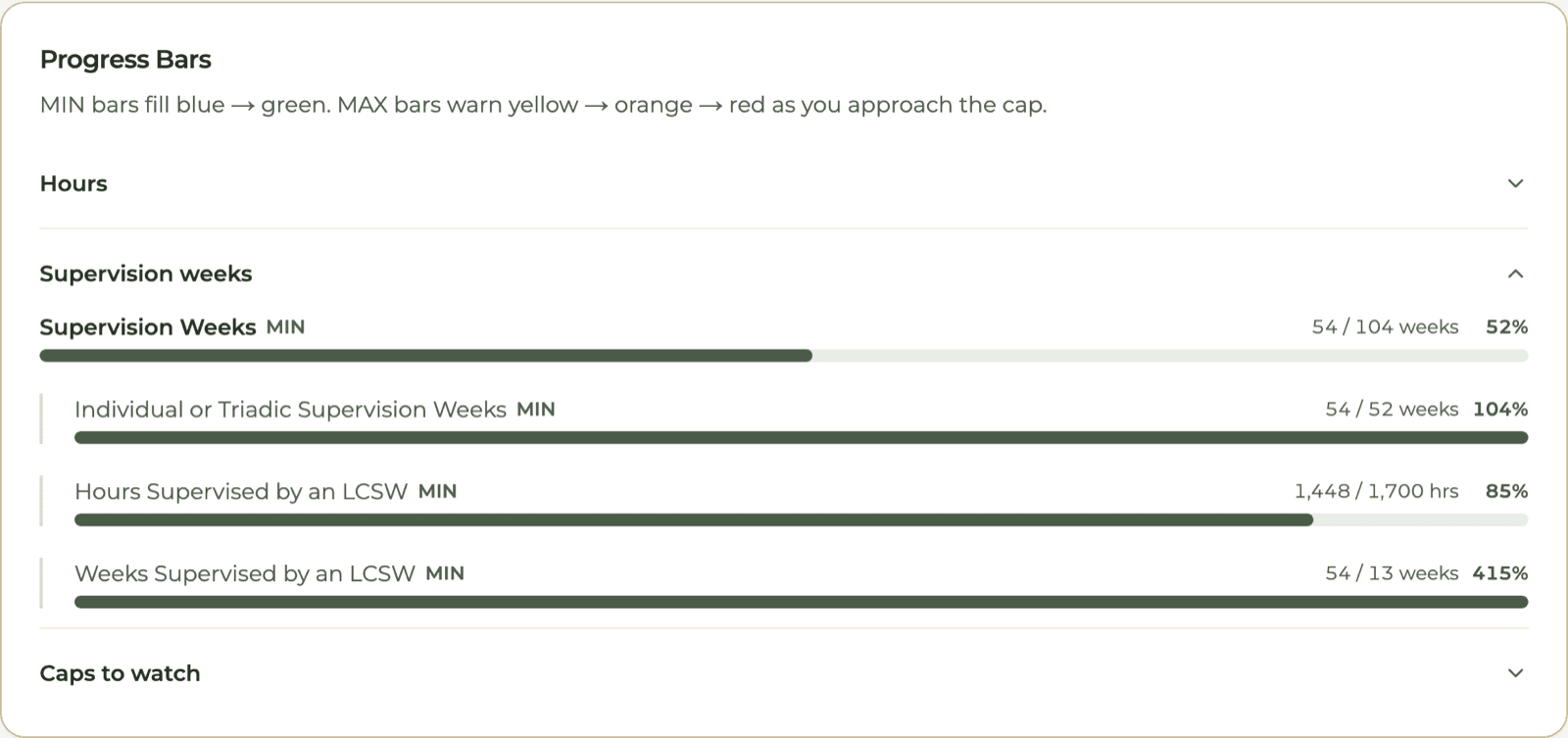
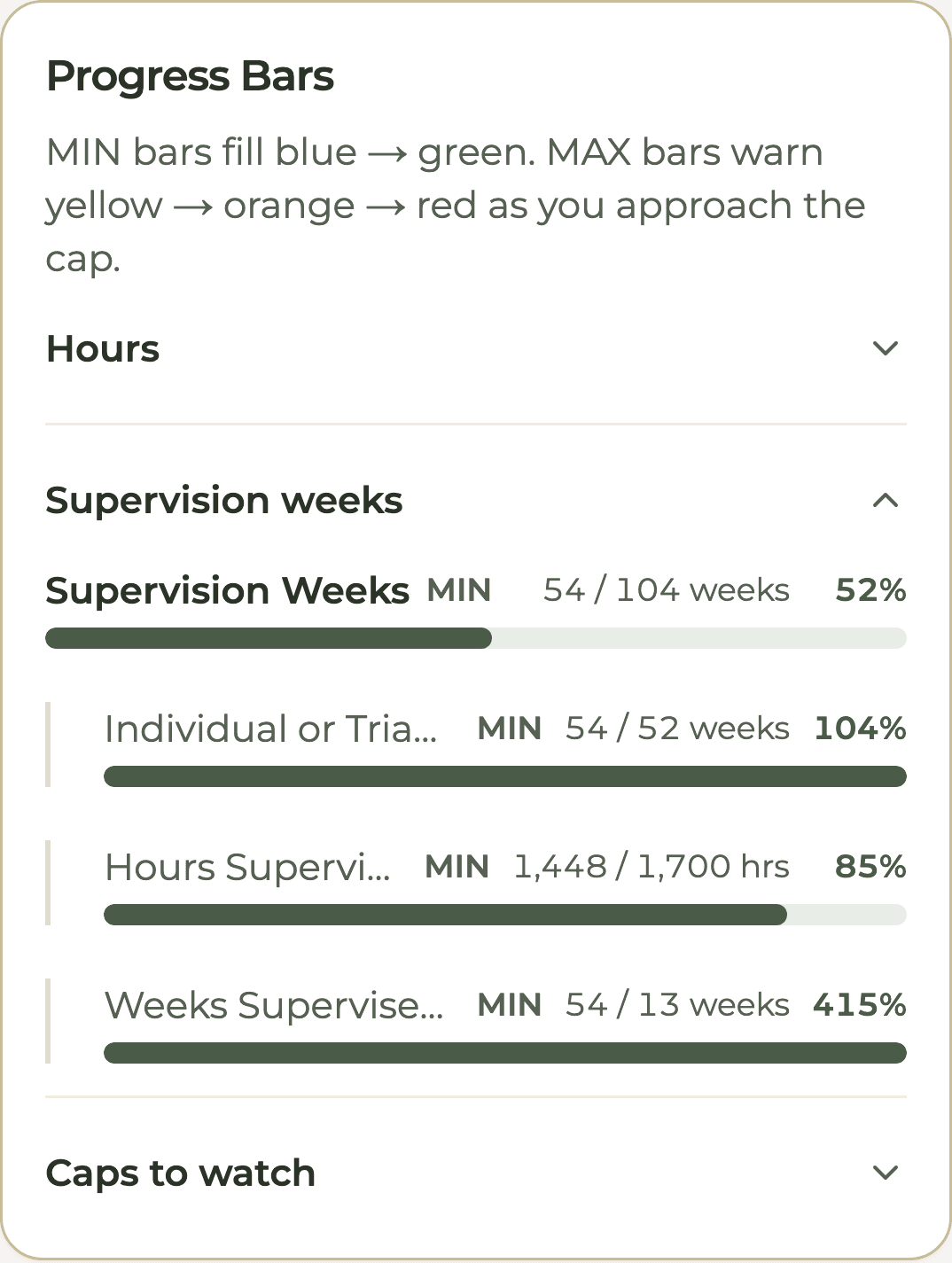
- ✓52 weeks minimum (of the 104) must include individual or triadic supervision.
- ✓13 weeks minimum (within those 52) must be supervised by an LCSW.
- ✓1,700 hours minimum (of any type, of the 3,000) must be supervised by an LCSW specifically.
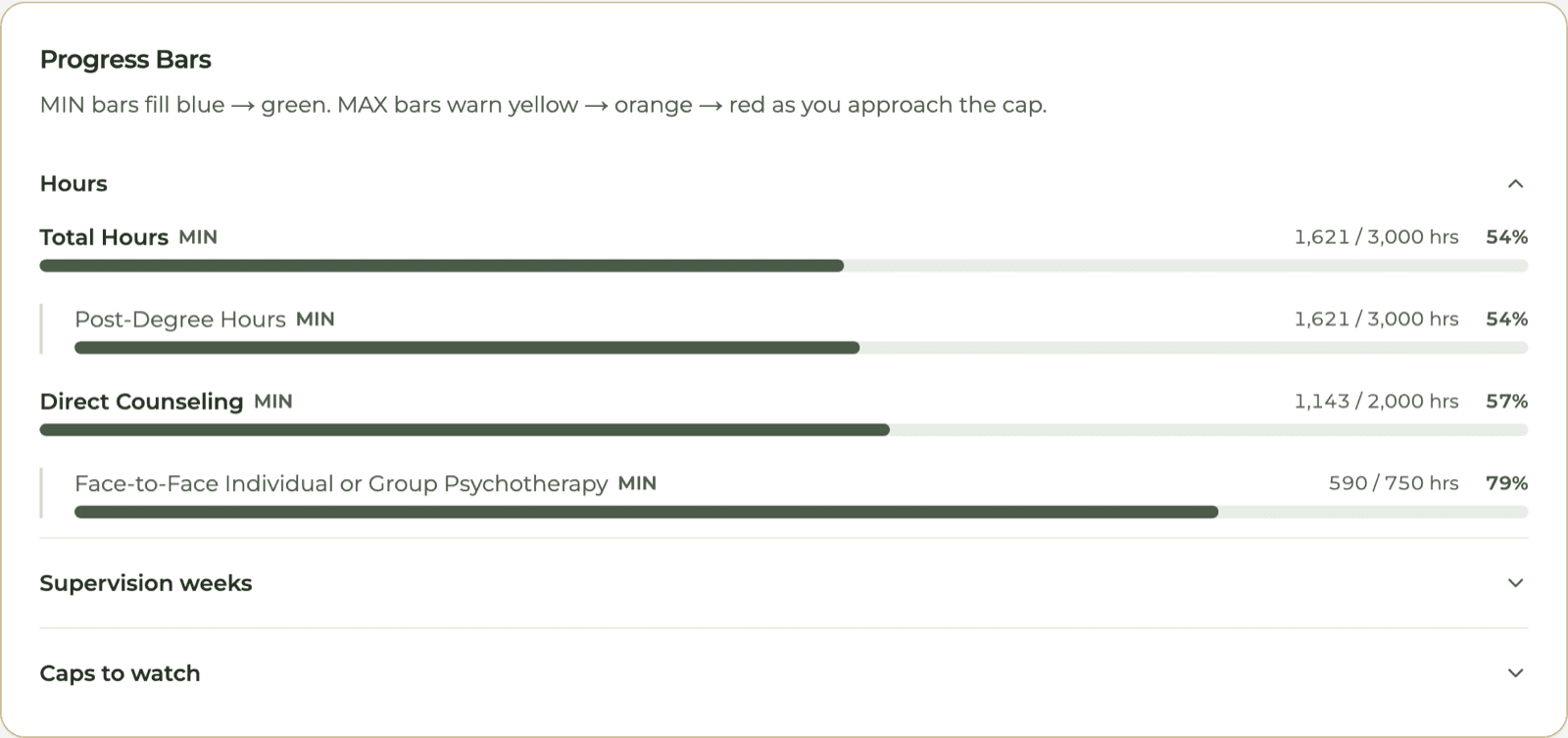
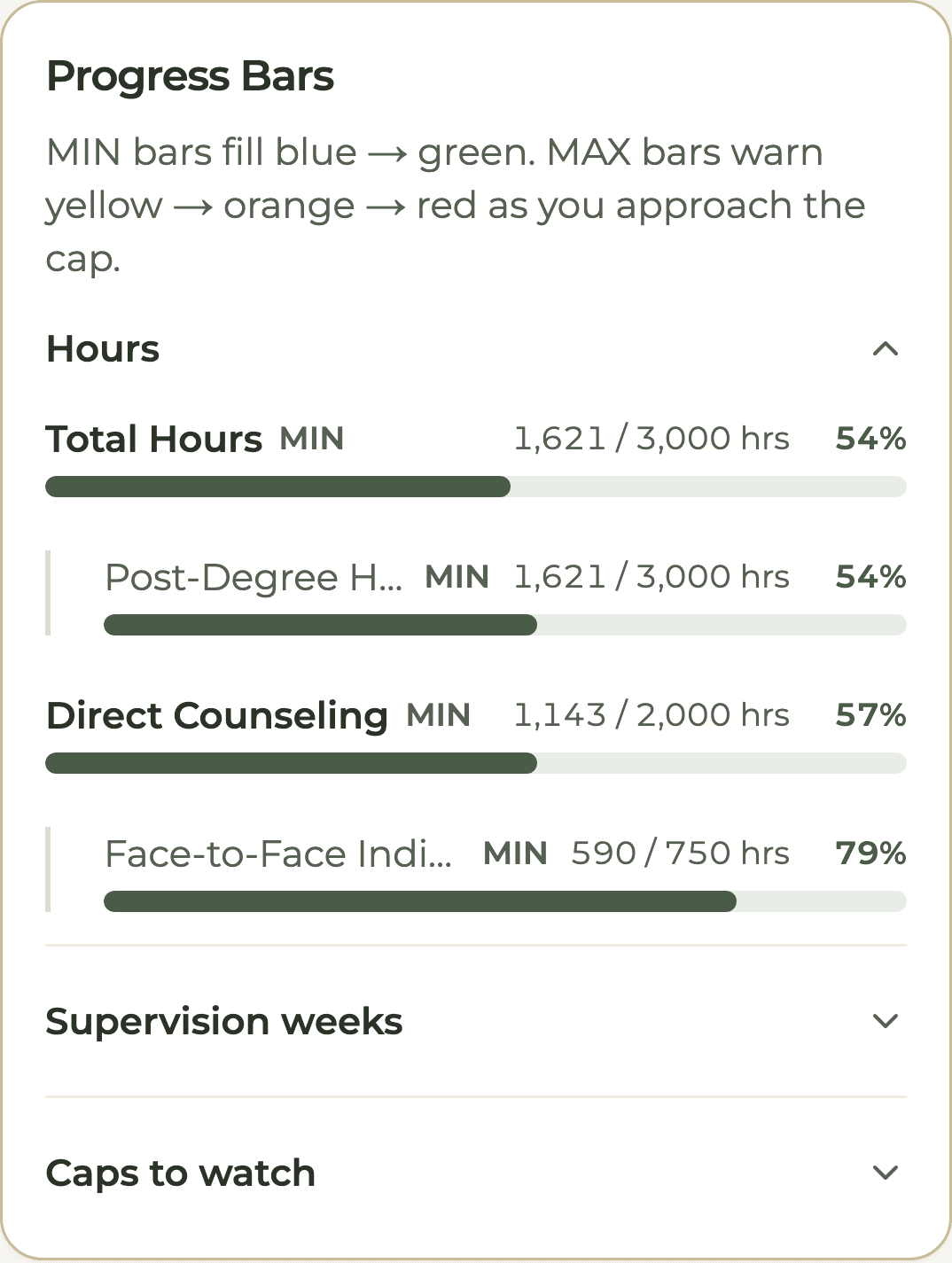
HourJourney tracks every LCSW hour category
Your dashboard shows total hours toward 3,000, clinical hours toward 2,000, and face-to-face psychotherapy toward 750, from the weeks you log.
The 1,700-hour LCSW-supervision rule makes your first job choice matter. Because 1,700 hours must be under an LCSW, ask each employer who your supervisor would be and whether they are an LCSW. See our guide on picking your first ASW job for the fastest path to LCSW before you sign an offer.
HourJourney counts the hours and weeks under an LCSW
Each supervisor's license type is on file, so the dashboard totals the hours and the individual or triadic weeks supervised by an LCSW against the 1,700-hour and 13-week minimums.
There are also weekly limits you have to respect. You may not count more than 40 hours of experience in any 7 consecutive days across all settings combined — if you work two jobs, the cap applies to the total. Weekly supervision credit is capped at 6 hours. And in any week where you have more than 10 hours of clinical psychosocial diagnosis, assessment, and treatment (including psychotherapy or counseling) in a setting, you need 1 additional unit of supervision for that week: one hour of individual or triadic supervision, or two hours of group supervision. Separately, up to 1,200 hours may be gained under a licensed educational psychologist, and those hours must be educationally related mental health services within the LEP scope of practice (BPC 4996.23(d)(1)(B)).
You document all of this on the BBS's ASW Weekly Log of Experience Hours (aswlog.pdf). The category figures follow the BBS LCSW experience chart (rev. 10/2023); the weekly supervision and LEP rules are from the BBS ASW FAQ (rev. 01/2026) and BPC 4996.23 and 4996.23.1. Verify the current versions before relying on any specific number.
Track from your very first week. The LCSW hour rules have a lot of moving parts: the 2,000-hour clinical minimum, the 750-hour psychotherapy subset, the 1,700-hour LCSW-supervision rule, the 13-week LCSW-supervision rule, the weekly caps. For the column-by-column details, see our guide to tracking LCSW hours in California, use our LCSW hours calculator to project your timeline, or start tracking with HourJourney to see each week marked Compliant or Non-Compliant.
Not sure who is allowed to sign off on your hours? Supervisor qualifications are their own topic — see our guides on who can supervise an ASW in California and the broader BBS supervision requirements, and confirm anything specific with the BBS.
Step 8: Take and Pass the ASWB Clinical Exam
Once you have finished your hours and the BBS approves your eligibility, you take the ASWB Clinical Exam. An important distinction: this exam is administered by the Association of Social Work Boards (ASWB) — not Pearson VUE, and not the NBCC. After the BBS confirms your eligibility, you register with ASWB and schedule the exam through ASWB directly.
There are deadlines attached. The re-exam waiting period is 90 days if you do not pass on a given attempt. And you must take the Clinical Exam within one year of your application approval — or, if you passed the Law & Ethics Exam after your application was approved, within one year of passing the Law & Ethics Exam.
For current passing scores, exam content, scheduling, and fees, see the ASWB Clinical Exam Candidate Handbook and the BBS exam pages. Exam details change — always confirm current requirements directly with the BBS at bbs.ca.gov and with ASWB.
Step 9: Obtain Your LCSW License
After you pass the ASWB Clinical Exam, the last step is to formally request your license. You submit the Request for Initial License Issuance and pay the initial license fee within one year after passing the Clinical Exam. Once the BBS processes that request, it issues your LCSW license — and you are now a Licensed Clinical Social Worker in California, able to practice independently and open a private practice. Once licensed, you may supervise ASWs if you meet the supervisor requirements in the ASW FAQ (Q29), including the training requirement.
The in-state forms you will encounter along the way include the ASW Registration Application (aswapp.pdf), the ASW Weekly Log of Experience Hours (aswlog.pdf), the Application for LCSW Licensure (lcsapp.pdf), and the LCSW In-State Experience Verification (lcs-exp.pdf). Fees mentioned in this guide, including the $49 fingerprint processing fee, are subject to change; check bbs.ca.gov for current fee amounts.
Once licensed, your LCSW license must be renewed periodically with continuing education. Keep it current to avoid lapses that could interrupt your ability to practice.
How Long Does It Take to Become an LCSW After Your MSW?
The single hard floor is the supervised-experience requirement: 3,000 hours over a minimum of 104 weeks. That is at least 104 weeks (two years), and you cannot compress it below 104 weeks no matter how many hours you log. Registration, the Law & Ethics Exam, the licensure application, and ASWB Clinical Exam scheduling add time that the BBS does not publish as an average.
- ✓At least 104 weeks: post-degree supervised experience as an ASW, 3,000 hours in total
Common factors: your weekly hours, how many settings you work in, and whether you take the exams on schedule. Working part-time lowers your countable hours per week, but the 104-week floor still applies.
Run the numbers for your own situation with our LCSW hours calculator.
Common Questions About Going From ASW to LCSW in California
How long does it take to become an LCSW after an MSW in California?
The minimum is at least 104 weeks (two years) of post-degree supervised work, because the BBS requires 3,000 supervised hours over a minimum of 104 weeks. Registration, the Law & Ethics exam, the licensure application, and ASWB Clinical Exam scheduling add time that the BBS does not publish as an average. Part-time work, supervisor changes, and re-exam waits can extend it.
How many supervised hours do you need for an LCSW in California?
You need 3,000 total supervised hours over a minimum of 104 weeks, all earned post-degree — no pre-degree hours count toward the LCSW. Within the 3,000, at least 2,000 hours must be clinical psychosocial diagnosis, assessment, and treatment (and within those 2,000, at least 750 hours must be face-to-face individual or group psychotherapy in the context of clinical social work services). No more than 1,000 hours may be non-clinical experience.
Do I have to be supervised by an LCSW?
At least 1,700 of your 3,000 hours (of any type) must be supervised by an LCSW specifically. In addition, of the minimum 52 weeks that include individual or triadic supervision, at least 13 weeks must be supervised by an LCSW. Up to 1,200 hours may be gained under a licensed educational psychologist, and those hours must be educationally related mental health services within the LEP scope of practice (BPC 4996.23(d)(1)(B)). Always confirm supervisor qualifications with the BBS.
What is an ASW and do I need to register?
An ASW (Associate Clinical Social Worker) is the pre-licensure registration that lets you accrue supervised experience toward LCSW licensure in California. Yes — you cannot accrue post-degree supervised experience in California without registering as an ASW, except under the 90-day rule. Hours count if the BBS receives your registration application within 90 days of your degree being granted and then grants the registration. If you graduated on or after January 1, 2020, the hours must also be at a workplace that required completed Live Scan before you started, and you provide that Request for Live Scan Service form with your Application for Licensure.
What exams do I have to pass to become an LCSW in California?
Two: the California Law & Ethics Exam, administered by Pearson VUE (which you must take annually to renew your ASW registration until you pass it), and the ASWB Clinical Exam, administered by the Association of Social Work Boards (not Pearson VUE or NBCC), which you take after the BBS approves your eligibility. Exam details change — always confirm current passing scores, exam content, scheduling, and fees directly with the BBS and ASWB.
How long is an ASW registration valid in California?
A registration can be renewed five times and cannot be renewed beyond six years from the last day of the month it was issued. When no more renewals are possible you may apply for a subsequent registration (BPC 4996.28(c)), and you must pass the California Law & Ethics Exam before a subsequent registration can be issued. Holders of a subsequent registration cannot work in a private practice or professional corporation setting. Separately, hours must be no more than six years old on the date the BBS receives your Application for Licensure (BPC 4996.23(d)(4); ASW FAQ Q24).
Is there a weekly cap on supervised hours for ASWs?
Yes. You may not count more than 40 hours of experience in any 7 consecutive days across all settings combined. Weekly supervision credit is capped at 6 hours. And in any week with more than 10 hours of clinical psychosocial diagnosis, assessment, and treatment (including psychotherapy or counseling) in a setting, you need one additional unit of supervision (one hour of individual or triadic supervision, or two hours of group supervision).
Do ASWs have to do continuing education?
Yes. Effective January 1, 2023, all registered Associates — including ASWs — must complete 3 hours of California Law & Ethics continuing education during each renewal period, before renewing, regardless of whether they have passed the Law & Ethics exam.
Related LCSW Guides
Tracking LCSW Hours in California
The hour-by-hour rules: categories, caps, the 2,000/750 clinical split, and supervision ratios.
California LCSW Hours Requirements
How many supervised hours you need for the LCSW, with the main caps.
ASW Renewal in California
The CE you owe every renewal period while you finish your hours, and how the 6-year cap fits in.
LCSW Hours Calculator
Estimate your timeline to 3,000 hours based on your current weekly pace.
Who Can Supervise an ASW?
Who is qualified to sign off on your hours — and the 1,700-hour LCSW-supervision rule.
BBS Supervision Requirements
How supervision works across California pre-licensure pathways.
LMFT vs. LCSW in California
Comparing the two California clinical licenses — coursework, hours, exams, and scope.
The 90-Day Rule
How to keep hours earned before your registration is issued from being lost.
How to Become an LCSW
The complete step-by-step path from MSW to LCSW licensure in California.
LCSW Clinical Exam (ASWB)
Format, content, scheduling, and how to prepare for the ASWB Clinical Exam.
Cost to Become an LCSW
Fees for registration, fingerprints, both exams, renewals and licensure, plus the BBS fee reduction.
Start Tracking Your Hours on Day One
The LCSW pathway has a lot of rules — the 2,000-hour clinical minimum, the 750-hour psychotherapy subset, the 1,700-hour and 13-week LCSW-supervision rules, the 40-hour limit in any 7 consecutive days, the extra supervision unit for heavy-counseling weeks. Tracking your hours week by week from the start means you are not reconstructing logs later.
HourJourney logs your weeks per supervisor and site, marks each week Compliant or Non-Compliant, shows progress toward 3,000 / 2,000 / 750 hours, and exports the ASW Weekly Log and LCSW Experience Verification PDFs.
Ready to start your LCSW journey?
30-day free trial, no card required. Associate plans are $7.95/month or $79/year.
Start counting your hours freeDisclaimer: This guide is for informational purposes only and does not constitute legal or professional advice. While we strive to keep all information accurate and up to date based on publicly available BBS publications, California Board of Behavioral Sciences rules and requirements may change at any time. Always verify requirements directly with the California Board of Behavioral Sciences (bbs.ca.gov) before making decisions about your licensure path. HourJourney is not affiliated with, endorsed by, or sponsored by the BBS.