BBS Supervision · California 2026
BBS Supervision Requirements in California: A Complete Guide for Associates and Supervisors
Whether you are an Associate Marriage and Family Therapist (AMFT), Associate Professional Clinical Counselor (APCC), or Associate Clinical Social Worker (ASW), the California Board of Behavioral Sciences sets rules about who can supervise your clinical hours, how often supervision must occur, and what documentation you need. This guide covers each BBS supervision requirement so you and your supervisor can stay compliant from day one.
Last Updated: September 2026
Quick Reference
Applies to AMFTs, APCCs and ASWs
Here for the supervision agreement? AMFTs, APCCs and ASWs all use the same agreement, BBS Form 37M-300, and sign it within 60 days of starting supervision. Your weekly log and experience verification forms depend on your license. Our section-by-section guide to Form 37M-300 walks through the agreement itself.
Who is qualified to supervise in California?
Not every licensed clinician can supervise associates earning BBS hours. California law restricts supervision to professionals who hold specific license types and meet experience thresholds. Before you start accruing hours under a supervisor, check that they meet all of the following.
Eligible license types. Your supervisor must hold a current, active license in one of these categories: Licensed Marriage and Family Therapist (LMFT), Licensed Clinical Social Worker (LCSW), Licensed Professional Clinical Counselor (LPCC), Licensed Educational Psychologist (LEP), licensed psychologist, or physician board-certified in psychiatry by the American Board of Psychiatry and Neurology.
The 2-of-5-year rule. Your supervisor must have held an active license for at least two of the five years immediately before supervision begins. In that same five-year period, they must also have practiced psychotherapy, or supervised associates or trainees who provide psychotherapy, for at least two years. Time licensed in another state can count toward this rule. A clinician who was licensed eight years ago but let the license lapse for the past four years would not meet it.
Active license, not under suspension or probation. A supervisor whose license is suspended or on probation cannot supervise associates. Hours you gain while your supervisor's license is lapsed will not count. The BBS recommends checking your supervisor's license status periodically on the Department of Consumer Affairs License Search.
Prohibited relationships. Your supervisor cannot be anyone who has ever provided therapy to you, or your spouse, domestic partner or other relative. The BBS also bars any personal, professional or business relationship with you that undermines the authority or effectiveness of supervision.
These supervisor qualification rules apply whether your goal is meeting the California LMFT hours requirements or following the LCSW licensure path. The one difference is the LCSW rule that part of your hours and weeks must be under an LCSW supervisor, covered below.
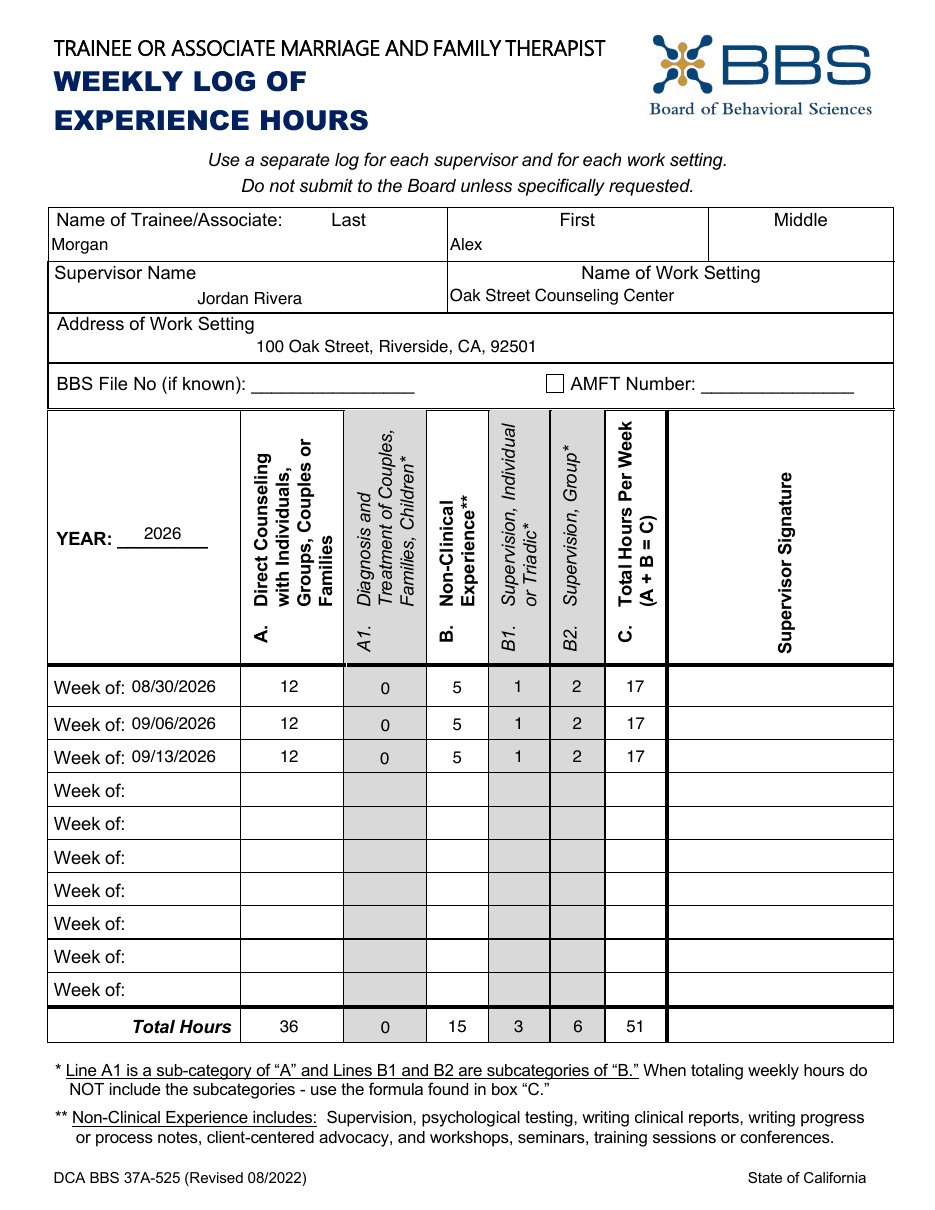
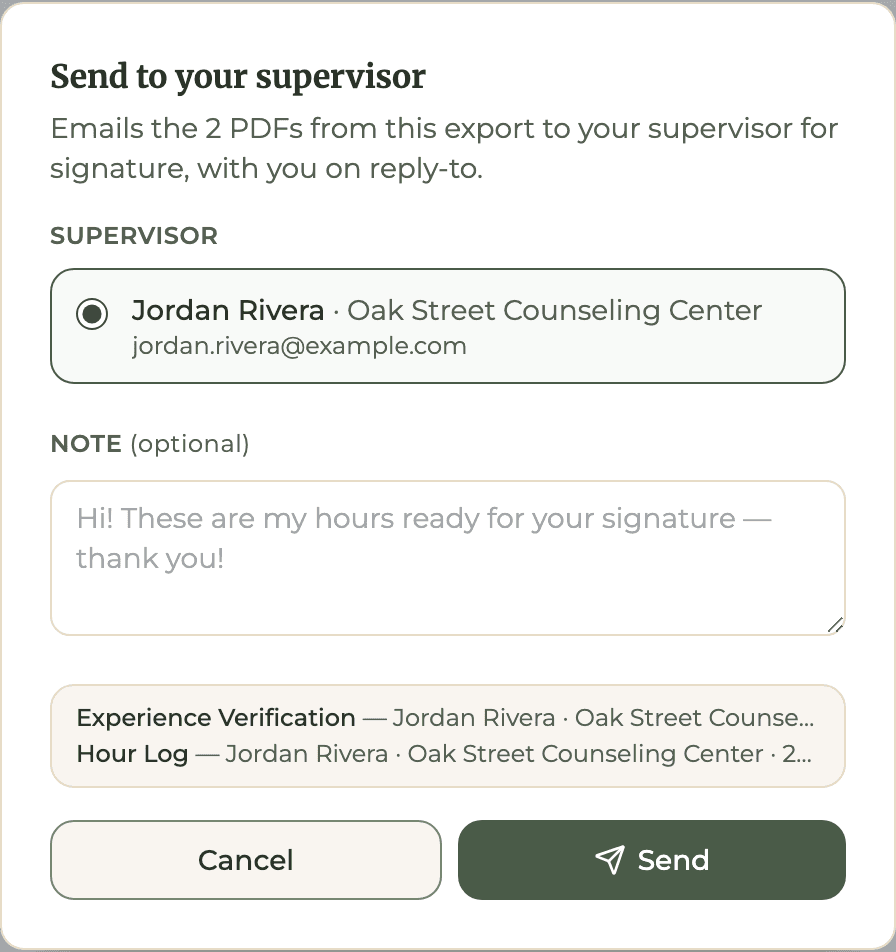
Send your weekly logs to your supervisor
HourJourney fills in your BBS weekly logs from the hours you record. With HourJourney Plus, you email the finished PDFs to your supervisor for signature straight from the app.
The supervision agreement (BBS form)
For all supervision relationships that began on or after January 1, 2022, the BBS requires a written supervision agreement, Form 37M-300. It spells out both parties' responsibilities from the start.
Timing. The supervision agreement must be signed within 60 days of the start of the supervisory relationship. Ideally, sign it before your first supervision session so there is no gap in documentation. You submit the signed original with your application for licensure.
What the agreement includes. The form has three parts: the supervisor's attestations (qualifications, the work setting and supervision duties), the supervisee's attestations, and a Supervisory Plan that describes the goals and objectives of supervision. The supervisor also commits to giving you written procedures for reaching them or an on-call supervisor in a crisis, and to one week's written notice before declining to sign for further hours.
Retention. Keep every page of the signed agreement, including the Supervisory Plan. You provide the originals to the BBS when you apply for licensure. Weekly logs are different: you keep them and send them only if the BBS asks.
You can find the official Supervision Agreement (Form 37M-300) on the BBS supervisor information page. Supervisory relationships that began before January 1, 2022 use the older Supervisor Responsibility Statement and Supervisory Plan instead. For a section-by-section walkthrough of the document itself, including where to download the current PDF, see our BBS supervisor agreement form, section by section guide.
BBS forms by license
Every associate signs the same supervision agreement, Form 37M-300 (PDF). The weekly log you keep and the experience verification you submit with your application are different for each license. Pick yours:
HourJourney fills in your license's weekly log and experience verification from the hours you record. Start counting your hours free
Weekly supervision ratios
The BBS supervision ratio determines how much supervision you need each week based on the number of direct clinical counseling hours you provide.
Associates (AMFTs, APCCs, ASWs). You must receive at least 1 unit of supervision per week at each work setting where you provide clinical services. If you provide more than 10 hours of direct clinical counseling in any week at a given setting (for ASWs, clinical psychosocial diagnosis, assessment and treatment), you need 1 additional unit at that setting. So a week with 14 direct hours at one clinic needs 2 units of supervision at that clinic.
MFT trainees. Pre-degree MFT trainees need 1 unit in each week they see clients in a setting, plus 1 additional unit for every 5 hours of direct clinical counseling in that setting that week. Only the additional units can be averaged over the time at that setting.
How units are counted. One unit of supervision equals 1 hour of individual supervision (one supervisor, one supervisee), 1 hour of triadic supervision (one supervisor, two supervisees), or 2 hours of group supervision (no more than eight people receiving supervision). Triadic supervision counts the same as individual supervision for all BBS purposes, including the 52-week individual/triadic minimum.
Weekly cap. The BBS credits a maximum of 6 hours of supervision per week. Any supervision hours beyond 6 in a single week do not count toward your licensure requirements. This cap applies across all settings and supervision formats combined.
Example: An AMFT working at two settings
Suppose you work at a community clinic (12 direct hours this week) and a private practice (6 direct hours this week). At the community clinic, you exceeded 10 direct hours, so you need 2 units. At the private practice, you logged 6 direct hours, so you need 1 unit. That is 3 units total for the week.
You could satisfy this with:
- 2 hours of individual supervision at the clinic + 1 hour of individual supervision at the private practice (3 units)
- 1 hour individual at the clinic + 2 hours group at the clinic + 1 hour triadic at the private practice (3 units)
- Any other combination that totals at least 2 units for the clinic setting and 1 unit for the private practice setting
The ratio applies independently per setting. You cannot combine supervision from one setting to cover a deficit at another.
If you are tracking your supervision hours manually, mistakes in ratio compliance are easy to miss, especially in weeks where you work at multiple settings or your caseload fluctuates. For a deeper look at how much supervision you need each week and a breakdown of how group and individual supervision each count, see our dedicated guides. Tools like HourJourney's hour tracker can flag ratio violations automatically.
How HourJourney checks your ratio
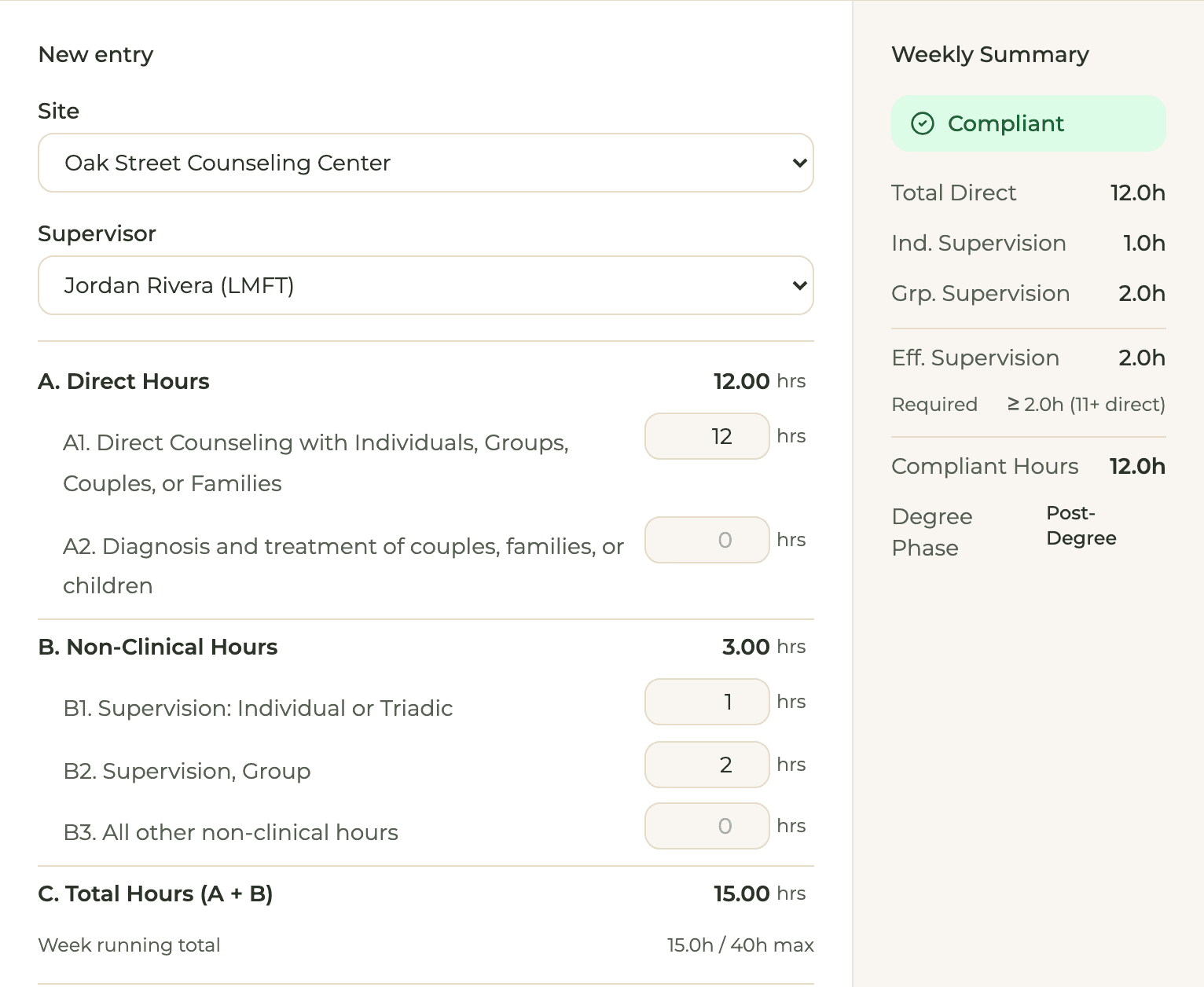
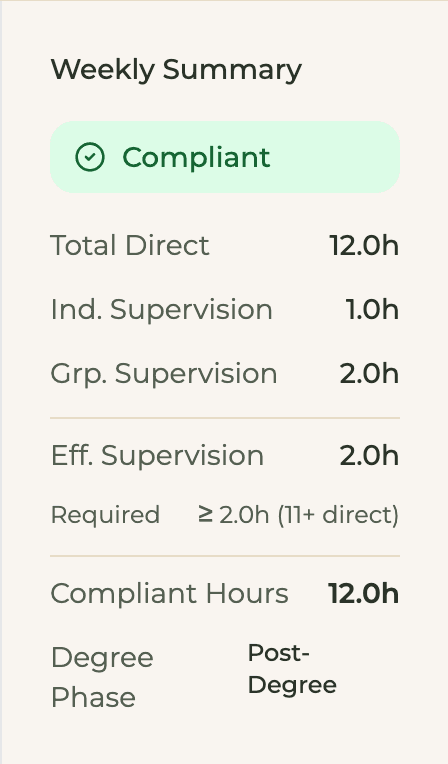
You log each week's direct hours and supervision for a site. HourJourney applies the ratio as you type and marks the week Compliant, or flags it before the shortfall costs you hours.
- Group supervision counts at half, triadic counts as individual
- Each week's compliant hours feed your totals and your BBS forms
LCSW-specific supervision rules
ASWs pursuing LCSW licensure in California have extra supervision requirements that do not apply to AMFTs or APCCs. Part of the experience must be under a Licensed Clinical Social Worker.
1,700 of 3,000 hours under an LCSW. At least 1,700 of your total 3,000 supervised experience hours must be accrued under the direct supervision of a Licensed Clinical Social Worker. The remaining 1,300 hours can be supervised by any BBS-qualified professional (LMFT, LPCC, psychologist, psychiatrist, or LEP within the 1,200-hour cap).
13 of 52 individual supervision weeks by an LCSW. Of the 52 weeks in which you must receive individual or triadic supervision, at least 13 of those weeks must be with an LCSW supervisor. That is roughly one quarter of your individual/triadic supervision weeks.
If your primary supervisor is an LMFT or LPCC, plan early to add an LCSW supervisor. The 1,700-hour and 13-week minimums can only be met under an LCSW. For a full breakdown of LCSW hour categories, see our guide to tracking LCSW hours in California.
ASWs: HourJourney tracks your hours and weeks under an LCSW supervisor against the 1,700-hour and 13-week minimums, so you know where you stand before you apply.
New supervisor training requirements
California requires licensees who supervise for the first time to complete supervision training, either before they start or within 60 days after.
15-hour initial training. First-time supervisors must complete 15 hours of supervision training or coursework, taken within two years before supervision starts (four years for master's-level coursework) or within 60 days after (16 CCR section 1821.3). Topics include competencies for new supervisors, goal setting and evaluation, the supervisor-supervisee relationship, California law and ethics, cultural and contextual variables, supervision theories, and documentation.
6-hour continuing professional development (CPD) per renewal. After the initial training, supervisors must complete 6 hours of continuing professional development in supervision during each renewal period while they supervise.
Exemptions. Licensed psychologists and physicians board-certified in psychiatry are exempt from both the initial training and the 6-hour requirement. So are supervisors with an approved supervisor certification from AAMFT, ABECSW, CAMFT or CCE.
Ask your supervisor whether they have completed the training or will finish it within 60 days of starting. The Supervision Agreement form warns that failing to meet any requirement may result in a supervisee losing hours of experience.
LEP supervisor limitations
Licensed Educational Psychologists (LEPs) can supervise associates, but their scope is narrower than that of the other qualifying license types.
1,200-hour cap. In each license track (LMFT, LPCC and LCSW), no more than 1,200 of your hours can be supervised by an LEP. Once you reach this threshold, any additional hours logged under an LEP supervisor will not count toward licensure, regardless of the quality or setting of the work.
Educationally related mental health services only. Hours under an LEP must consist of educationally related mental health services within the LEP scope of practice (Business and Professions Code section 4989.14). Other clinical work needs a supervisor with a different license type.
If you are working in a school district and your only available supervisor holds an LEP license, track your hours carefully. Once you approach 1,200 hours, you will need a supervisor with a different license type for further hours to count. The LMFT hours calculator, LCSW hours calculator, and LPCC hours calculator project your completion date. Track your LEP hours against the 1,200-hour cap yourself.
Can your supervisor work at a different agency?
Yes, with conditions. Whether a supervisor must be on site depends on the situation, and a supervisor who does not work for your employer needs extra documentation.
Written oversight agreement required. In any work setting, if your supervisor is not employed by your employer, or is a volunteer, the supervisor and your employer must sign a written oversight agreement before supervision starts. It sets out the supervisor's and the employer's responsibilities. In a private practice or professional corporation, the supervisor must also be employed by or contracted with your employer, or be an owner of the practice.
Supervisor responsibility. On site or off site, supervision means the supervisor is responsible for, and controls, the quality of the services you provide.
If your supervisor does not work for your employer, confirm that the written oversight agreement is signed before supervision starts. For the registration-deadline rule that governs when your hours start counting, see our 90-day rule guide for AMFTs. If your supervisor meets with you by video, see the telehealth and video supervision rules.
Common supervision mistakes that delay licensure
The Supervision Agreement form warns that failing to meet any requirement may result in a supervisee losing hours of experience. These are the mistakes to watch for.
- Not verifying your supervisor's license status before starting. If your supervisor's license lapsed during any period of supervision, those hours will not count. Check the Department of Consumer Affairs License Search before your first session and periodically after that.
- Failing to sign the supervision agreement within 60 days. Since January 1, 2022, the agreement is required by law, and you submit the signed original with your application for licensure.
- Miscounting supervision units in weeks with more than 10 direct hours. If you log 11 direct hours and only receive 1 unit of supervision, that week is non-compliant.
- Assuming group supervision counts toward the 52-week individual/triadic minimum. It does not. Group supervision counts toward your 104 total supervised weeks, but you must have at least 52 weeks that include individual or triadic supervision specifically.
- LCSW candidates not tracking LCSW-supervised hours separately. If you are an ASW, you need 1,700 hours and 13 individual weeks under an LCSW. If you wait, you may need to find an LCSW supervisor late to make up the difference.
- Exceeding the LEP 1,200-hour cap without realizing it. Once you reach 1,200 hours under an LEP supervisor, additional hours do not count. If you do not track the limit, you may find out only when the BBS reviews your application.
- Not documenting off-site supervision arrangements. If your supervisor is not employed by your employer, or is a volunteer, a written oversight agreement is required. Without it, the BBS may question the validity of hours logged at that setting.
- Letting supervision lapse during breaks or transitions. Any week in which you provide clinical services but do not receive supervision is a non-compliant week. If you change jobs, take vacation, or transition between supervisors, make sure there is no gap in supervision coverage for weeks when you are seeing clients.
Many of these mistakes are preventable with consistent tracking. If you are logging hours on paper or in a basic spreadsheet, it is easy for compliance gaps to go unnoticed until you submit your application. For a detailed look at what the BBS requires on your hour tracking forms, see our guide on how to track LMFT supervised hours. If you are weighing which license path to pursue, our LMFT vs LCSW comparison covers the differences.
Source: BBS AMFT and APCC FAQs (revised February 2025), ASW FAQ (revised January 2026), Supervision Agreement Form 37M-300 (revised May 2026), California Code of Regulations Title 16 section 1821.3, and Business and Professions Code sections 4980.03, 4980.43, 4996.23 and 4999.46. This guide is for informational purposes only and does not constitute legal advice. Always verify requirements directly with the California Board of Behavioral Sciences at bbs.ca.gov.
Frequently asked questions
Who can supervise an AMFT in California?
Does my supervisor need to work at the same agency as me?
What is the BBS supervision agreement and when do I need it?
How much supervision do I need each week as an AMFT?
What is the BBS supervision ratio in California?
What are the group supervision requirements for the BBS in California?
What is triadic supervision?
Can an LEP supervise my BBS hours?
What happens if my supervisor's license lapses?
How many supervisees can a supervisor have in private practice?
What is the new supervisor training requirement in California?
Related guides and tools
How Much Supervision You Need Each Week
The weekly BBS ratio and the 10-hour additional-unit trigger
Group vs Individual Supervision
How each format counts toward your BBS hours and weeks
Who Can Supervise an ASW?
License types and the 1,700-hour LCSW-supervision rule
The BBS Supervision Agreement (Form 37M-300)
Required since Jan 1, 2022. A section-by-section walkthrough
How to Become an MFT in California
The full 7-step path to LMFT licensure
LMFT 3,000 Hours Breakdown
Complete category guide
How to Track LMFT Supervised Hours
Weekly log best practices
How to Track LCSW Hours
LCSW-specific supervision rules
90-Day Rule for AMFTs
Registration deadlines explained
LMFT vs LCSW in California
Compare the two license paths
LMFT Hours Calculator
Estimate your completion date
LCSW Hours Calculator
Estimate your completion date
LPCC Hours Calculator
Estimate your completion date
Supervision compliance, handled automatically
HourJourney validates your supervision requirements in real time. It checks your ratio, flags weeks where supervision is missing, and tracks your 52-week individual minimum.