The Core Difference: How Each License Thinks About People
Both LMFTs and LCSWs are licensed to provide independent psychotherapy in California. Both can assess, evaluate and treat mental health conditions and run a private practice. The difference isn't in what you're allowed to do; it's in the theoretical tradition you train in and the clinical identity that follows.
LMFT: systemic and relational. The LMFT lens asks: how do relationships, family dynamics, and interpersonal patterns shape a person's mental health? California defines marriage and family therapy as applying "psychotherapeutic and family systems theories" (BPC 4980.02). Even when working with individuals, the LMFT clinician tends to think relationally: who else is in the room, even when they are not physically present? The work centers on couples, families, and the relational context surrounding every client.
LCSW: the person in their social context. The LCSW lens asks: how do social systems, environment, poverty, racism, and structural factors shape a person's wellbeing? The social work tradition is broader by design. Besides psychotherapy, California's definition of clinical social work includes information and referral services, arranging social services, and helping communities organize (BPC 4996.9). The LCSW clinician is trained to see the person within overlapping systems (family, community, institution, society) and to intervene at multiple levels.
Neither lens is superior. They illuminate different aspects of the same human experience. In practice, clinicians can integrate elements of both. But the starting point (the theoretical home base you train from) shapes your clinical identity in ways that persist throughout your career.
This choice is about identity, not income.
The choice between LMFT and LCSW is not primarily about salary or job availability. It's about which theoretical tradition resonates with how you already think about people and their struggles. Do you naturally see relationships and patterns? LMFT. Do you naturally see systems and structures? LCSW. The right answer depends on the kind of clinician you want to become.
Education: What Degree Do You Need?
The two licenses require different degrees, so the choice usually starts before graduate school. This is a fork in the road that matters.
LMFT degree path
A master's or doctoral degree in one of the fields listed in BPC 4980.36(b), for example marriage and family therapy, counseling psychology, or clinical psychology, with at least 60 semester or 90 quarter units.
The school must be approved by the Bureau for Private Postsecondary Education, or accredited by COAMFTE (Commission on Accreditation for Marriage and Family Therapy Education) or by an accreditor recognized by the U.S. Department of Education. The BBS makes the final determination on whether a degree qualifies, regardless of accreditation (BPC 4980.36(b)).
Curriculum centers on systemic theory, family therapy models, couples work, human development, psychopathology, and clinical practicum.
Key advantage: practicum is integrated into the program. You begin seeing clients while enrolled, building toward up to 1,300 pre-degree hours as an MFT Trainee. This head start is unique to the LMFT path.
LCSW degree path
Master of Social Work (MSW) from a school of social work accredited by the Council on Social Work Education (CSWE).
The BBS requires a master's degree from an accredited school of social work, meaning one accredited by CSWE's Commission on Accreditation (BPC 4996.2(b), 4991.2(a)).
Curriculum covers human behavior and social environment, social policy, research methods, clinical practice, and field education across diverse populations and settings.
Key difference: field placements are part of the program but do not count toward BBS hours. All 3,000 hours are post-master's supervised experience (BPC 4996.23(a)).
The pre-degree hours question is one of the biggest structural differences between these paths. LMFT candidates can count up to 1,300 hours earned during their graduate program, meaning some graduates enter the associate period with up to 1,300 of their 3,000 hours already logged. LCSW candidates start at zero post-graduation. For a deeper look at how pre-degree hours work, see our California LMFT hours requirements guide.
Scope of Practice: What Can Each License Do in California?
In California, both licenses authorize the same core clinical activities. The meaningful differences are in emphasis and training.
Assess, evaluate and treat mental health conditions
Provide individual psychotherapy
Provide couples and family therapy
Run a private practice independently
Supervise associates toward licensure
Prescribe medication
Clinical case management
LMFT
LCSW
The scope overlap is significant. For clinical therapy work (assessment, treatment and private practice), both licenses function the same way. Clinical case management is part of the LMFT scope (BPC 4980.02(b)(7)), and the LCSW scope adds information and referral services and arranging social services (BPC 4996.9). Employers set their own credential requirements for particular roles, so check the posting for any job you want.
For more detail on the LMFT scope, visit bbs.ca.gov/applicants/lmft. For LCSW, see bbs.ca.gov/applicants/lcsw.
The BBS Path: Hours, Exams, and Timeline for Each
This is where the details matter. The BBS sets specific requirements for each license type, and the internal structure of those 3,000 hours differs meaningfully. Here is a comparison drawn from the BBS FAQs and statutes.
Requirement
LMFT (AMFT)
LCSW (ASW)
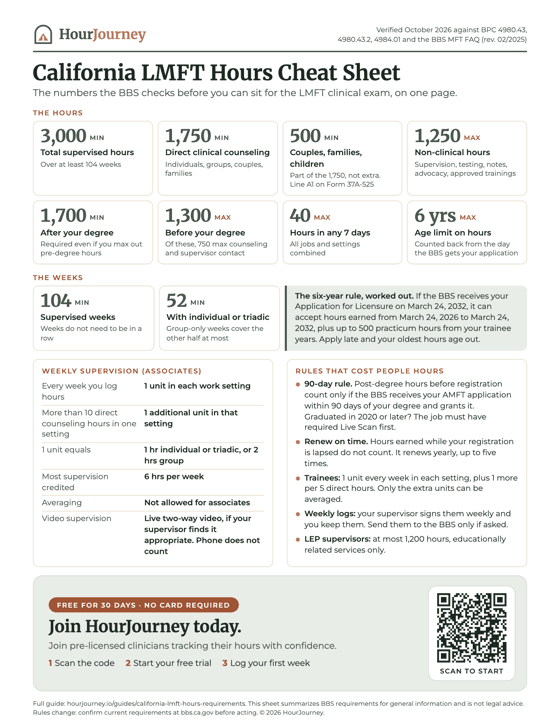
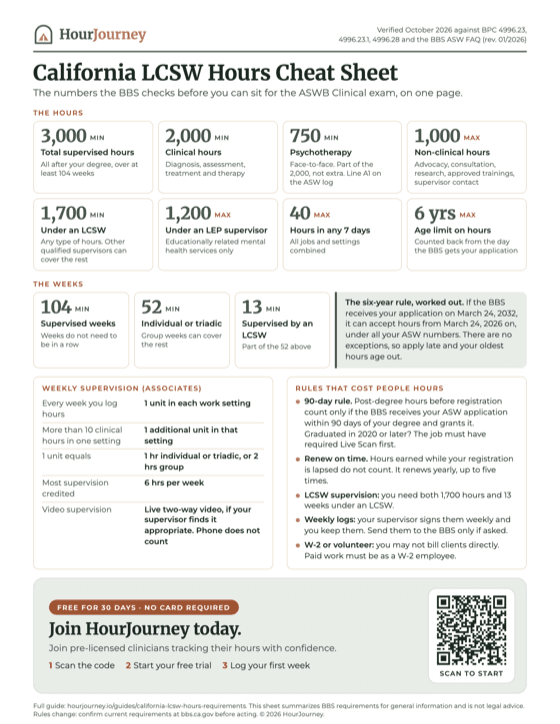
| Total hours | 3,000 | 3,000 |
| Min. weeks | 104 weeks | 104 weeks |
| Clinical minimum | 1,750 hours of direct clinical counseling | 2,000 hours of clinical psychosocial diagnosis, assessment, and treatment |
| Specialty direct | 500 hrs CFC (Couples, Families, Children) | 750 hrs face-to-face psychotherapy |
| LCSW supervisor | Not required (any qualified supervisor) | 1,700 hrs and 13 weeks must be under LCSW supervision |
| Non-clinical max | 1,250 hours | 1,000 hours |
| Pre-degree hours | Up to 1,300 as MFT Trainee | None allowed |
| Post-degree hrs | 1,700 minimum | 3,000 (all must be post-degree) |
| Supervision ratio | 1 unit a week in each setting, plus 1 more unit when you do more than 10 hours of direct clinical counseling there that week (1 unit = 1 hr individual or triadic, or 2 hrs group) | Same unit rule, with the extra unit triggered by more than 10 hours of clinical psychosocial diagnosis, assessment, and treatment |
| Indiv./triadic weeks | 52 weeks minimum of individual or triadic supervision | 52 weeks minimum of individual or triadic supervision |
| Weekly cap | 40 hours credited in any seven consecutive days | 40 hours credited in any seven consecutive days |
| Weekly log form | BBS Form 37A-525 | ASW Weekly Log of Experience Hours |
| Exam: Law & Ethics | Required (LMFT version) | Required (LCSW version) |
| Exam: Clinical | LMFT Clinical Exam (developed by DCA OPES, delivered by Pearson VUE) | ASWB Clinical Examination (16 CCR 1877.1(b)) |
| 90-day rule | Applies if the BBS receives your registration application within 90 days of your degree award, the workplace required Live Scan first (2020+ graduates), and the BBS grants the registration | Same conditions |
The most impactful differences in this table: LCSWs need 2,000 clinical hours where LMFTs need 1,750 hours of direct clinical counseling, LCSWs cannot count any pre-degree hours, and they must have 1,700 of their hours supervised by a licensed LCSW specifically. LMFTs have more flexibility in supervisor type and can enter the associate period with up to 1,300 hours already banked from their training.
For the complete LMFT hour breakdown, see our California LMFT hours requirements guide. For LCSW-specific tracking details, see how to track LCSW hours in California. Both paths are subject to the 90-day rule for post-degree hours gained before your registration number is issued.
Salary: What Does Each License Pay in California?
California pay from the U.S. Bureau of Labor Statistics, Occupational Employment and Wage Statistics (OEWS), May 2025. BLS reports occupations, not licenses: its counts include everyone working in each job, licensed or not, and there is no separate LCSW figure. The two social worker occupations below are the closest match for clinical social work.
| Occupation (SOC code) | Median annual wage | Mean annual wage |
|---|---|---|
| Marriage and Family Therapists (21-1013) | $67,300 | $79,440 |
| Mental Health and Substance Abuse Social Workers (21-1023) | $79,000 | $91,050 |
| Healthcare Social Workers (21-1022) | $89,660 | $93,840 |
Source: U.S. Bureau of Labor Statistics, OEWS, California, May 2025 (state 06, all industries). bls.gov/oes. Pay varies by setting, region and experience.
Private Practice: Which License Has the Advantage?
Neither. Once fully licensed, both LMFTs and LCSWs can practice independently in California, including opening their own practice and setting their own fees.
During the associate period, both AMFTs and ASWs work under supervision and cannot practice independently. For ASWs, only a first registration may be used in a private practice or professional corporation (BPC 4996.28(c)).
Which License Is Right for You? A Self-Assessment
Choose LMFT if you...
tends to be a strong fit if you...
Are drawn to couples and family therapy as a primary modality
Think in terms of relational patterns, attachment styles, and family systems
Want to build a private practice focused on relationships and individuals in relational context
Value the pre-degree hours advantage (up to 1,300 hours during grad school)
Find systemic theory more compelling than social policy frameworks
See yourself working primarily in outpatient, private practice, or community mental health settings
Choose LCSW if you...
tends to be a strong fit if you...
Are interested in serving diverse populations across a wide range of settings
Want to work in hospitals, government agencies, child welfare, or corrections
Think in terms of social systems, structural inequality, and community-level impact
Are drawn to combining clinical work with case management, advocacy, or policy
Consider dual licensure if you...
Want maximum flexibility across clinical, institutional, and private practice settings
Are willing to invest in two separate degree programs and two separate sets of supervised hours
See yourself moving between therapy-focused and systems-focused roles throughout your career
If You Choose LMFT: What Comes Next
You have decided on the LMFT path. Here is what the road ahead looks like:
Complete a qualifying master's or doctoral degree (BPC 4980.36(b), at least 60 semester or 90 quarter units). Log up to 1,300 pre-degree hours as an MFT Trainee during your program.
Apply for Associate Marriage and Family Therapist (AMFT) registration so the BBS receives your application within 90 days of your degree being awarded.
Accrue 3,000 total supervised hours over at least 104 weeks: at least 1,750 hours of direct clinical counseling, including 500 hours with couples, families and children, and no more than 1,250 non-clinical hours.
Track your hours weekly on BBS Form 37A-525. Log each week's hours by category (A: direct, B: non-clinical, C: total) and have your supervisor sign. You keep the logs.
Pass the LMFT California Law and Ethics Exam and the LMFT Clinical Exam.
Apply for your full LMFT license.
For a complete walkthrough of the hour structure, see our guide to tracking LMFT supervised hours and our BBS Form 37A-525 walkthrough. Use the LMFT hours calculator to estimate your timeline.
HourJourney is built for AMFTs.
Weekly logging by category, a weekly supervision ratio check, dashboard bars for your caps, and the weekly log as a PDF with signatures left blank. Start tracking from day one.
Start free trial →30-day free trial
If You Choose LCSW: What Comes Next
You have decided on the LCSW path. Here is what the road ahead looks like:
Complete a Master of Social Work (MSW) from a CSWE-accredited school. Field placements are part of the program but do not count toward BBS hours.
Apply for Associate Clinical Social Worker (ASW) registration so the BBS receives your application within 90 days of your degree being awarded.
Accrue 3,000 supervised post-degree hours over at least 104 weeks: at least 2,000 hours of clinical psychosocial diagnosis, assessment, and treatment, including 750 hours of face-to-face psychotherapy. At least 1,700 hours and 13 weeks must be supervised by a licensed LCSW.
Track your hours weekly on the ASW Weekly Log of Experience Hours. Your supervisor signs it, and you keep it.
Pass the LCSW California Law and Ethics Exam and the ASWB Clinical Examination.
Apply for your full LCSW license.
For LCSW-specific tracking guidance, see our guide to tracking LCSW hours in California. Use the LCSW hours calculator to estimate your timeline.
HourJourney is built for ASWs too.
Weekly logging by category, a dashboard bar for your 2,000 clinical and 750 psychotherapy hours, LCSW-supervised hours and weeks, and the ASW Weekly Log and LCSW experience verification as PDFs with signatures left blank.
Start free trial →30-day free trial
FAQ: LMFT vs LCSW California
What is the difference between LMFT and LCSW in California?+
Both licenses authorize independent clinical practice, including assessing, evaluating and treating mental health conditions and running a private practice. The core difference is the professional tradition: California defines marriage and family therapy as applying psychotherapeutic and family systems theories (BPC 4980.02), while clinical social work also includes information and referral services, arranging social services, and helping communities organize (BPC 4996.9). Degree paths differ (marriage and family therapy or a related field vs. an MSW), and some hour requirements vary, but total hours (3,000) and minimum weeks (104) are identical.
Which pays more, LMFT or LCSW in California?+
In California, the BLS May 2025 median annual wage was $67,300 for marriage and family therapists and $79,000 for mental health and substance abuse social workers ($89,660 for healthcare social workers). BLS counts occupations, not licenses, so these include unlicensed workers and there is no separate LCSW figure. Pay varies by setting, region and experience.
Is it harder to get an LMFT or LCSW in California?+
The two paths differ more than one is harder. Both require 3,000 hours over at least 104 weeks. LCSWs need 2,000 hours of clinical psychosocial diagnosis, assessment, and treatment (LMFTs need 1,750 hours of direct clinical counseling) and cannot count pre-degree hours. LMFTs take the LMFT Clinical Exam, and LCSWs take the ASWB Clinical Examination.
Can both LMFTs and LCSWs have private practices in California?+
Yes. Once fully licensed, both can practice independently, including opening a practice and setting fees. During the associate period, both work under supervision. For ASWs, only a first registration may be used in a private practice or professional corporation (BPC 4996.28(c)).
Which license is better for couples therapy?+
Both licenses can provide couples and family therapy. The LMFT hour rules include a 500-hour minimum of diagnosing and treating couples, families and children; the LCSW rules have no such minimum.
What exams do I need for LMFT vs LCSW in California?+
Both require a California Law and Ethics Exam, and each license has its own version. LMFTs then take the LMFT Clinical Exam, developed by the Department of Consumer Affairs' Office of Professional Examination Services and delivered by Pearson VUE. LCSWs take the ASWB Clinical Examination, administered by the Association of Social Work Boards (16 CCR 1877.1(b)).
Do pre-degree hours count for LMFT or LCSW?+
For LMFT, yes: up to 1,300 hours earned during your graduate program as an MFT Trainee count toward the 3,000-hour total. For LCSW, no: all 3,000 hours must be earned post-degree as a registered ASW. This is one of the most significant structural differences between the two paths.
What BBS forms do LMFT and LCSW use to track hours?+
AMFTs use BBS Form 37A-525, the Weekly Log of Experience Hours. ASWs use the ASW Weekly Log of Experience Hours. Both document weekly hours by category and are signed by the supervisor; you keep them and send them to the BBS only on request. HourJourney generates the weekly log for your license as a PDF with signatures left blank.
Can I get both an LMFT and LCSW license in California?+
Yes, but each license has its own degree and hour requirements, so you would meet each set separately. A more common route is dual AMFT and APCC registration, where some hours can count toward both LMFT and LPCC if you register as both and meet the BBS conditions.
Requirements reflect BBS guidance current as of 2025-2026. Always verify at bbs.ca.gov. This guide is for informational purposes only and does not constitute legal or professional advice.
Licensing in Texas instead? Our guide to Texas LPC Associate hours requirements covers the BHEC version of this math: 3,000 hours, a 1,500-hour direct minimum, and an 18-month floor counted in calendar months rather than supervised weeks.
Related guides
California LMFT Hours Requirements: The Complete 2026 Guide
Every hour minimum, maximum, and deadline in plain English.
How to Track LCSW Hours in California
The ASW hour structure, LCSW supervisor requirements, and the ASW Weekly Log of Experience Hours.
How to Become an LCSW in California: Step-by-Step
The full ASW-to-LCSW path: registration, hours, exams, and timeline.
LPCC vs LCSW in California: Which Path Is Right for You?
How the counseling and social work clinical licenses compare.
How to Track Your LMFT Supervised Hours in California
The BBS A/B/C structure explained step by step.
BBS Form 37A-525: How to Fill It Out Without Losing Hours
A step-by-step walkthrough of the weekly supervision log.
The 90-Day Rule for AMFTs in California
What counts, what doesn't, and how to protect your hours.
All Guides
Browse every HourJourney guide for California pre-licensed clinicians.