What Is ASW Registration?
An Associate Clinical Social Worker (ASW) registration is the California Board of Behavioral Sciences (BBS) credential that lets recent Master of Social Work graduates begin earning supervised post-degree experience toward an LCSW license. You cannot accrue post-degree supervised experience in California without registering as an ASW — the only exception is the 90-day rule, described later in this guide.
An ASW registration is not a license. It is a fixed window during which you complete your supervised hours, satisfy California’s exam requirements, and apply for full LCSW licensure. The registration is valid for a six-year period — that period covers five renewals. To keep earning hours after six years, you can apply for a subsequent ASW registration before the first one is cancelled, and certain workplace restrictions then apply. For exactly how that six-year limit is counted and what the subsequent-registration restrictions involve, see our guide to the BBS six-year rule for associates.
For the path from an ASW registration all the way to the LCSW license, see our guide to going from ASW to LCSW in California.
Confirm Your Eligibility
Before you submit your ASW application, confirm three things:
- 1.Your degree has been conferred. You need a Master’s degree in Social Work from an accredited school of social work (CSWE-accredited). Walking at graduation is not enough — the degree must be officially awarded, and your transcript will show the conferral date. The 90-day window starts on that exact date.
- 2.You have completed California law and professional ethics coursework. BPC 4996.18(b)(3) requires it for registration. The separate Additional Coursework list (suicide risk assessment, telehealth, child abuse and others) is due before your Application for Licensure, not before registration. Check the ASW registration application instructions for what to enclose.
- 3.Your transcripts are in order. Follow the transcript instructions in the ASW registration application packet on bbs.ca.gov. The 90-day window is based on your degree award date.
Read the Application Instructions first
The single most useful thing you can do before applying is read the “Application Instructions” section inside the ASW Registration Application packet on bbs.ca.gov. It lists what to enclose and the exact submission steps. Everything in this guide is a summary; that packet is the authority.
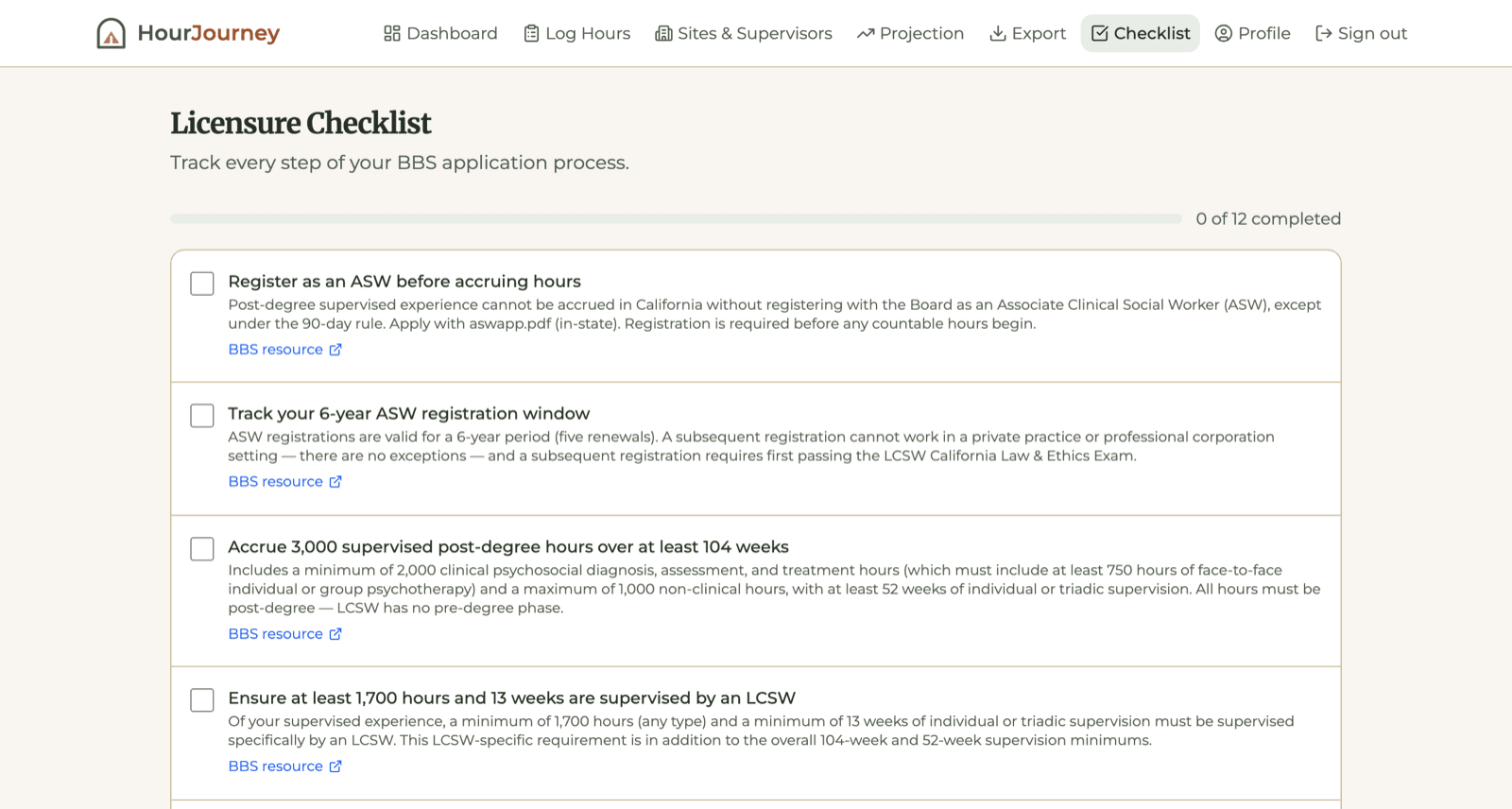
HourJourney keeps your ASW-to-LCSW checklist for you
Every step from registration to licensure in one list, from registering as an ASW to the 1,700 hours under an LCSW. Check items off as you go.
Choose and Complete the Right Application
The BBS uses three different ASW registration forms. Pick the one that matches your situation:
- ✓aswapp.pdf: the in-state ASW registration application.
- ✓aswapp_oos.pdf: the out-of-state ASW registration application. The application instructions say which of the two applies to your degree.
- ✓aswapp_2reg.pdf — subsequent registration application, for someone who previously held an ASW registration and is applying for a subsequent number before the six-year registration is cancelled (applications are accepted up to 90 days early).
The application packet lists what to enclose. A criminal background check is part of the process, and the Board can deny registration under BPC 480.
Answer every question on the application completely and accurately. A criminal background check is part of the process. Fees beyond the $49 Live Scan processing fee are subject to change, so check bbs.ca.gov for current fee amounts.
Complete Live Scan Fingerprinting
If you live in California, you complete an electronic Live Scan: the provider scans your fingerprints and forwards the results to the Department of Justice and the FBI, which report back to the BBS. Download the Live Scan request form from the BBS site (it lives at /pdf/forms/livescan.pdf) and take it to a Live Scan site listed in the California Attorney General's directory. Sites may charge their own rolling fee.
If you live outside California, you cannot use Live Scan. Instead you submit hard fingerprint cards, mailed to the BBS at 1625 N. Market Blvd., Suite S-200, Sacramento, CA 95834. Hard-card processing takes roughly six to eight weeks, so build that into your timeline — especially if you are trying to hit the 90-day window.
The BBS lists a $49 processing fee. Live Scan sites may charge an additional rolling fee on top of that, and the amount varies by location. The Board recommends completing your Live Scan no more than 30 days before you submit your application, and Live Scan results expire after six months if no application is filed — so do not get fingerprinted months in advance.
For a fuller walkthrough of fingerprinting (how Live Scan and the background check work, what the fees cover, and how out-of-state hard cards are handled), see our guide to BBS Live Scan and the background check.
A second Live Scan can matter for 90-day hours
If you graduated on or after January 1, 2020 and want hours before your number issues to count, your workplace must have required Live Scan before you started. That is separate from your own BBS Live Scan.
The 90-Day Rule
If the BBS receives your completed ASW registration application within 90 days of your degree award date, and the Board then issues your registration, post-degree hours gained before issuance can count if they meet all other requirements. If it arrives later, those hours do not count (BPC 4996.23(b)).
There is an important limit on gap-period hours: during the window before your ASW number is issued, you can earn hours in any setting that is not a private practice or a professional corporation (BPC 4996.14.2(b)(2)), provided you meet the 90-day rule. If you graduated on or after January 1, 2020, those hours count only if your workplace required completed Live Scan before you began, and you submit the processed Request for Live Scan Service form with your licensure application. You cannot work in a private practice or professional corporation during the gap.
For how the 90-day window works and what happens if you miss it, read our complete guide to the BBS 90-day rule.
Apply as soon as your degree is awarded. The BBS must receive your application within 90 days of your degree award date.
The California Law and Ethics Exam
You do not need to pass an exam before your first ASW registration is issued. But the California Law and Ethics Exam, administered by Pearson Vue, has two ongoing roles for ASWs: it must be taken annually to renew your ASW registration until you pass it, and it must be passed before the BBS will issue a subsequent ASW registration. Plan to schedule it early in your associateship.
Separately, effective January 1, 2023, all registered Associates — including ASWs — must complete 3 hours of California Law and Ethics continuing education during each renewal period, before renewing, regardless of whether you have already passed the Law and Ethics Exam.
For current passing scores, exam content, scheduling, and fees, see the BBS Law and Ethics Exam Candidate Handbook (Pearson Vue) and bbs.ca.gov. Exam details change — always confirm with the BBS.
After You Submit
While your ASW application is being processed, hours can count only in a setting that is not a private practice or a professional corporation (BPC 4996.14.2(b)(2)), only if the BBS received your application within the 90-day window, and, for 2020 and later graduates, only if your workplace required completed Live Scan before you began. You cannot work in a private practice or professional corporation until your ASW number is issued. For what actually drives the wait, see our guide on how long the BBS takes to issue your ASW number.
When the BBS approves your registration, it issues an ASW registration number and an issue date. Hours count from your registration issue date, or from your degree award date if the 90-day rule applies. You need 3,000 supervised hours over at least 104 weeks toward LCSW licensure, and no pre-degree hours are allowed for the LCSW. The full hour categories and caps are covered in our guide to tracking LCSW hours in California.
You will also need an approved supervisor. See our guides on who can supervise an ASW in California and the broader BBS supervision requirements. And if you want to estimate your finish date, try the LCSW hours calculator.
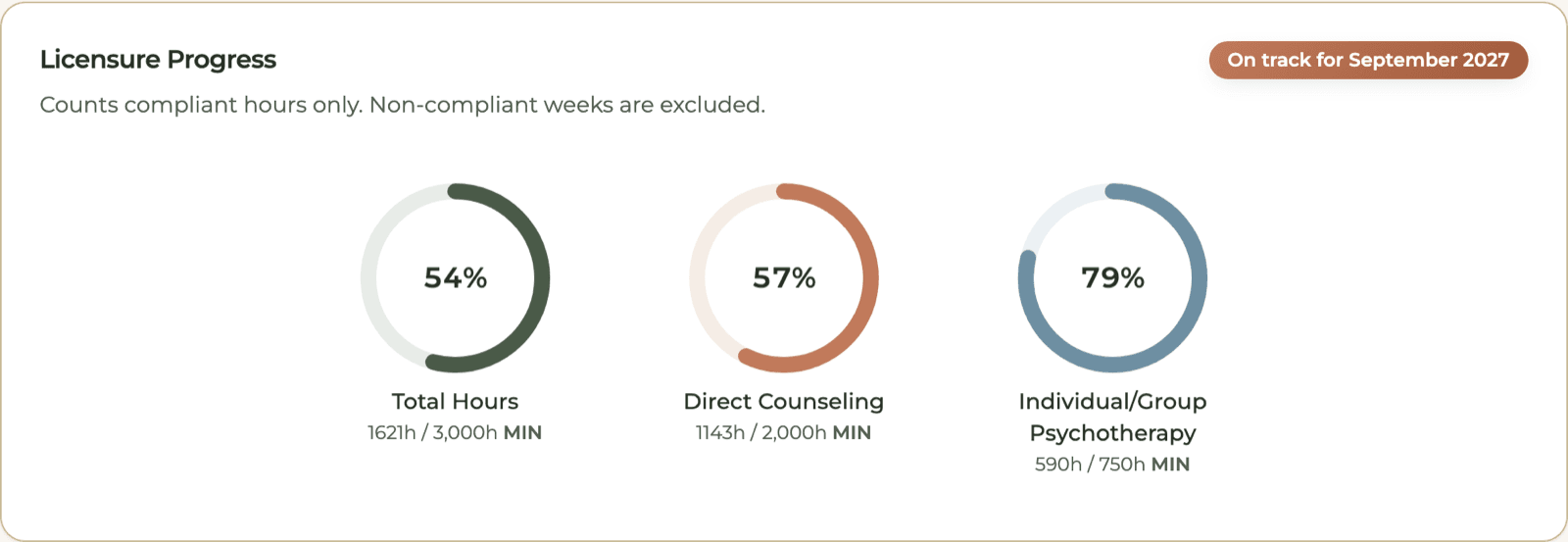
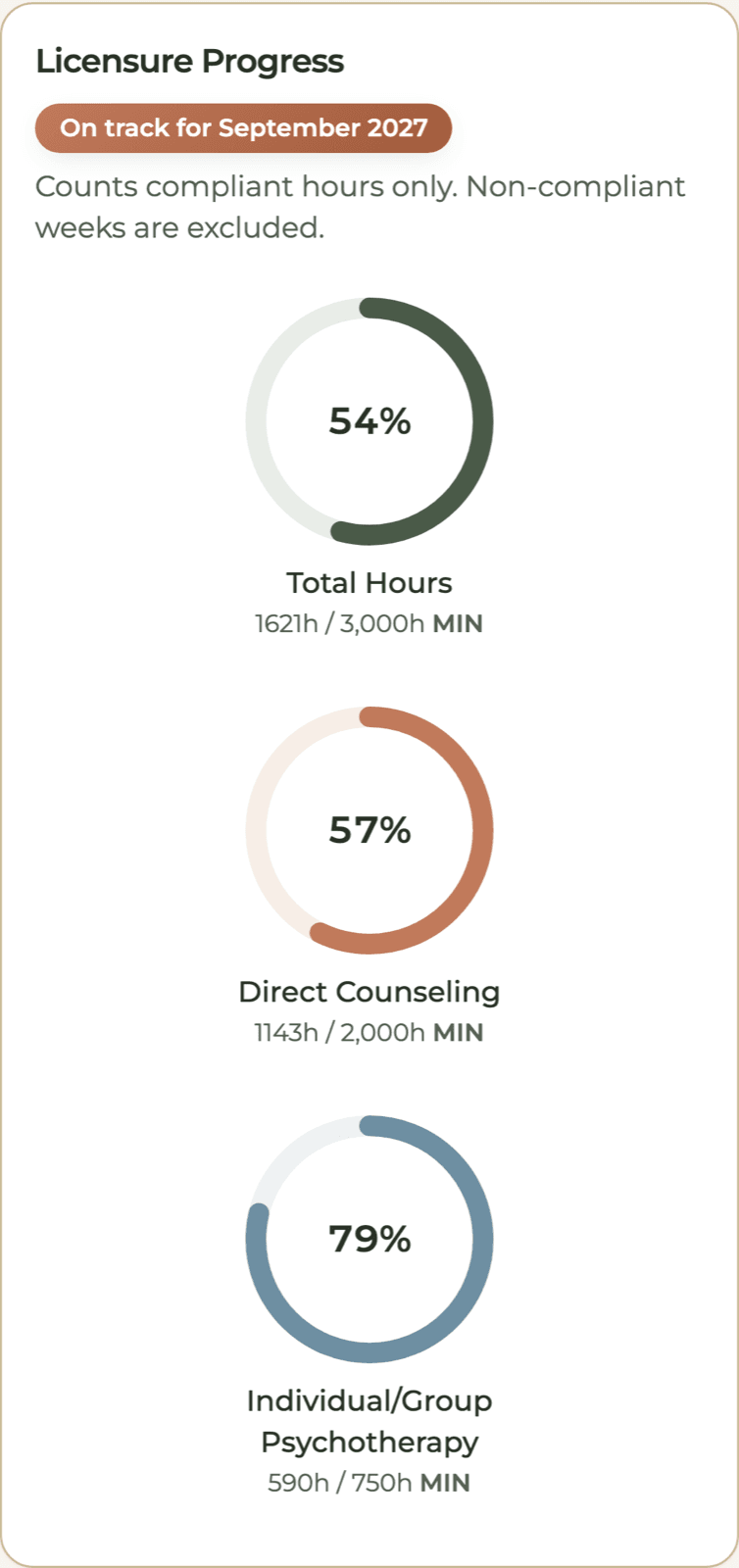
HourJourney counts your 3,000 hours and 104 weeks once your number issues
Log your hours each week. The dashboard shows your progress toward the 3,000 total, the clinical hours, and the 750 psychotherapy hours.
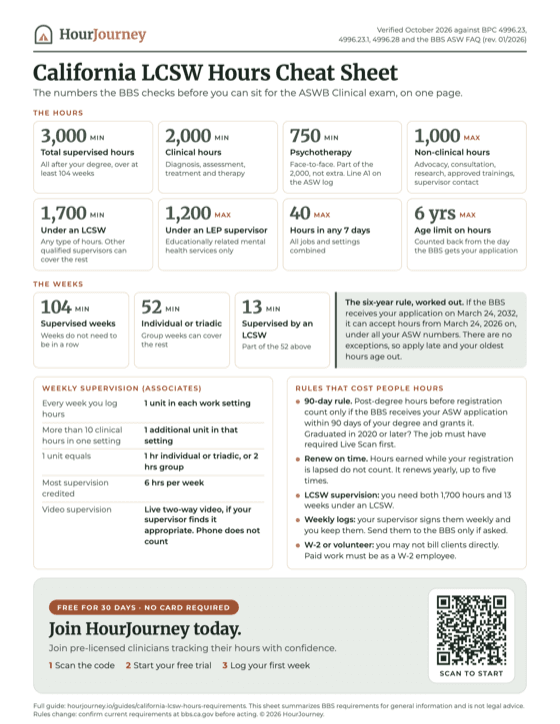
Don’t lose hours to a tracking mistake.
HourJourney checks each week's supervision against the BBS requirement and marks it Compliant or Non-Compliant. It blocks a week over 40 hours and shows your progress toward the 3,000-hour and 104-week totals. It exports the ASW Weekly Log and the LCSW Experience Verification as PDFs. 30-day free trial, no card required.
Start counting your hours freeFrequently Asked Questions
What is an ASW registration in California?
ASW stands for Associate Clinical Social Worker. It is the registration the California Board of Behavioral Sciences issues to graduates of an accredited Master of Social Work program so they can begin earning supervised post-degree experience toward an LCSW license. With one narrow exception — the 90-day rule — you cannot accrue countable post-degree hours in California without registering as an ASW first. The ASW registration is valid for a six-year period with five renewals.
Which ASW application form do I use?
Use aswapp.pdf for the in-state application and aswapp_oos.pdf for the out-of-state application; the application instructions say which applies to your degree. If you previously held an ASW registration and are applying for a subsequent number before the first one is cancelled (applications are accepted up to 90 days early), use the subsequent registration form, aswapp_2reg.pdf. All forms and their detailed Application Instructions are on bbs.ca.gov.
How does the 90-day rule work for ASWs?
If the BBS receives your completed application within 90 days of your degree award date, and the Board then issues your registration, post-degree hours gained before issuance can count if they meet all other requirements. During that gap you can earn hours in any setting that is not a private practice or a professional corporation (BPC 4996.14.2(b)(2)). If you graduated on or after January 1, 2020, those hours count only if your workplace required completed Live Scan before you began, and you submit the processed Request for Live Scan Service form with your licensure application. If the application arrives later, those hours do not count.
Do I need Live Scan fingerprinting to register as an ASW?
Yes. California residents must complete an electronic Live Scan; results go to the Department of Justice and FBI. Applicants living outside California submit hard fingerprint cards mailed to the BBS at 1625 N. Market Blvd., Suite S-200, Sacramento, CA 95834, which take roughly six to eight weeks to process. The BBS lists a $49 processing fee; Live Scan sites may add a rolling fee that varies by location. The Board recommends completing Live Scan no more than 30 days before submitting your application, and Live Scan results expire after six months if no application is filed.
Do I have to pass an exam before registering as an ASW?
Not before your first ASW registration. But the California Law and Ethics Exam, administered by Pearson Vue, must be taken every year to renew your ASW registration until you pass it, and it must be passed before the BBS will issue a subsequent ASW registration. For current passing scores, exam content, scheduling, and fees, see the BBS Law and Ethics Exam Candidate Handbook (Pearson Vue) and bbs.ca.gov. Exam details change — always confirm with the BBS.
How long is an ASW registration valid, and what happens after six years?
An ASW registration is valid for a six-year period, which covers five renewals. To keep earning hours after six years, you can apply for a subsequent ASW registration, applying before the first one is cancelled (up to 90 days early). You must have passed the LCSW California Law and Ethics Exam before it can be issued. Subsequent-registration holders cannot work in a private practice or professional corporation setting, with no exceptions.
Can I work between graduation and getting my ASW number?
Yes, in any setting that is not a private practice or a professional corporation (BPC 4996.14.2(b)(2)), and those hours count only if the BBS received your ASW application within 90 days of your degree award date and then grants the registration. If you graduated on or after January 1, 2020, those hours count only if your workplace required completed Live Scan before you began, and you submit the processed Request for Live Scan Service form with your licensure application. You cannot work in a private practice or professional corporation until your ASW number is issued.
What continuing education do ASWs need?
Effective January 1, 2023, all registered Associates — including ASWs — must complete 3 hours of California Law and Ethics continuing education during each renewal period, before renewing, regardless of whether you have already passed the Law and Ethics Exam. This is separate from the requirement to take the Law and Ethics Exam annually until you pass it.
Related Guides
From ASW to LCSW in California
The full path from your ASW registration to the LCSW license: hours, exams, and the licensure application.
How Long Does the BBS Take to Issue Your ASW Number?
What drives the wait after you apply, and how to use the time productively before your number lands.
You Got Your ASW Number: First-Week Checklist
The moment your number arrives: the 6 things to set up in week one so every hour counts toward LCSW.
ASW Renewal in California: CE Requirements
What you owe the BBS every renewal period once your number is issued, including the law and ethics CE.
The BBS 90-Day Rule for AMFTs, APCCs, and ASWs
Exactly how the deadline works, the Live Scan requirements, and what happens if you miss the window.
How to Track LCSW Hours in California
The 3,000-hour requirement, the 104-week minimum, category caps, and how to log it all.
Who Can Supervise an ASW in California
Which license types can supervise an ASW, and the 1,700-hour and 13-week LCSW supervision rule.
BBS Supervision Requirements: California Associates
Weekly supervision ratios, who qualifies as a supervisor, and how the rules apply across license types.
This guide is for informational purposes only. Always verify requirements directly with the BBS at bbs.ca.gov. Application fees, processing times, and procedures may change.