LPCC Hour Tracking · California 2026
How to Track LPCC Supervised Hours in California: A Step-by-Step BBS Guide
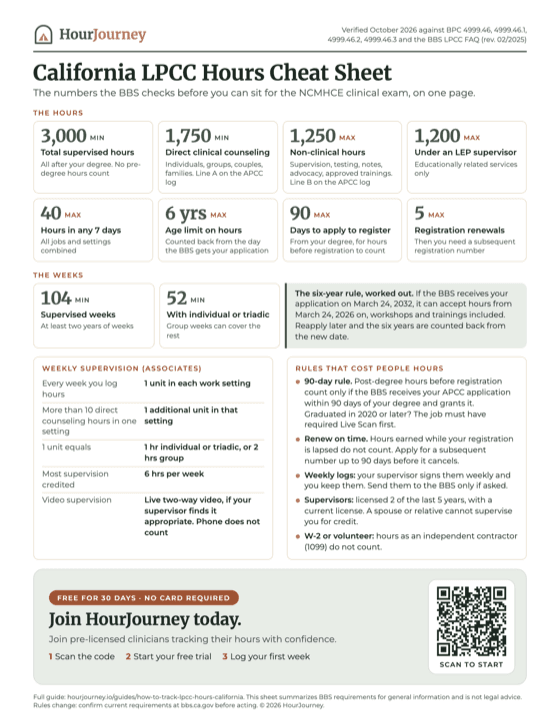
California requires 3,000 supervised hours for LPCC licensure, all earned after your degree is awarded, mostly as a registered Associate Professional Clinical Counselor (APCC). With no specialty sub-minimum, the LPCC path is structurally different from both LMFT and LCSW. This guide walks you through every category, cap, form, and rule you need to track accurately, sourced from the BBS APCC FAQ revised February 2025 and the LPCC licensing statutes.
Last Updated: June 2026
Quick Reference: LPCC Hour Requirements
Total Hours
3,000
Supervised Weeks
104
Direct Clinical
1,750 min
Specialty Subset
None
Non-Clinical Cap
1,250
Pre-Degree
None
Weekly Cap
40 hrs / 7 days
Form
37A-638
Couples/family therapy is within scope — no extra coursework since Jan 1, 2022 (AB 462)
How LPCC Hours Differ from LMFT and LCSW
The LPCC licensure path shares its 3,000-hour total with LMFT, but the internal structure diverges in important ways. Understanding these differences is essential if you are comparing license tracks or considering dual licensure.
No pre-degree hours. Like LCSW but unlike LMFT, LPCC does not allow any pre-degree hours. Every one of your 3,000 hours must be earned after your master's degree is awarded. Most are earned as a registered APCC; the 90-day rule lets some hours earned before registration count. LMFT, by contrast, allows up to 1,300 pre-degree trainee hours. This means APCCs typically start their post-graduation clock with zero hours, while AMFTs may already have hundreds logged from practicum and fieldwork during their program.
No specialty subset. LMFT requires 500 hours of couples-family-child (CFC) counseling within the 1,750 direct clinical hours. LCSW requires 750 hours of psychotherapy within 3,000 total. LPCC has no specialty sub-minimum at all. Your 1,750 direct clinical hours can be any combination of individual, group, couples, or family counseling without a mandated distribution. This makes LPCC tracking simpler than the LMFT or LCSW paths.
Same 1,750 direct clinical minimum as LMFT. Despite the structural differences, both LPCC and LMFT require at least 1,750 direct clinical hours. The LCSW path requires more: 2,000 direct clinical hours out of 3,000 total. The non-clinical cap for LPCC is 1,250 (matching LMFT), while LCSW caps non-clinical at 1,000.
Couples and family therapy is now within the standard LPCC scope. Until January 1, 2022, a standard LPCC license did not authorize you to assess or treat couples or families without additional coursework and 500 supervised hours. AB 462 (Stats. 2021, Ch. 440) removed that requirement effective January 1, 2022, so LPCCs can now assess and treat couples and families without extra coursework or extra hours (BBS AB 462 FAQ).
| Requirement | LPCC | LMFT | LCSW |
|---|---|---|---|
| Total hours | 3,000 | 3,000 | 3,000 |
| Direct clinical minimum | 1,750 | 1,750 | 2,000 |
| Specialty sub-minimum | None | 500 CFC | 750 psychotherapy |
| Non-clinical cap | 1,250 | 1,250 | 1,000 |
| Pre-degree hours | None | Up to 1,300 | None |
| Couples/family scope | Core license | Core license | Families |
| Clinical exam | NCMHCE | CA Clinical | ASWB Clinical |
For deeper comparisons, see our LMFT vs. LPCC and LMFT vs. LCSW guides.
What You Need to Track Every Week
Consistent weekly tracking is the foundation of a clean BBS submission. Every week you work, you need to record the following data points for each work setting:
- Direct clinical hours: Counseling with individuals, groups, couples, or families using psychotherapeutic techniques and recognized counseling interventions. These count toward your 1,750 minimum.
- Non-clinical hours: Direct supervisor contact, administering and evaluating psychological tests, writing clinical reports and progress or process notes, client-centered advocacy, and supervisor-approved workshops, seminars, trainings, or conferences. Capped at 1,250 total.
- Supervision units received: Individual or triadic supervision (counted as 1 unit per hour) and group supervision (counted as 0.5 units per hour). You need at least 1 unit per week per work setting, with an additional unit triggered if you log more than 10 direct clinical hours in a week at any setting.
- Work setting: The site where hours were earned. Community mental health centers, private practices, schools, hospitals, and other work settings each need their own tracking column.
- Supervisor: The licensed professional supervising your work at that setting.
Keep a Form 37A-638 for each supervisor in each work setting. If you work at two community agencies under different supervisors, you keep two separate weekly logs. If a second supervisor at the same setting gives you some of your supervision, the BBS recommends recording all of your hours under your primary supervisor; only the supervision hours the second supervisor gave go on separate logs that supervisor signs (BBS APCC FAQ, Q39).
For the full supervision ratio rules, including weekly caps and the two-tier system, see our BBS Supervision Requirements guide.
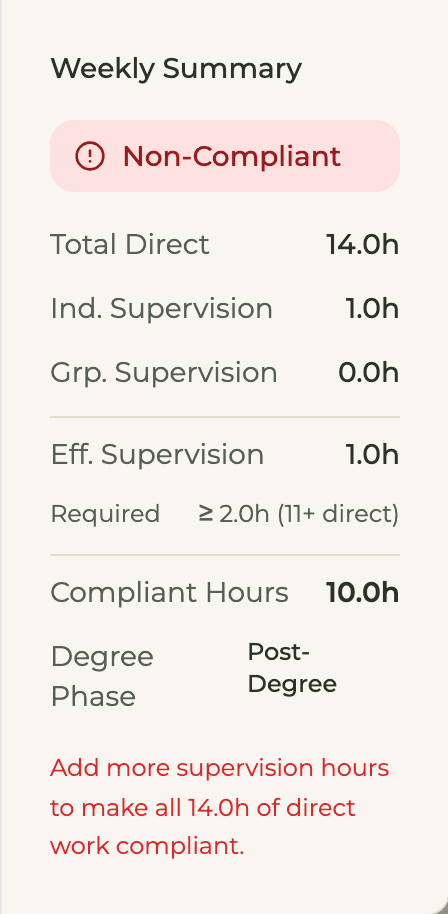
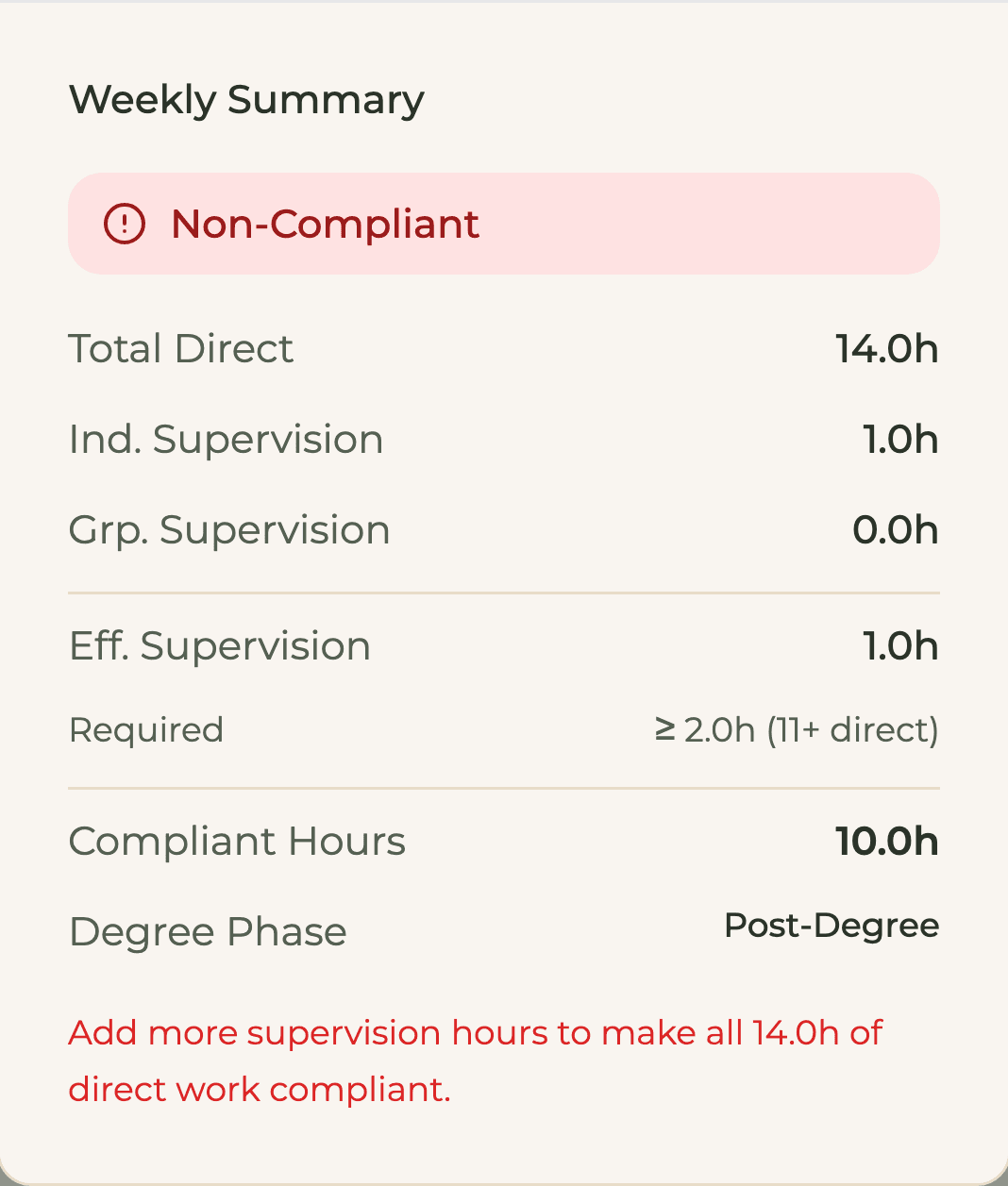
HourJourney checks your weekly supervision for you
Enter your direct hours and supervision. The week shows Compliant or Non-Compliant right away, how many hours count, and what to add.
The 1,750-Hour Direct Clinical Requirement
At least 1,750 of your 3,000 hours must be direct clinical counseling: counseling with individuals, groups, couples, or families using a variety of psychotherapeutic techniques and recognized counseling interventions (BPC 4999.46(c)(3)). Telehealth hours count, with no limit (BBS APCC FAQ).
No mandatory subset. Unlike LMFT, which requires 500 of the 1,750 direct hours to be specifically in couples, family, and child therapy, LPCC has no specialty carve-out within the direct clinical bucket. Your 1,750 can be entirely individual counseling, entirely group work, or any mix. This makes tracking simpler because you do not need to monitor progress toward a subset goal. You are tracking one number: total direct clinical hours toward 1,750.
Note that couples and family work counts as direct clinical counseling like any other modality. Since AB 462 took effect on January 1, 2022, you no longer need to track those hours separately for any special authorization — they simply roll into your total direct clinical hours.
For a detailed breakdown of LMFT's 3,000-hour structure including the 500-hour CFC requirement, see our LMFT Hours Requirements guide.
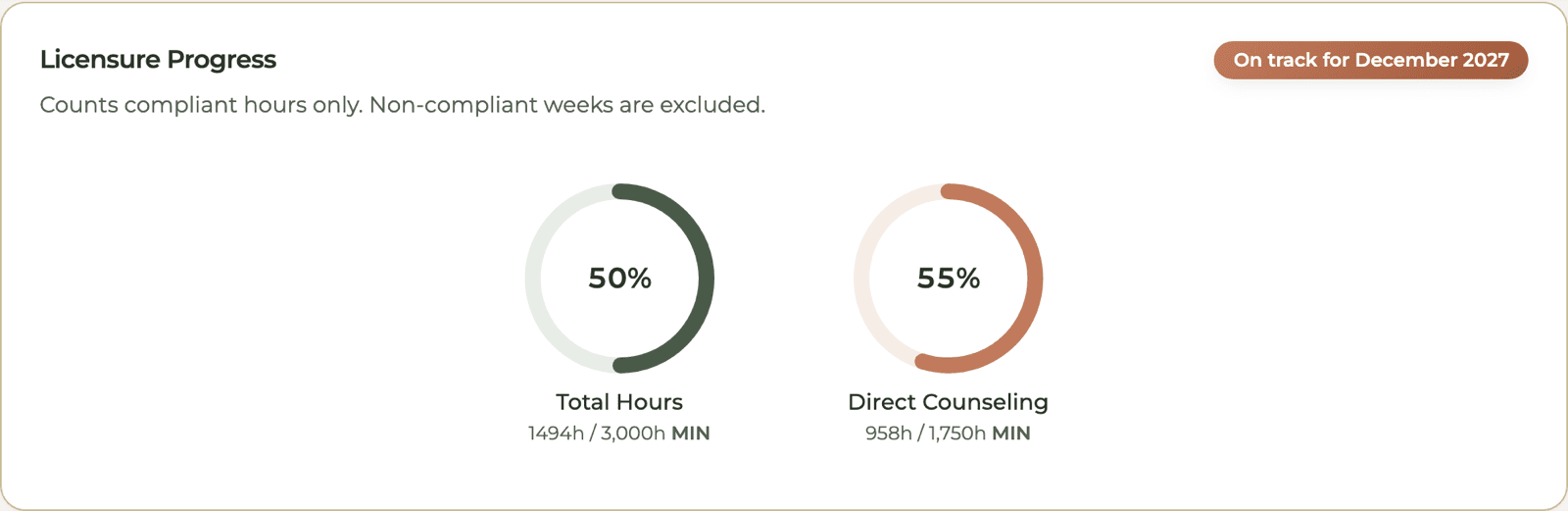
HourJourney tracks your 1,750 direct hours
Your dashboard shows total hours toward 3,000 and direct clinical counseling toward 1,750, counting compliant weeks only.
Couples and Family Therapy: No Extra Requirements Since 2022
For years, the couples-and-family rule was the single most important structural difference between LPCC and the other two California therapy licenses. That changed on January 1, 2022, when AB 462 (Stats. 2021, Ch. 440) took effect. If you are reading older guides, this is the area most likely to be out of date.
Before January 1, 2022, a standard LPCC license did not authorize you to assess or treat couples or families without three extra requirements: 6 semester (or 9 quarter) units of additional education (or a named marriage and family therapy specialization), 500 hours of supervised experience working directly with couples, families, or children, and 6 hours of related continuing education each renewal cycle.
As of January 1, 2022, all of that is gone. AB 462 repealed the additional-coursework and supervised-experience requirement, so an LPCC may now assess, evaluate, and treat couples and families as part of the standard license scope, with no extra coursework, hours, or continuing education (BBS AB 462 FAQ).
Career planning implication: If couples or family therapy is central to your intended practice, you no longer need to plan around extra coursework or hours. Your standard supervised experience qualifies you for that work once licensed.
The LMFT and LCSW scope statutes both cover work with families (BPC 4980.02, 4996.9). For a side-by-side look at the counseling and MFT paths, see our LMFT vs. LPCC California guide.
Form 37A-638 for APCCs
APCCs use BBS Form 37A-638 (APCC Weekly Log of Experience Hours) to document supervised experience. This is the APCC weekly log, separate from the 37A-525 that AMFTs use.
The log records direct clinical counseling, non-clinical experience, supervision received, and the work setting for each week. Your supervisor signs it every week. Keep a 37A-638 for each supervisor in each work setting.
You keep the signed weekly logs; the BBS says to submit them only on request. With your Application for Licensure you submit the Experience Verification (Form 37A-675 for in-state APCC experience), signed by each supervisor. Keep your weekly logs organized by supervisor and setting to make that step straightforward. For a column-by-column walkthrough, see our guide to filling out Form 37A-638.
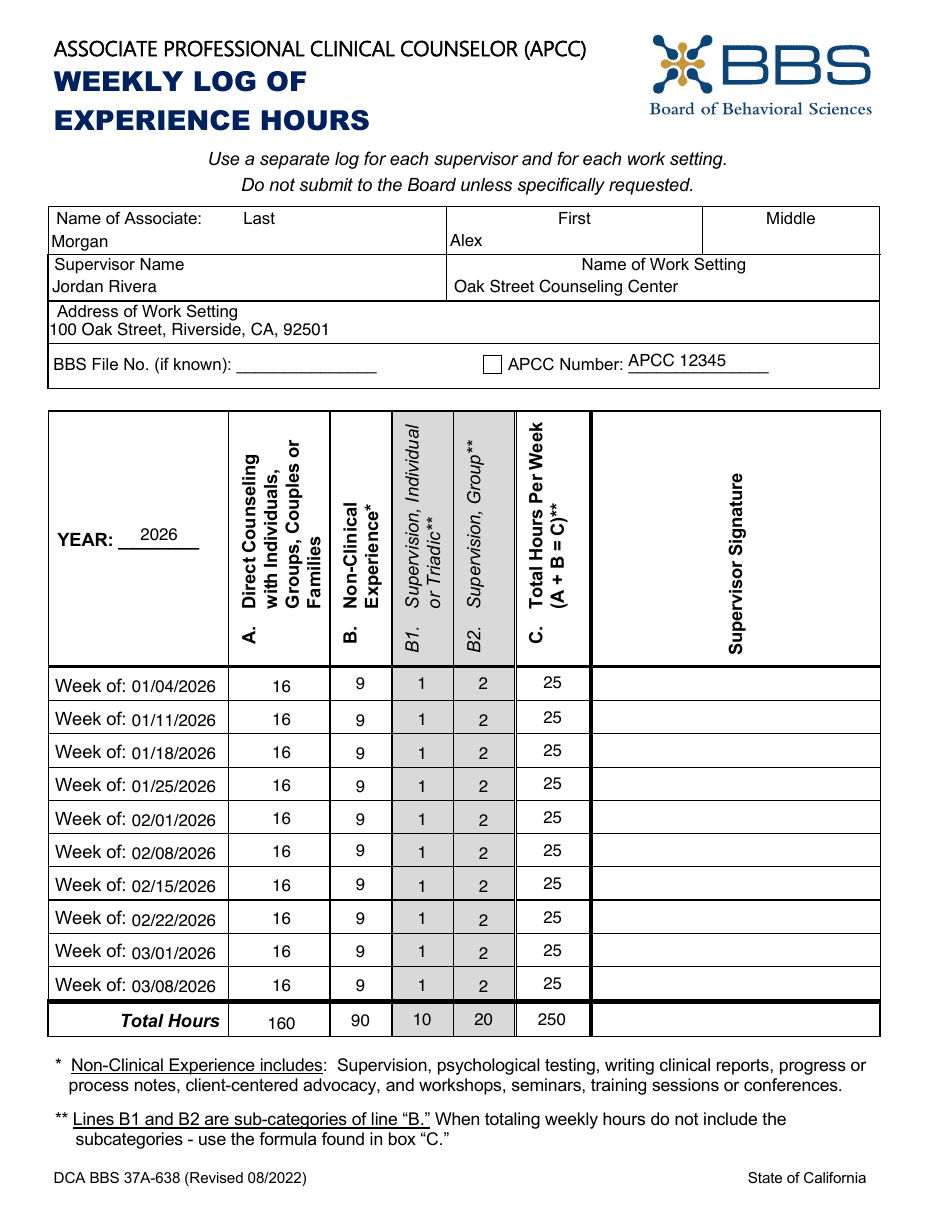
HourJourney can automatically generate your 37A-638 for you
Your logged weeks fill in the APCC weekly log for each supervisor, ready for your supervisor's signature.
The 90-Day Rule for APCCs
The 90-day registration rule applies to APCCs the same way it applies to AMFTs and ASWs. If the BBS receives your APCC registration application within 90 days of your degree award date and then grants the registration, post-degree hours you earn before your registration number is issued can count toward your 3,000 (BPC 4999.46(b)(1)).
For graduates on or after January 1, 2020, those hours count only if you gained them at a workplace that required completed Live Scan fingerprinting before you started, and you give the BBS a copy of the processed Request for Live Scan Service form from your employer (BBS APCC FAQ, Q3).
If the BBS does not receive your application within 90 days, only hours earned after your registration is issued count. Because the APCC path has no pre-degree hours, apply early.
For a detailed walkthrough of the 90-day rule, including common mistakes and how to protect your hours, see our 90-Day Rule for AMFTs guide (the same rule applies to APCCs and ASWs).
Dual Licensure: LMFT and LPCC
Some graduates register as both an AMFT and an APCC to pursue dual licensure. First, your degree must qualify for both license types.
The same hours can count toward both licenses. The BBS lets you count hours toward both if you register as both an APCC and an AMFT (separate applications and fees), keep both registrations active while you gain the hours (or submit both applications within 90 days of your degree award date under the 90-day rule), and make sure the hours are within the scope of both licenses and fit both sets of categories, minimums, and maximums (BBS APCC FAQ, Q42).
Each license has its own log. AMFT hours go on the 37A-525 and APCC hours on the 37A-638, each signed by your supervisor.
Different sub-requirements still apply. You must satisfy the LMFT's 500-hour CFC requirement and the LPCC's structural rules independently. A week that counts toward your LMFT CFC hours also counts as direct clinical for LPCC, but the reverse is not necessarily true: individual counseling counts as direct clinical for both, but does not satisfy the LMFT's CFC subset.
Separate exams. You take the California Law and Ethics Exam for each license type (separate applications, fees, and exams). LMFT also requires the LMFT Clinical Exam, and LPCC requires the NCMHCE.
Out-of-state portability depends on each state's board, so check with that board before relying on either license. Note that an LPCC alone can already treat couples and families since AB 462 took effect on January 1, 2022, so dual licensure is no longer needed for couples scope.
How HourJourney Tracks APCC Hours
HourJourney is purpose-built for California pre-licensed therapists, including APCCs tracking toward LPCC. Here is what the app handles for you:
- 40-hour weekly cap: The app stops you from saving a logged week above 40 hours across all work settings.
- 1,750 direct clinical tracking: Your dashboard shows real-time progress toward the 1,750 direct clinical minimum, separate from your overall 3,000-hour total. You always know exactly where you stand.
- Supervision ratio validation: HourJourney applies the BBS two-tier supervision ratio automatically. If you log more than 10 direct clinical hours in a week, the app verifies you have the required additional supervision unit and warns you if you do not.
- 37A-638 PDF export: When you are ready to compile your experience verification, HourJourney auto-fills Form 37A-638 based on your logged hours, matched to the correct supervisor and site. No manual transcription from spreadsheets.
- 104-week tracking: The app counts your supervised weeks independently from your hours, including the 52-week individual/triadic supervision requirement, so you can see both metrics on your dashboard.
- Dual AMFT/APCC support: If you are pursuing dual licensure, HourJourney lets you switch between your AMFT and APCC tracks in one account. The same logged hours are counted against each license's own requirements, and each track exports its own weekly log.
Start your free trial and enter your past weeks one at a time, or begin with this week's log. The app handles LMFT, LPCC, and LCSW tracking for California associates.
BBS Disclaimer: This guide is for informational purposes only and does not constitute legal or professional advice. Hour requirements, supervision rules, and BBS policies are subject to change. Always verify current requirements directly with the California Board of Behavioral Sciences before making licensure decisions. HourJourney is not affiliated with or endorsed by the BBS.
Source: BBS APCC FAQ revised February 2025; BBS AB 462 FAQ; California Business and Professions Code sections 4999.20, 4999.46, and 4999.46.2.
Frequently Asked Questions
How many hours do I need for LPCC licensure in California?
Can LPCC track hours toward LMFT licensure simultaneously?
Does LPCC require a couples and family therapy specialization?
What is the difference between APCC and AMFT hour requirements?
What form do APCCs use to track supervised hours?
Do pre-degree counseling hours count toward LPCC licensure?
What is the 90-day rule for APCC registration?
Licensing in Texas instead? Our guide to Texas LPC supervision requirements explains the rule that trips up counselors moving between states: Texas sets 4 supervision hours per month, with no weekly ratio at all.
Related Guides
How to Become an LPCC in California
The full step-by-step path to LPCC licensure
APCC Registration in California
Applying, Live Scan, and the 90-day rule
BBS Form 37A-638: APCC Weekly Log
How to fill out the APCC weekly log of experience hours
Can an LPCC Treat Couples & Families?
The LPCC scope of practice and the 2022 couples/families change
California LPCC Exams: Law & Ethics + NCMHCE
The two exams on the path to LPCC licensure
LMFT vs LPCC in California
Scope, couples/family work, and which path fits you
BBS Supervision Requirements
Ratios, weeks, and weekly caps for all licenses
The 90-Day Registration Rule
Protect your post-graduation hours