What Is the Supervision Agreement (Form 37M-300)?
The Supervision Agreement — full title “Supervision Agreement Between the Supervisor and Supervisee” — is an 11-page form issued by the California Department of Consumer Affairs, Board of Behavioral Sciences (DCA BBS Form 37M-300, revised 05/2026). It documents the terms and acknowledgments of a supervisory relationship between a licensed mental health professional and a supervisee gaining hours toward licensure as an LMFT, LCSW, or LPCC.
It replaced the older two-form system. For supervisory relationships that began before January 1, 2022, supervisors and supervisees used a separate “Supervisory Plan” and a “Supervisor Responsibility Statement.” For relationships entered into on or after January 1, 2022, those two documents were merged into the single Supervision Agreement. The supervisory plan didn't disappear — it became Part III of the combined form.
The form itself notes that it “does not contain an exhaustive list of all legal requirements pertaining to supervision.” The full legal text lives in the Statutes and Regulations, and the BBS publishes an accompanying “Supervision Agreement – Index of Legal Citations” that maps each statement on the form to its statute or regulation. If you need the complete legal picture, that index is the authoritative source.
Always grab the current version
The BBS revises this form periodically. Always download the current version of Form 37M-300 from bbs.ca.gov, read it in full, and review the accompanying Index of Legal Citations. This guide summarizes the form — it is not legal advice.
Who Completes It, and the 60-Day Deadline
Any licensed mental health professional who provides supervision — whether they are the primary supervisor or another supervisor — to anyone gaining hours toward LMFT, LCSW, or LPCC licensure must complete this form, together with the supervisee. That means every supervisory relationship gets its own agreement. If you have two supervisors, you have two agreements.
The hard deadline: the supervisor and supervisee must complete all parts of the form within 60 days of the commencement of supervision. That 60-day clock covers Part I (the supervisor's section), Part II (the supervisee's section), and Part III (the supervisory plan, developed collaboratively).
Once it's signed, the supervisee retains all pages of the form. You provide the original when you submit your Application for Licensure. For how this fits with the rest of your documentation, see our overview of the full BBS supervision requirements for California.
The 60-day window is per supervisory relationship, not per job. If you pick up a second supervisor partway through your associateship, a new 60-day clock starts the day that supervision commences — and you and that supervisor need a separate, fully completed Form 37M-300 before it runs out.
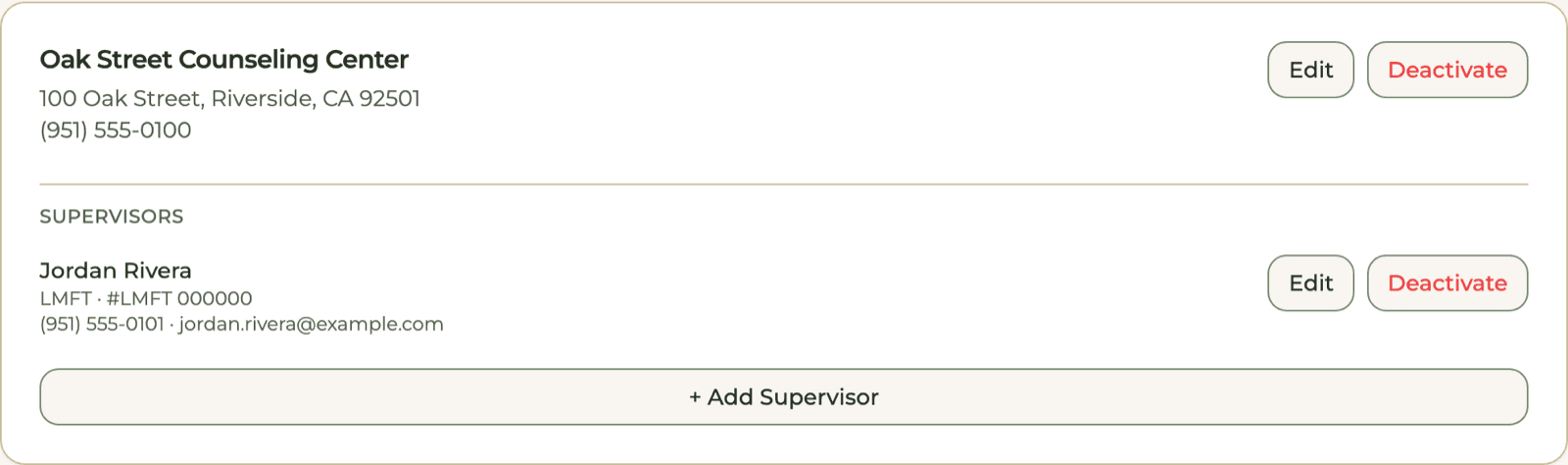
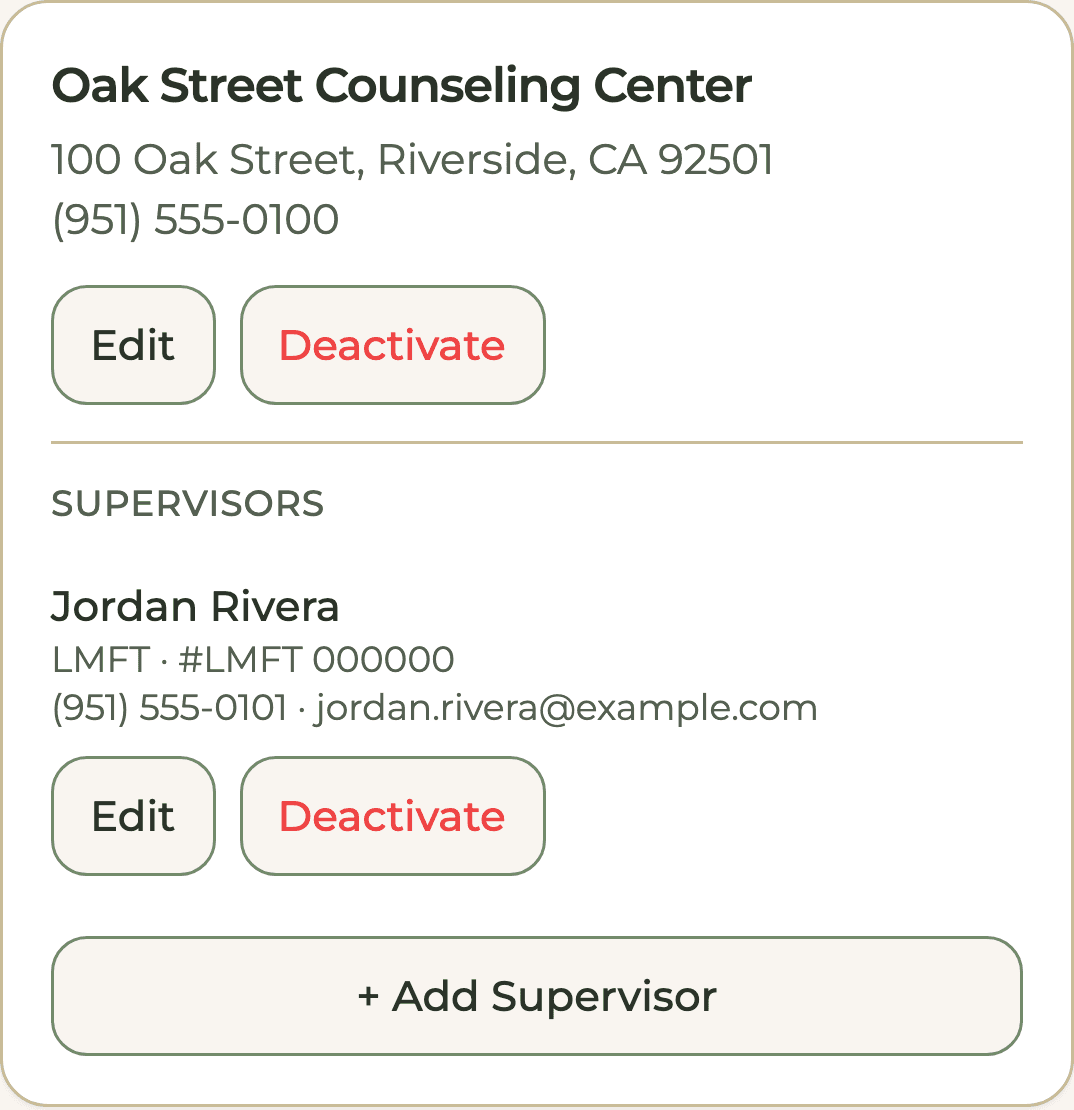
HourJourney keeps every supervisor's license details on file
Each supervisor's license type, number and date first licensed are saved once and carried onto your BBS forms.
The Top Section: Identifying Information
Before Part I, the form opens with an identifying block. It captures:
The supervisee's name.
The date the supervisory relationship was established.
The supervisee's current status: MFT Trainee, AMFT, ASW, APCC, an associate applicant (with the date applied and the BBS File No., if known), or a registered associate (with the registration number and the date issued).
The supervisor's name, employer, and employer address.
This block records when the supervisory relationship was established and which status the supervisee holds. The 60 days run from the commencement of supervision.
Part I: Completed by the Supervisor
Part I is the longest section. The supervisor works through four subsections (A through D), initialing a series of statements and, at the end, signing under penalty of perjury. Here is what each subsection covers.
Subsection A — Supervisor Qualifications
First, basic identification: the supervisor's name and employer; their license type — LMFT, LCSW, LPCC, LEP, Licensed Psychologist, or a Physician Board-Certified in Psychiatry by the American Board of Psychiatry and Neurology; their California license number and dates. If the supervisor has been licensed in California for less than two years, they also provide equivalent out-of-state license information. The form also asks whether the supervisor holds an “approved supervisor” designation from AAMFT, ABECSW, CAMFT, or CCE — if yes, the supervisor skips qualification questions 5 and 6.
Then comes the series of initialed statements the supervisor must affirm, including that they:
Maintain a current, active California license in good standing, not under suspension or probation — and will immediately notify the supervisee of any disciplinary action or any lapse.
Have held an active license for at least 2 of the past 5 years immediately prior to commencing supervision.
Have practiced psychotherapy (or psychological counseling, if an LEP) or provided direct clinical supervision of qualifying supervisees for at least 2 of the past 5 years.
Have completed the initial supervisor training/coursework required at the time they began supervising, or will complete it within 60 days — Psychologists, Psychiatrists, and those with an approved-supervisor designation are exempt from this.
Have completed (or will complete) 6 hours of continuing professional development in supervision during each subsequent license renewal period — the same exemption applies.
Have sufficient experience, training, and education in clinical supervision and in the profession the supervisee is pursuing; know and understand the supervision laws and regulations; will keep informed of developments; and will be competent in the areas being supervised.
Have never provided therapeutic services to the supervisee; are not a spouse, domestic partner, or relative; and have no personal, professional, or business relationship that undermines supervision.
Have submitted, or will submit, a Supervisor Self-Assessment report to the Board.
Subsection B — Employment and Work Setting Requirements
More initialed statements, this time about the setting and the employment arrangement:
The setting must lawfully and regularly provide mental health counseling or psychotherapy, and provide oversight.
If the supervisee has not yet been issued an associate registration, the setting cannot be a private practice or professional corporation.
The supervisee may not receive remuneration directly from clients (only from the employer), may not have a proprietary interest in the employer's business, and may not lease or rent space or pay the employer's obligations.
The supervisee must be a W-2 employee or volunteer, not an independent contractor.
Supervisors who are not employed by the supervisee's employer, or who serve as voluntary supervisors, must have a written oversight agreement with the organization.
When the associate works in a private practice or professional corporation, the supervisor must be employed or contracted by — or own — the practice, and must either provide psychotherapeutic services there or have a written contract giving them the same access to clinical records as employees.
“Supervision” means responsibility for, and control of, the quality of the services the supervisee provides. Consultation or peer discussion is not supervision.
In a nonexempt setting (private practice or professional corporation), the supervisor may not serve as an individual or triadic supervisor for more than six supervisees receiving supervision for clinical mental health services who aren't fully licensed for independent practice.
Subsection C — Supervision Requirements
Provide the amount and type of direct supervisor contact required by law.
Keep group supervision groups to no more than eight persons.
Within 60 days of commencing supervision via videoconferencing, conduct a meeting to assess whether videoconferencing supervision is appropriate, document the result, and not use it if it's not appropriate.
Sign the supervisee's experience log weekly and verify the completed hours at the end of supervision.
Provide written procedures for contacting the supervisor and an alternative on-call supervisor for crises.
An LEP may only supervise educationally-related mental health services consistent with the LEP scope.
Subsection D — Other Supervisor Requirements
Obtain the supervisee's most recent supervisor's and employer's information.
Provide documentation to the Board on request.
Self-monitor and address supervision dynamics, such as countertransference.
Give at least one week's prior written notice before declining to sign for further hours — and if no notice was given, sign for hours obtained in good faith where the required supervision was provided.
At the end of Part I, the supervisor signs under penalty of perjury. That weekly experience-log signature requirement is the bridge between this agreement and your week-to-week documentation — see our walkthrough of BBS Form 37A-525, the weekly log of experience hours.
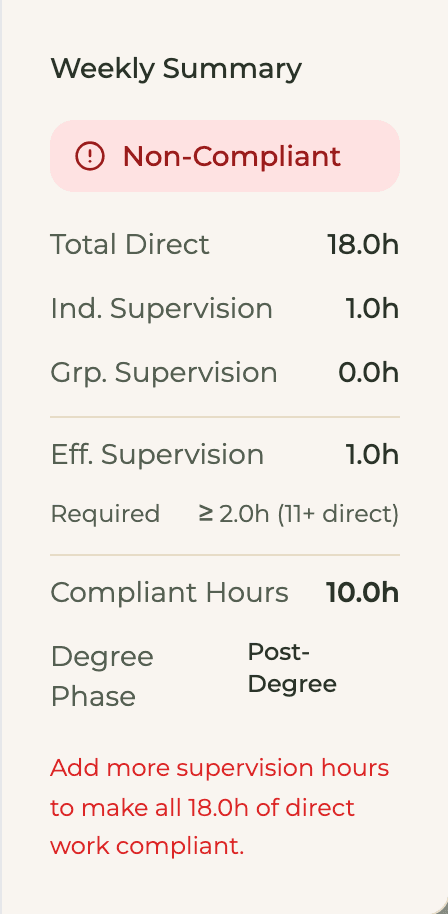
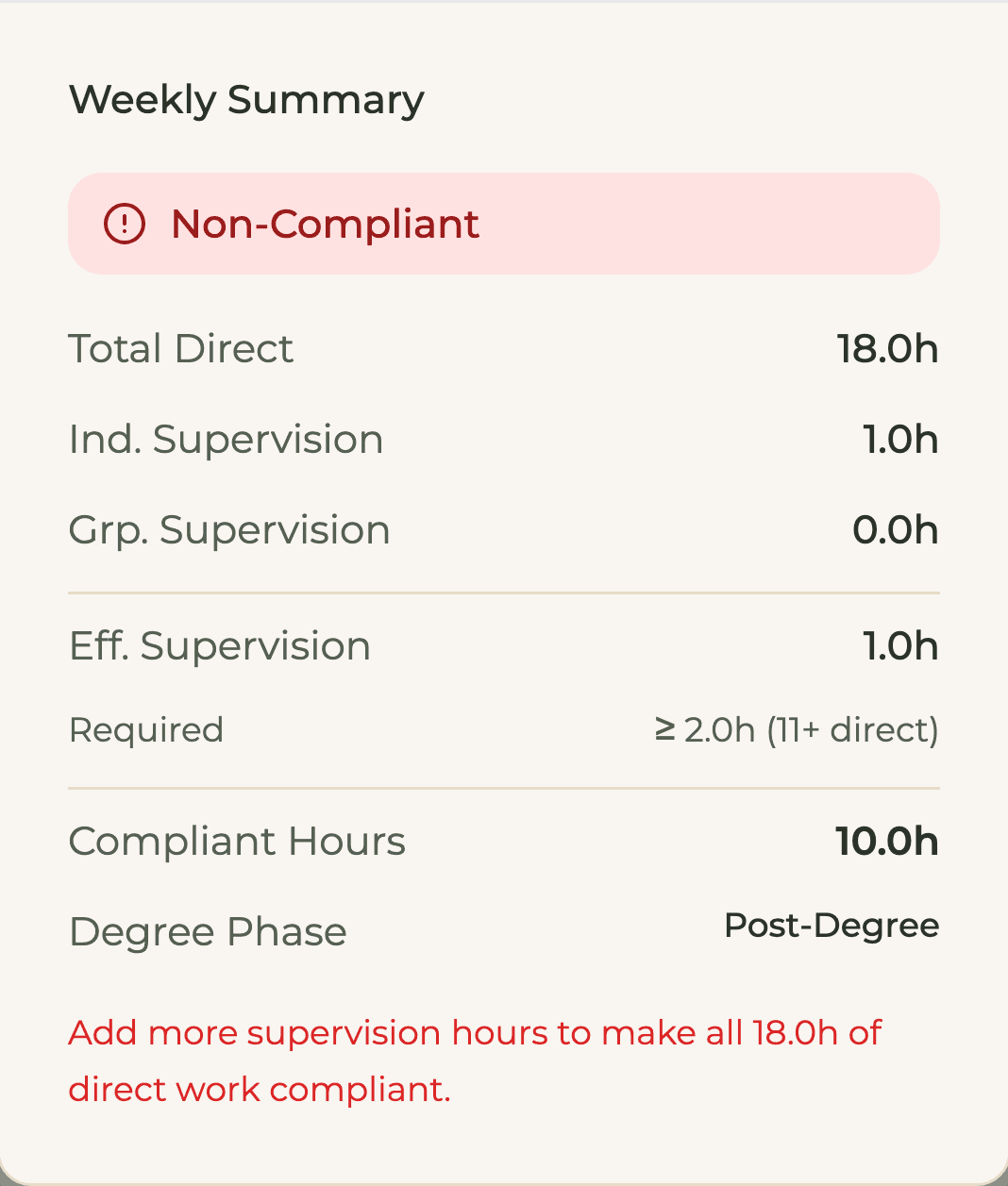
HourJourney checks the supervision ratio for you every week
Enter your direct hours and supervision. The week shows Compliant or Non-Compliant right away, how many hours count, and what to add.
Part II: Completed by the Supervisee
Part II is the supervisee's set of initialed acknowledgments. By initialing each, the supervisee confirms that they:
Meet all licensing-law requirements to practice with clients.
Will only provide services where the employer allows business to be conducted.
Must possess an active Associate registration to provide clinical services in a private practice or professional corporation.
Must possess an active Associate registration to earn post-degree experience, unless a legal exception applies.
Understand the supervisor must maintain an active California license in good standing while supervising — hours obtained during a lapse don't count.
Must be a W-2 employee or volunteer, not an independent contractor, and will provide a W-2 or a volunteer-status letter with the Application for Licensure.
Understand the supervisor must sign the experience log weekly and at completion.
Understand that all hours of experience must be completed within the six-year period immediately preceding submission of the Application for Licensure, except for the 500 supervised practicum hours for LMFT applicants.
May not receive client remuneration, hold a proprietary interest, or pay the employer's obligations.
The six-year window is easy to overlook
That eighth bullet matters a lot in practice: hours that are more than six years old when you finally submit your application don't count. Tracking the calendar, not just the totals, is part of the job. Our California LMFT hours requirements guide covers the six-year limit.
Part III: The Supervisory Plan, Completed Together
Part III is what used to be the standalone “Supervisory Plan.” Within 60 days of commencing supervision, the supervisor and supervisee collaboratively develop a supervisory plan describing the goals and objectives of supervision. A non-primary supervisor may develop a separate plan or simply use the primary supervisor's.
In Part III the supervisor also acknowledges a set of ongoing duties:
Complete an assessment of the supervisee's strengths and limitations at least once a year and at completion or termination, with a copy to the supervisee.
Ensure the kind and quality of counseling is consistent with the supervisee's education, training, and experience.
Monitor and evaluate the supervisee's assessment, diagnosis, and treatment decisions, and give regular feedback.
Monitor and evaluate the supervisee's ability to serve at the practice site(s) and with the clientele served.
Monitor and address clinical dynamics.
Review progress notes, process notes, and treatment records.
Directly observe therapy or review audio/video recordings of therapy — with the client's written consent — in an amount the supervisor deems appropriate.
Both the supervisor and the supervisee sign Part III. With Parts I, II, and III all signed within the 60-day window, the agreement is complete — and the supervisee tucks the original away for the licensure application.
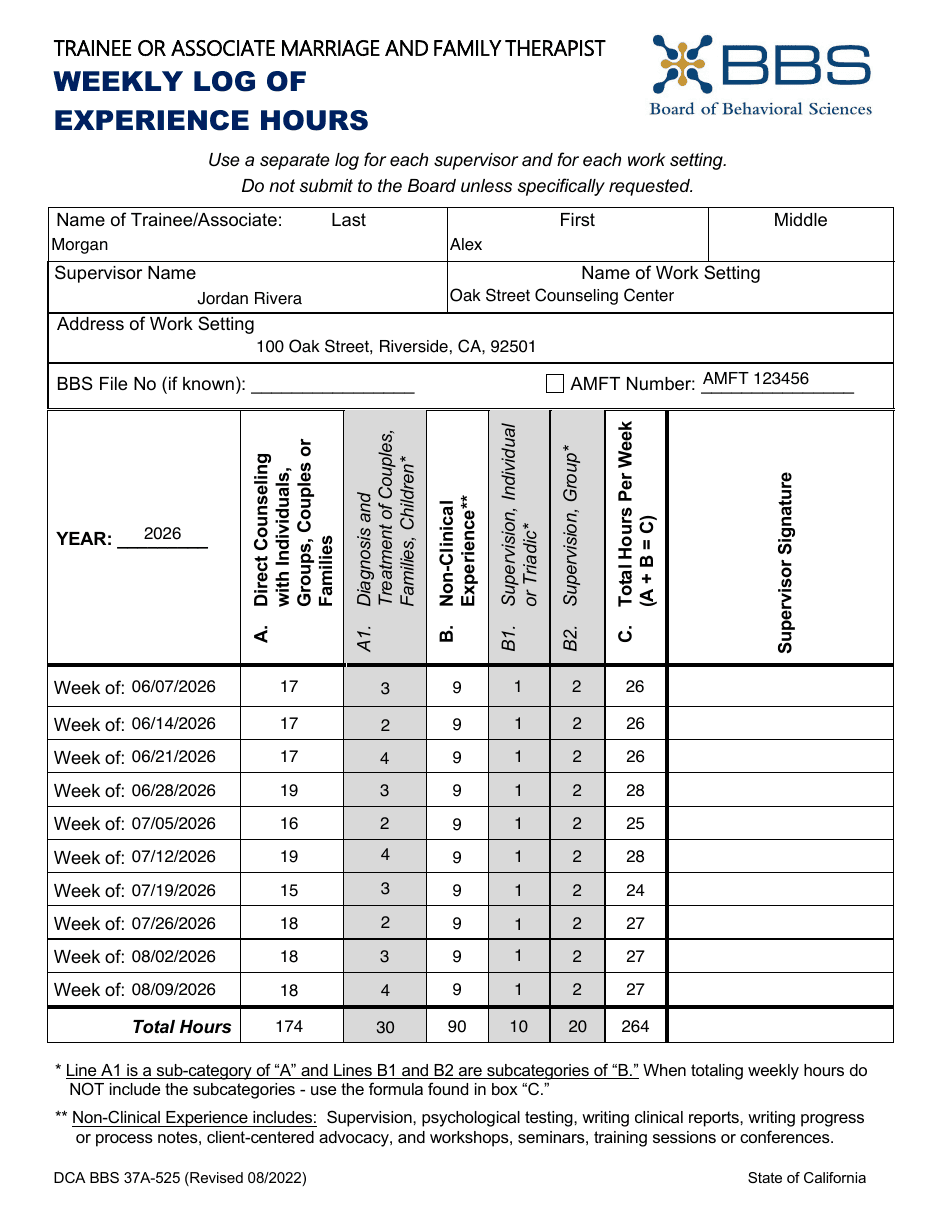
HourJourney fills in your weekly log for your supervisor to sign
Your logged weeks fill in the BBS weekly log for your track, one per supervisor, site and year, ready for your supervisor's signature.
“Supervision Agreement” vs. “Supervisory Plan”
These terms get used interchangeably, but they aren't the same thing:
| Term | What it means now |
|---|---|
| Supervision Agreement (Form 37M-300) | The whole 11-page document — Part I (supervisor), Part II (supervisee), and Part III (the supervisory plan). Required for relationships entered into on or after January 1, 2022. |
| Supervisory Plan | Today: Part III of the agreement — the collaboratively developed goals and objectives of supervision. Before January 1, 2022: a standalone form used alongside a separate Supervisor Responsibility Statement. |
| Supervisor Responsibility Statement | The pre-2022 companion form, used for relationships that began before January 1, 2022. |
If you started a supervisory relationship before January 1, 2022 and kept the old forms, those still document that period — you don't retroactively switch to Form 37M-300 for it. But any new relationship from that date forward needs the agreement. If you're an ASW figuring out whether a particular clinician can sign for you, see our guide on who can supervise an ASW in California.
Supervision Agreement Checklist
Confirm Form 37M-300 applies — the supervisory relationship was entered into on or after January 1, 2022.
Download the current version from bbs.ca.gov and grab the Index of Legal Citations too.
Fill the top section: supervisee name, date established, current status, and the supervisor's name, employer and employer address.
Supervisor completes Part I, Subsections A–D, initialing each statement and signing under penalty of perjury.
Supervisee completes Part II, initialing each statement.
Supervisor and supervisee develop and sign Part III, the supervisory plan.
All parts done within 60 days of the commencement of supervision.
Supervisee keeps the signed form and submits the original with the Application for Licensure.
Every additional supervisory relationship gets its own Form 37M-300, on its own 60-day clock.
The Agreement Sets the Rules — HourJourney Tracks the Hours
Form 37M-300 defines the supervisory relationship. Everything that flows from it, including the weekly experience logs, the supervision ratios and the W-2 employment requirement, is what you live with week after week. HourJourney is built for exactly that.
Logs your direct and non-clinical hours each week, per supervisor and per site
Validates BBS supervision ratios as you go, so a short-supervision week doesn't quietly cost you hours
Warns you in the dashboard within 12 months of your registration's 6-year expiry
Generates a pre-filled BBS weekly log for your track (37A-525 for AMFT), ready for your supervisor's signature
Keeps a clean audit trail of every edit, so your records hold up if the BBS asks
Get the agreement signed, then let HourJourney handle the running record. Start with our guide on how to track your LMFT supervised hours.
30-day free trial. No card required.
FAQ: BBS Supervision Agreement
Where do I get the BBS supervision agreement form?+
Download the BBS supervision agreement form directly from bbs.ca.gov. It's officially titled the Supervision Agreement Between the Supervisor and Supervisee (Form 37M-300), and it must be completed within 60 days of the commencement of supervision. The supervisee keeps the signed original and submits it with the Application for Licensure.
What is the BBS Supervision Agreement (Form 37M-300)?+
Form 37M-300 is the Supervision Agreement Between the Supervisor and Supervisee, issued by the California Board of Behavioral Sciences (DCA BBS, revised 05/2026). It is an 11-page document that a licensed supervisor and a supervisee gaining hours toward LMFT, LCSW, or LPCC licensure complete together. It is required for new supervisory relationships entered into on or after January 1, 2022.
When is the Supervision Agreement due?+
All parts of Form 37M-300 must be completed within 60 days of the commencement of supervision. That includes Part I (the supervisor's section), Part II (the supervisee's section), and Part III (the supervisory plan, developed together).
Who has to complete Form 37M-300?+
Any licensed mental health professional who provides supervision — whether they are the primary supervisor or another supervisor — to anyone gaining hours toward LMFT, LCSW, or LPCC licensure must complete the form together with that supervisee. Each supervisory relationship needs its own agreement.
What's the difference between the Supervision Agreement and the old Supervisory Plan?+
For supervisory relationships that began before January 1, 2022, supervisors and supervisees used the older Supervisory Plan and Supervisor Responsibility Statement forms. For relationships entered into on or after January 1, 2022, the single Supervision Agreement (Form 37M-300) replaced both. The supervisory plan still exists, but now as Part III of the combined agreement.
Do I send the Supervision Agreement to the BBS?+
Not on a rolling basis. The supervisee retains the signed form and provides the original when applying for licensure. Keep it complete and safe.
How long must a supervisor have been licensed to sign this form?+
Among the statements the supervisor initials in Part I, Subsection A: the supervisor must have held an active license for at least 2 of the past 5 years immediately prior to commencing supervision, and must have practiced psychotherapy (or psychological counseling, if an LEP) or provided direct clinical supervision for at least 2 of the past 5 years. The form lists additional qualification requirements — see the BBS Index of Legal Citations for the exhaustive list.
Does the supervisee have to be a W-2 employee?+
Yes. Among the initialed statements in both Part I and Part II, the supervisee must be a W-2 employee or a volunteer of the work setting — not an independent contractor — and must provide a W-2 or a volunteer-status letter with the Application for Licensure.
What goes in the supervisory plan (Part III)?+
Within 60 days of commencing supervision, the supervisor and supervisee collaboratively develop a supervisory plan describing the goals and objectives of supervision. A non-primary supervisor may develop a separate plan or use the primary supervisor's. The supervisor also acknowledges ongoing duties in Part III, including assessing the supervisee's strengths and limitations at least once a year and at completion, reviewing notes and records, and directly observing or reviewing recordings of therapy with the client's written consent.
Where do I get the current version of Form 37M-300?+
Download it directly from bbs.ca.gov. The BBS revises this form periodically — always use the current version, read it in full, and review the accompanying Supervision Agreement Index of Legal Citations for the full statutory and regulatory text.
Related Guides
BBS Supervision Requirements in California
The full picture: ratios, supervisor qualifications, and what counts.
BBS Form 37A-525: How to Fill It Out
The weekly log of experience hours, column by column.
Who Can Supervise an ASW in California
Eligibility rules for supervisors of associate clinical social workers.
How to Track Your LMFT Supervised Hours
The BBS A/B/C structure explained step by step.
The BBS revises this form periodically — always download the current version of Form 37M-300 from bbs.ca.gov, read it in full, and review the accompanying Index of Legal Citations. This guide summarizes the form; it is not legal advice.
This guide is for informational purposes only. Always verify supervision requirements directly with the BBS at bbs.ca.gov.