LCSW Supervision · California 2026
Who Can Supervise an ASW in California? (The 1,700-Hour LCSW Rule)
If you are an Associate Clinical Social Worker (ASW) building hours toward LCSW licensure in California, one fact about supervision matters most: several license types can supervise you, but at least 1,700 hours and 13 individual or triadic weeks must come from a Licensed Clinical Social Worker (LCSW). Hours under a supervisor who does not qualify do not count. This guide explains exactly who can supervise an ASW and what the LCSW rule means in practice.
Last Updated: June 2026
Quick Reference
The short answer
An ASW in California may be supervised by an LCSW, LMFT, LPCC, licensed psychologist, or ABPN-certified psychiatrist (and, narrowly, an LEP for up to 1,200 ERMHS hours). But at least 1,700 of the 3,000 hours and 13 individual/triadic weeks must be supervised by an LCSW.
Which License Types Can Supervise an ASW?
California's Board of Behavioral Sciences (BBS) allows an ASW's supervised experience to be provided by a licensed clinician holding any one of these license types:
- Licensed Clinical Social Worker (LCSW) — and, as we explain below, the only license type that can satisfy the LCSW-specific portion of your requirement.
- Licensed Marriage and Family Therapist (LMFT)
- Licensed Professional Clinical Counselor (LPCC)
- Licensed psychologist
- Physician certified in psychiatry by the American Board of Psychiatry and Neurology
There is one additional, narrowly scoped option: a Licensed Educational Psychologist (LEP) may supervise a maximum of 1,200 hours, but only for educationally related mental health services, and only if certain qualifications are met. Hours beyond that 1,200-hour ceiling — or LEP-supervised hours outside of educationally related mental health work — will not count toward licensure.
So the short answer to "can an LMFT supervise an ASW?" is yes, and the same goes for an LPCC, a psychologist, or a board-certified psychiatrist. But none of those clinicians can be your only supervisor for the full experience, because of the LCSW rule that follows. If you are on the counseling track instead, see who can supervise an APCC in California.
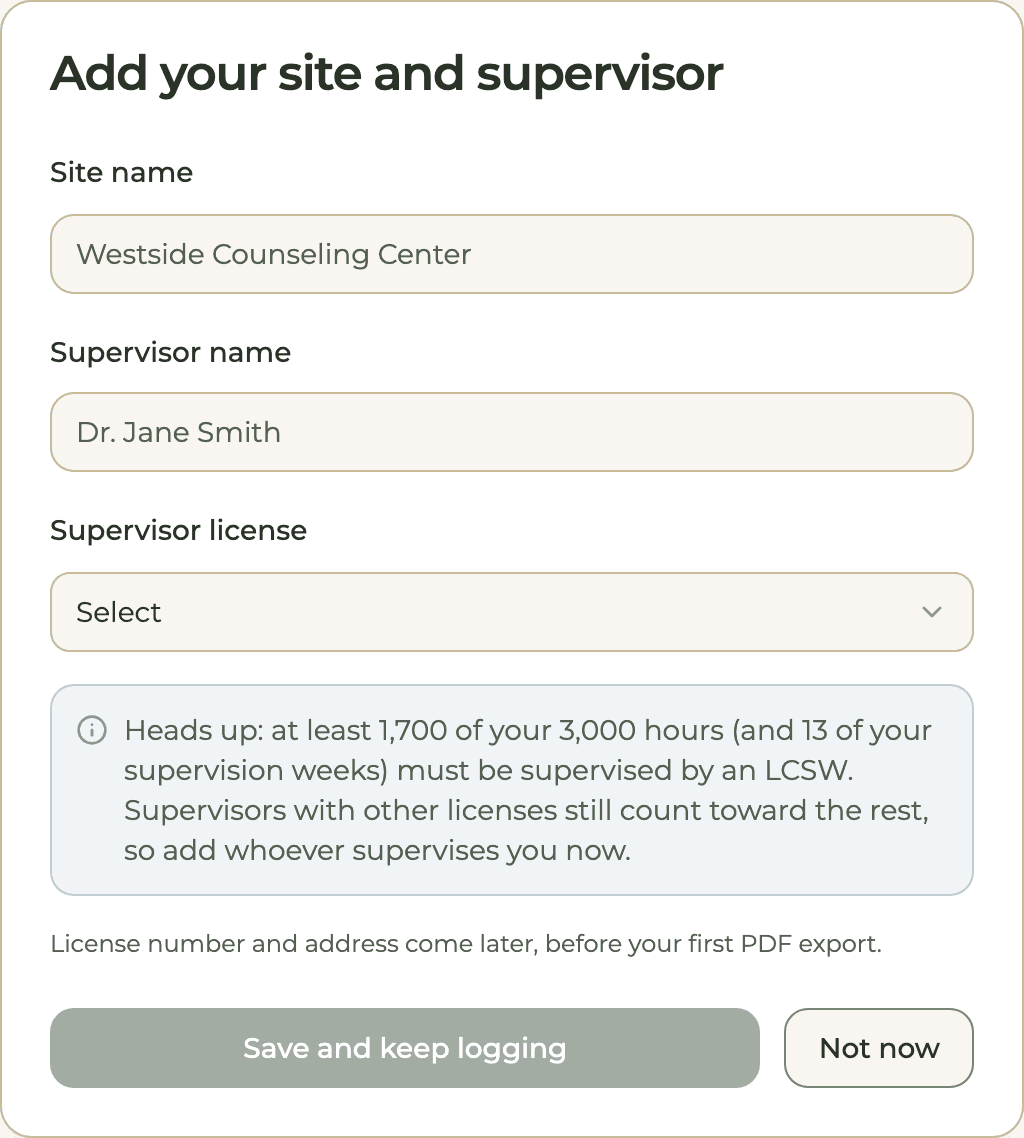
HourJourney records each supervisor's license for you
Add each supervisor with their license type. On the LCSW track, the setup screen reminds you that at least 1,700 hours and 13 weeks must be supervised by an LCSW.
The 1,700-Hour LCSW Rule (and the 13-Week Rule)
This rule has two parts:
The LCSW-supervision minimums
- 1,700 hours. Of the 3,000 total supervised experience hours required for LCSW licensure, a minimum of 1,700 hours (of any type — direct clinical work, non-clinical work, etc.) must be supervised by an LCSW.
- 13 weeks. Of the minimum 52 weeks in which you receive individual or triadic supervision, at least 13 of those weeks must be supervised by an LCSW.
This requirement is unique to the LCSW path. It does not exist for the LMFT or LPCC pathways.
In plain terms: a little over half of your total hours, and a quarter of your individual/triadic supervision weeks, have to involve a social work supervisor. The remaining hours and weeks can be supervised by any of the other qualifying license types (within the LEP cap, where applicable).
The practical implication: if your primary, on-site supervisor is an LMFT, LPCC, psychologist, or psychiatrist, you will need an LCSW supervisor for at least 1,700 hours and 13 weeks, so plan for one early. Falling short of either threshold means your hours do not meet the LCSW requirement, so track LCSW-supervised hours and weeks separately from day one. For the rest of the LCSW hour categories and how supervision interacts with them, see our guide to the California LCSW hours requirements.
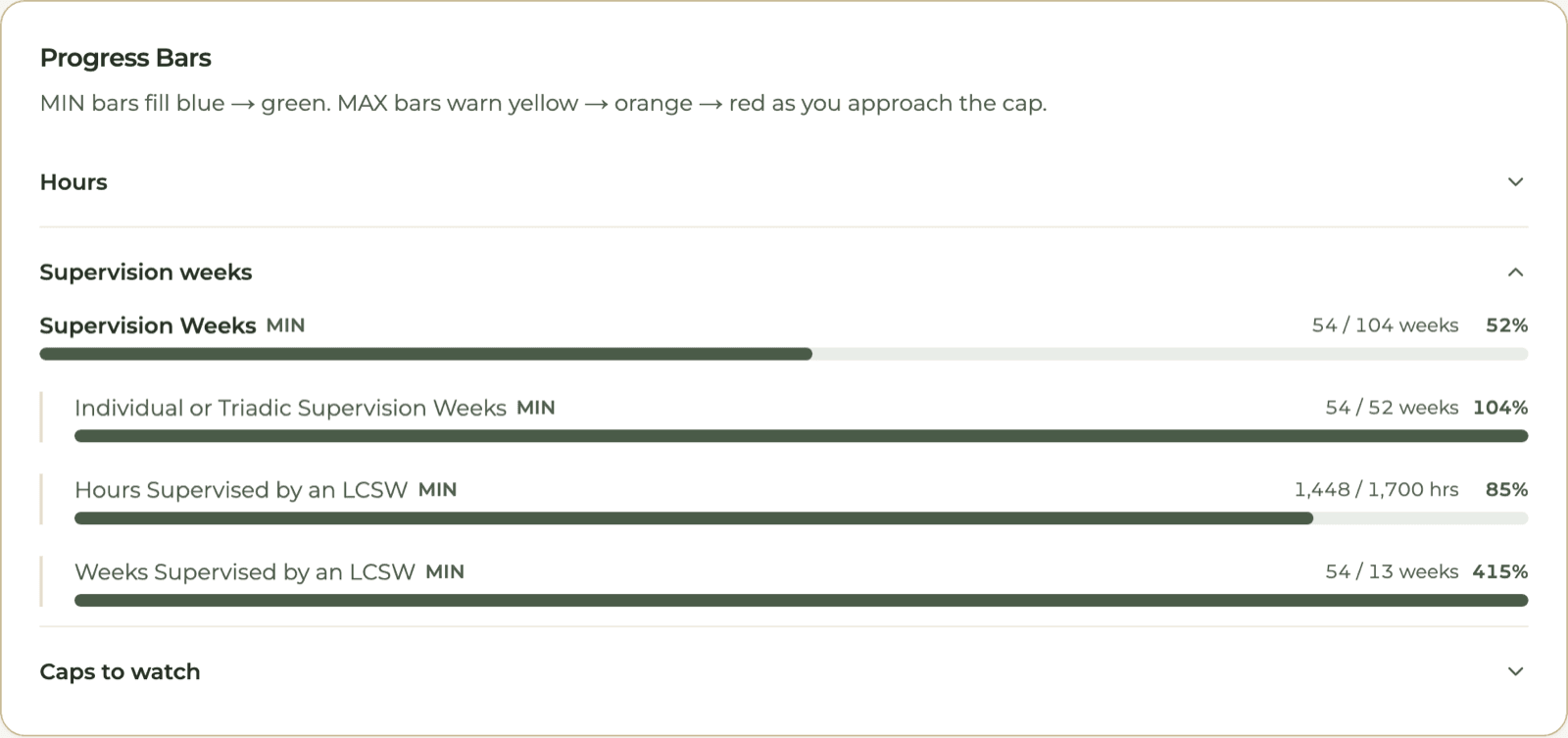
HourJourney counts the hours and weeks under an LCSW for you
Your dashboard totals the hours and the weeks supervised by an LCSW against the 1,700-hour and 13-week minimums, separately from your 3,000 and 104.
Weekly Supervision Mechanics for ASWs
Beyond the LCSW-specific rule, ASWs follow the same supervision hours per week the BBS requires across BBS associate categories:
- A minimum of 104 supervised weeks of work experience is required overall.
- One unit of supervision (one hour of individual or triadic supervision, or two hours of group supervision) is required in each week you gain experience, in each work setting.
- One additional hour of individual/triadic supervision (or two additional hours of group) is required for any week in which more than 10 hours of direct clinical counseling are performed in each setting. "Direct clinical counseling" means clinical psychosocial diagnosis, assessment, and treatment, including psychotherapy or counseling.
- A maximum of 6 hours of direct supervisor contact may be credited toward licensure in any single week.
The "in each setting" language matters: if you work at more than one site, the more-than-10-hours trigger is evaluated independently per setting. A week with 12 direct hours at a community clinic and 4 at a private practice means the clinic needs the additional supervision hour; the private practice does not. For a deeper walkthrough of these mechanics — including triadic supervision, the individual-week minimum, and how the additional-unit rule works — see our guide to the full BBS supervision requirements.
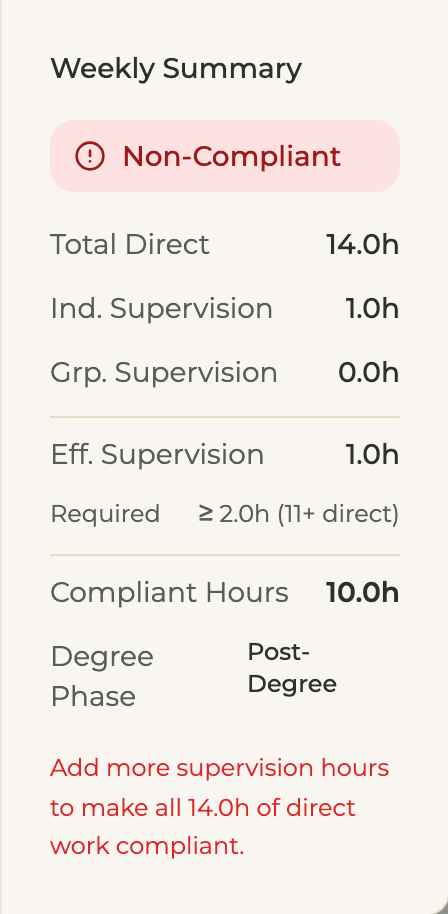
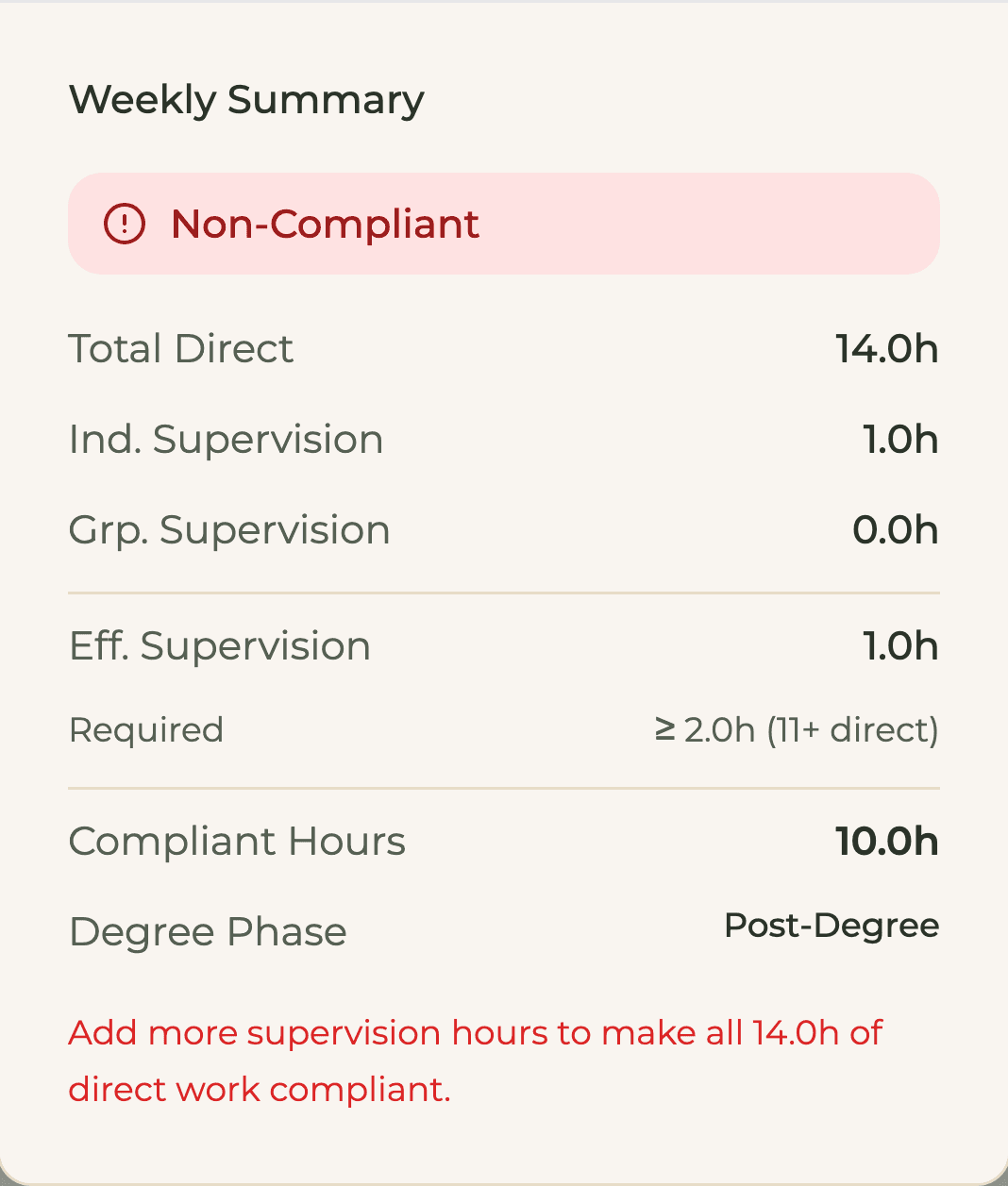
HourJourney checks your weekly supervision for you
Enter your hours and supervision for the week. The week shows Compliant or Non-Compliant right away, how many hours count, and what to add.
What Your Supervisor Has to Be (and What to Verify)
Holding the right license type is necessary but not sufficient. Your supervisor must hold a current and active California license that is not under suspension or probation for the entire time they supervise you. Time licensed in another state can count toward the requirement to have been licensed for at least two of the last five years. And critically: hours and weeks supervised by a clinician whose license lapses, is suspended, or is placed on probation during the supervisory relationship will not count. Check your supervisor's license periodically on the Department of Consumer Affairs License Search, not just once at the start.
In any work setting, if your supervisor is not employed by your employer or is a volunteer, a written oversight agreement signed by the supervisor and your employer is required before supervision starts. Whether a supervisor must be on site depends on the situation, and supervisors have the same duties on site or off site, including ensuring the extent, kind and quality of your work fits your training and experience (BBS ASW FAQ, Q34 and Q35).
Beyond those widely established points, the BBS imposes a detailed set of supervisor qualifications — things like minimum licensure tenure, prohibitions on probation or suspension, prohibited relationships (you cannot be supervised by your spouse, relative, or former therapist), written oversight agreements when the supervisor is not employed by your employer, and supervisor training (15 hours for first-time California supervisors; psychologists and psychiatrists are exempt). The exact specifics change periodically and are spelled out in the BBS's publications.
Before you start logging hours: The BBS's supervisor-qualification rules are detailed and change periodically — confirm your supervisor meets every current requirement before you begin logging hours under them, against BPC 4996.20, 16 CCR 1870 and 1871, the ASW FAQ (Q29) and the Supervision Agreement (Form 37M-300), linked from the BBS supervisor page. We do not reproduce the full list here because it is long and subject to change — go to the source.
A Practical Setup for ASWs
Putting it together, here is a sensible way to think about supervision as an ASW:
- Confirm your primary supervisor's license type and status. Any of LCSW, LMFT, LPCC, psychologist, or ABPN-certified psychiatrist works for general supervision. If they are an LEP, remember the 1,200-hour ceiling and the educationally-related-services limitation.
- If your primary supervisor is not an LCSW, line up an LCSW too. You need at least 1,700 LCSW-supervised hours and 13 LCSW-supervised individual/triadic weeks. Arranging this early — rather than scrambling near the end — keeps your timeline intact.
- Verify qualifications before the first session. Use the ASW FAQ (Q29) and the Supervision Agreement. Confirm the supervisor's license is current and active and not under suspension or probation, that any required oversight agreement is signed, and that they have met the supervisor training requirement.
- Track LCSW-supervised hours and weeks separately. Your total-hours tally is not enough — you need to be able to show, at any moment, how many of those hours and weeks were under an LCSW. A spreadsheet works; a tool that does it automatically works better.
- Re-check your supervisor's license status periodically. A lapse, suspension, or probation mid-relationship disqualifies the hours accrued during that time.
If you would rather not manage all of this by hand, HourJourney is built for exactly this: it checks each week's supervision against the BBS requirement, totals your LCSW-supervised hours and weeks separately, and marks weeks where supervision is short. You can start a free trial, run the numbers with our LCSW hours calculator, or read the broader path overview in our ASW to LCSW in California guide.
Source: BPC 4996.20, 4996.23 and 4996.23.1; 16 CCR 1870 and 1871; BBS ASW FAQ (rev. 01/2026); BBS supervisor page, bbs.ca.gov/licensees/supervisor.html. This guide is for informational purposes only and does not constitute legal advice. Always verify supervisor qualifications and current requirements directly with the BBS at bbs.ca.gov.
Frequently Asked Questions
Can an LMFT supervise an ASW in California?
Who can supervise an ASW in California?
What is the 1,700-hour LCSW rule?
Can an LCSW supervise an ASW?
Does my ASW supervisor have to work at the same agency as me?
What happens if my supervisor's license lapses while supervising me?
How much weekly supervision does an ASW need?
Related Guides and Tools
BBS Supervision Requirements
The full rules for AMFTs, APCCs, and ASWs
California LCSW Hours Requirements
How many supervised hours you need, with every cap
How to Track LCSW Hours
LCSW hour categories and supervision rules
ASW Renewal in California
The CE you owe every renewal period
ASW to LCSW in California
The full path to LCSW licensure
LCSW Hours Calculator
Estimate your completion date