Step 1: Earn a Qualifying Master's or Doctoral Degree
The LPCC path starts with a qualifying master's or doctoral degree that is counseling or psychotherapy in content (BPC 4999.33(b)). Which education statute applies to you depends on when you began graduate study:
- ✓If you began your graduate program on or after August 1, 2012 — or you began before that date but did not graduate by December 31, 2018 — your degree must meet the requirements in Business and Professions Code section 4999.33.
- ✓If you began your graduate program before August 1, 2012 and graduated by December 31, 2018, your degree is evaluated under Business and Professions Code section 4999.32, or you may alternatively qualify under section 4999.33 (BPC 4999.32(a); 4999.33(a)(2)).
Confirm with the BBS that your degree meets BPC 4999.33 (or 4999.32) before you assume it qualifies.
No pre-degree hours. Unlike the LMFT pathway, the LPCC pathway does not let you count any pre-degree (practicum/trainee) hours toward the 3,000-hour total. Every one of those 3,000 hours must be earned after your degree is conferred — so the practical clock on supervised experience starts at graduation, not before.
Step 2: Register as an Associate Professional Clinical Counselor (APCC)
Before you can accrue supervised experience in California, you must register with the BBS as an Associate Professional Clinical Counselor (APCC). Without an active APCC registration, clinical hours you work do not count — with one narrow exception, the 90-day rule, described below. The in-state APCC application is BBS form pci_app.pdf.
The 90-day rule. If the BBS receives your APCC application within 90 days of your degree award date and then grants the registration, hours gained before it was issued can be credited. If you completed graduate study on or after January 1, 2020, the workplace must also have required completed Live Scan before you gained those hours. Otherwise they are not credited. The 90-day rule for associates works the same way across license types — see our 90-day rule guide for the mechanics.
An APCC registration can be renewed five times and cannot be renewed beyond six years from the last day of the month it was issued. Separately, hours cannot be older than six years when the BBS receives your Application for Licensure (BPC 4999.46(e)). When no further renewals are possible, you may apply for a subsequent registration number if you meet the education requirements and have passed the California Law and Ethics Exam. Holders of a subsequent registration cannot work in a private practice or professional corporation.
Renewals come with continuing education requirements. Effective January 1, 2023, every registered associate — including APCCs — must complete 3 hours of California Law and Ethics continuing education during each renewal period, before renewing, regardless of whether they have passed the Law & Ethics Exam yet.
Application and renewal fees are subject to change — check bbs.ca.gov for current fee amounts before you budget.
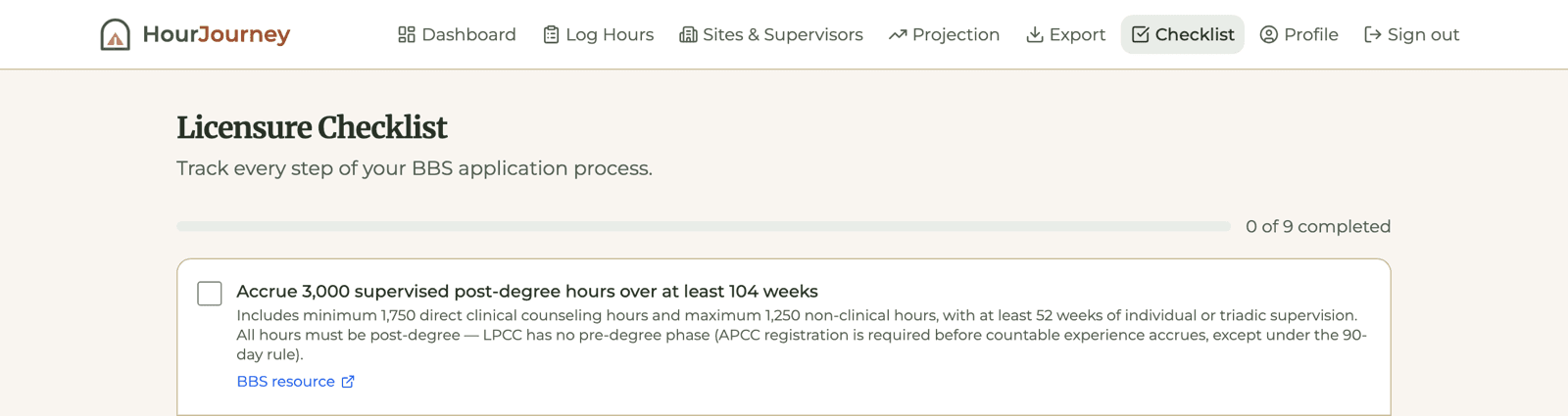
HourJourney keeps your APCC-to-LPCC checklist
The app lists each licensure step for your track so you can check it off as you go.
Step 3: Complete the Fingerprint Requirement
The BBS requires fingerprints so your criminal history can be checked against California Department of Justice (DOJ) and FBI records. California residents use Live Scan (electronic fingerprinting); applicants outside California submit hard cards. Either way, the results go to both the DOJ and the FBI.
The processing fee is $49. Note that Live Scan locations may charge an additional "rolling" fee on top of that, which varies by site. The Board recommends doing Live Scan no more than 30 days before you submit an application, and Live Scan results expire after six months if you have not filed an application — so don't get fingerprinted too early.
Sequence it with your application. Schedule Live Scan close to when you'll actually submit your APCC application — within that 30-day recommendation. Doing it the moment you graduate, then waiting months to apply, can force you to redo it.
Live Scan rolling fees are set by the sites and are subject to change — check bbs.ca.gov for current information.
Step 4: Criminal Background Check
Once your fingerprints are processed, the BBS evaluates your criminal history as part of the application process. This is a built-in step, not a separate filing — it runs alongside the Board's review of your APCC application and, later, your license application.
If your history includes anything that could be flagged, it is worth disclosing it fully and proactively in your application materials and consulting the BBS directly about how it will be considered. Honesty and complete disclosure go a long way; surprises do not.
Step 5: Take and Pass the California Law & Ethics Exam
The LPCC California Law & Ethics Exam is delivered by Pearson VUE: 50 scored and 25 pretest questions in 90 minutes (Pearson VUE Candidate Handbook).
There is a hard rule attached to this exam: as an APCC, you must take the Law & Ethics Exam each year to renew your registration until you pass it, and you must pass it to receive a subsequent APCC registration. In practice that means you should sit for it early and keep sitting for it until you pass — letting it slide can jeopardize a renewal.
Exam details change. For current passing scores, exam content, scheduling, and fees, see the BBS exam pages. Always confirm current requirements directly with the BBS at bbs.ca.gov and with the testing vendor.
Remember that this exam requirement is separate from — and in addition to — the 3 hours of California Law and Ethics continuing education that every APCC must complete each renewal period regardless of exam status.
Step 6: Accrue 3,000 Hours of Supervised Professional Experience
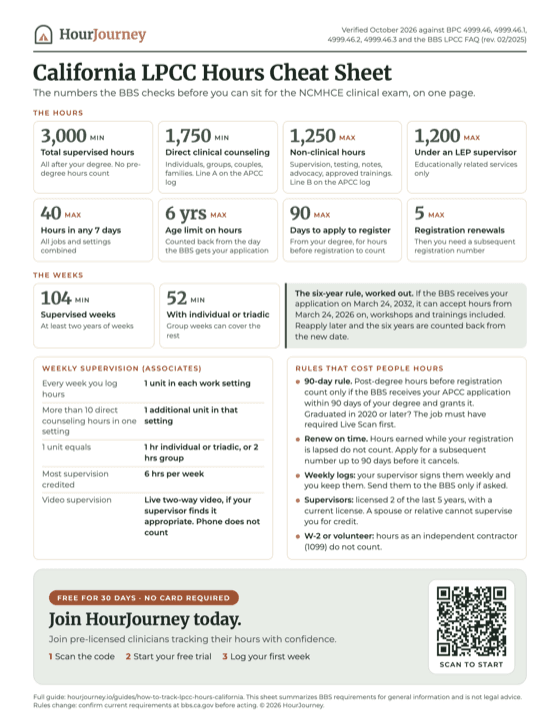
This is the longest stretch of the journey. You must accumulate 3,000 total supervised hours over a minimum of 104 weeks, and — critically for LPCCs — all 3,000 must be post-degree. No pre-degree hours count toward this total.
Hour and supervision rules
- ✓1,750 hours minimum of direct clinical counseling experience.
- ✓1,250 hours maximum of non-clinical experience: direct supervisor contact, administering and evaluating psychological tests, writing clinical reports, writing progress or process notes, client-centered advocacy, and workshops, seminars, training sessions, or conferences directly related to professional clinical counseling that have been approved by your supervisor (BPC 4999.46(c)(4)).
- ✓104 weeks minimum over which the 3,000 hours are spread.
- ✓52 weeks minimum (of the 104) must include individual or triadic supervision.
- ✓40-hour weekly cap — no more than 40 hours of experience in any seven consecutive days, counted across all settings combined.
- ✓6-hour weekly supervision credit cap — you can't bank more than six hours of supervision toward a single week.
- ✓Extra supervision unit — any week with more than 10 hours of direct clinical counseling in a setting requires one additional unit of supervision that week (one hour of individual/triadic, or two hours of group).
- ✓LEP cap: no more than 1,200 hours may be gained under the supervision of a licensed educational psychologist providing educationally related mental health services (BPC 4999.46(c)(5)).
You document your weeks on the APCC Weekly Log of Experience Hours (Form 37A-638, Option 1). Each week needs accurate hour categories and the right supervision to be valid. For the full breakdown of categories, caps, and how to log them, see our LPCC hours tracking guide, and for how supervision itself works across BBS license types, our BBS supervision requirements guide.
Track from day one. Each week needs the required supervision units for each setting. Estimate your timeline with our LPCC hours calculator, or start tracking with HourJourney to see each week marked Compliant or Non-Compliant as you log.
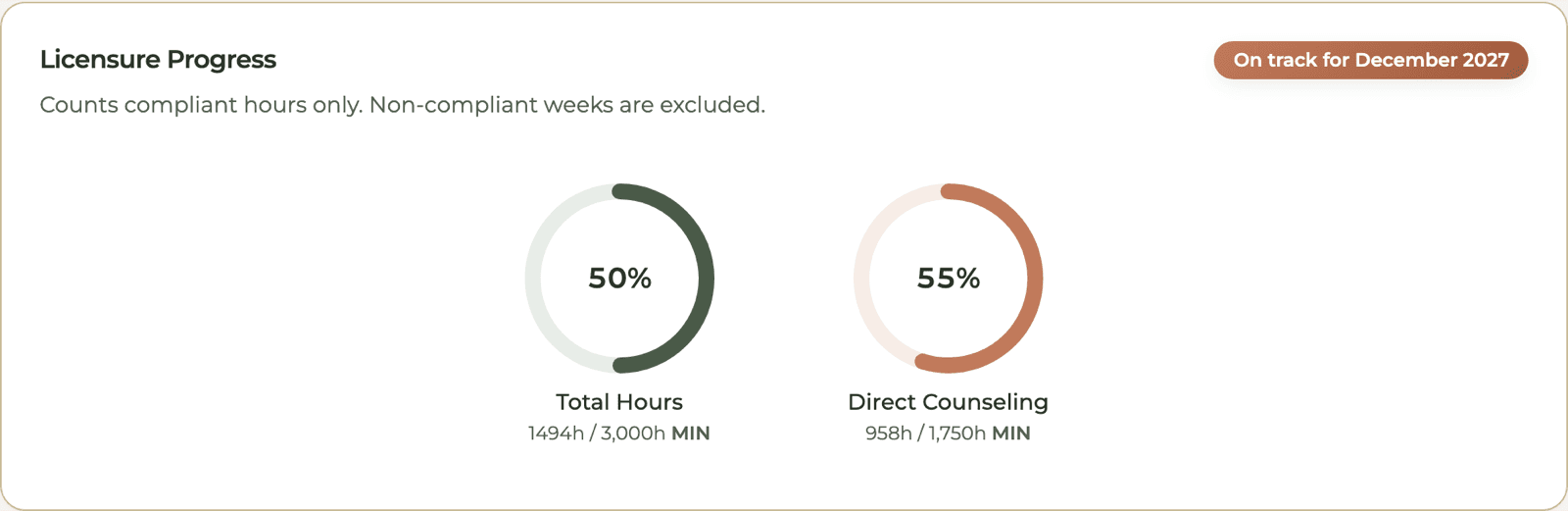
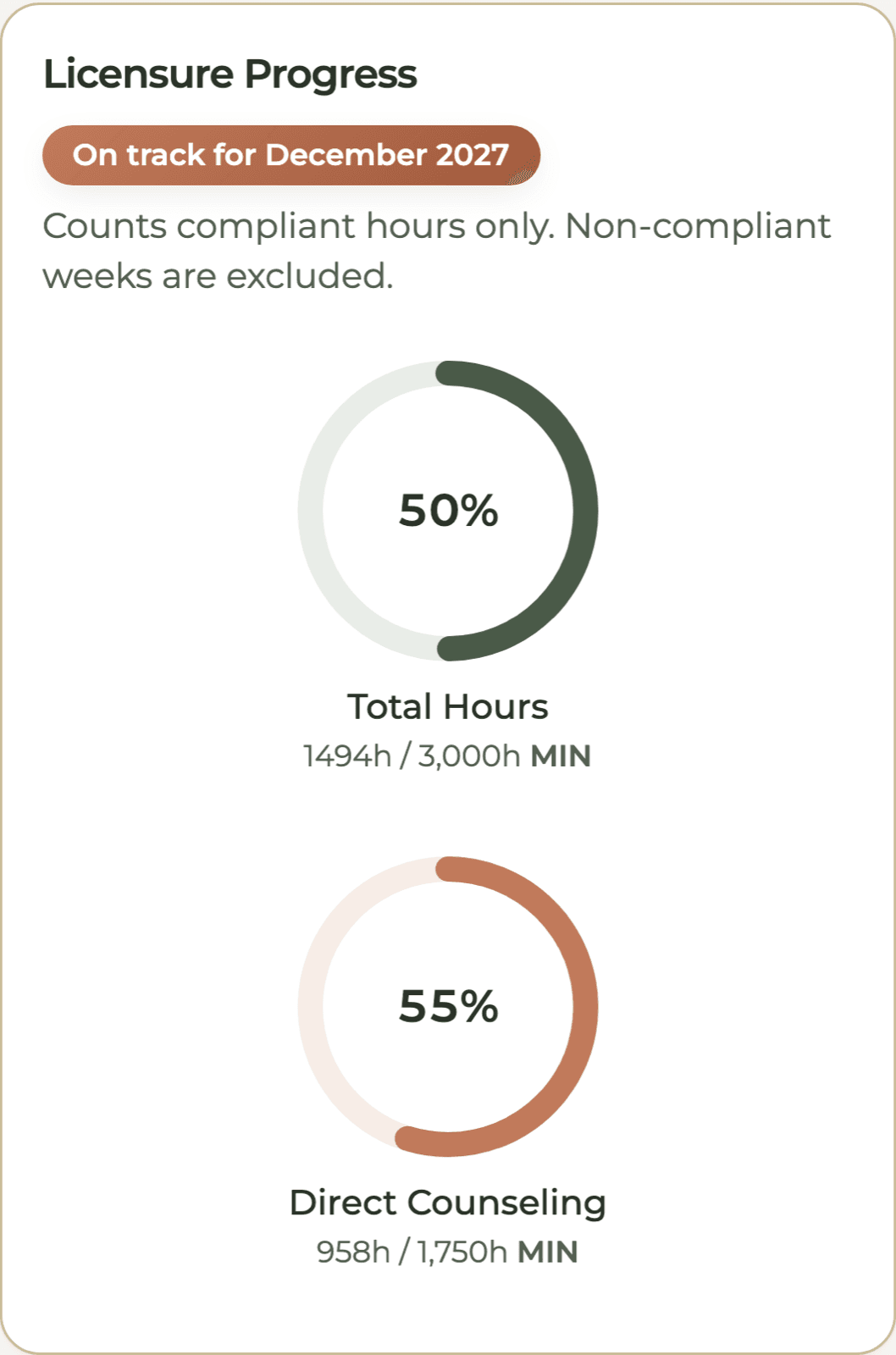
HourJourney tracks your 3,000 hours and 1,750 direct hours
Your dashboard shows total hours toward 3,000 and direct counseling toward 1,750, counting compliant weeks only.
Step 7: Apply for Licensure
Once all 3,000 hours are in, you submit your Application for Licensure to the BBS. The in-state license application form is lpc_app_st.pdf. With it you submit Form 37A-675, the In-State Experience Verification, signed by each of your supervisors. Keep your weekly logs (APCC Weekly Log of Experience Hours, Form 37A-638); the BBS asks for them only on request.
Keep complete records of every week so your Experience Verification forms are easy to prepare.
Export your BBS forms. HourJourney exports your APCC Weekly Log of Experience Hours and your Experience Verification as PDFs from the hours you logged, with signature fields left blank.
Step 8: Take and Pass the Clinical Exam (NCMHCE)
The clinical exam for LPCC licensure is the National Clinical Mental Health Counseling Examination (NCMHCE). Unlike the Law & Ethics Exam, the NCMHCE is administered by the National Board for Certified Counselors (NBCC) — not Pearson VUE. After the BBS approves your eligibility, you register with NBCC and schedule the exam through cce-global.org.
A few timing rules to know: the re-exam waiting period is 30 days between attempts, and you must take the NCMHCE within one year of your application approval — or, if you passed the Law & Ethics Exam after your application was approved, within one year of passing the Law & Ethics Exam.
Exam details change. For current passing scores, exam content, scheduling, and fees, see the NCMHCE Candidate Handbook (NBCC) and the BBS exam pages. Always confirm current requirements directly with the BBS at bbs.ca.gov and with the testing vendor.
Step 9: Obtain Your LPCC License
After you pass the NCMHCE, there is one last action: request the license and pay the initial license fee within one year of passing the Clinical Exam, using the BBS Request for Initial License Issuance form. Don't let that one-year window slip — you have done the hard part by this point.
Once the BBS issues your LPCC license number, you are a Licensed Professional Clinical Counselor in California. You may practice independently, and you can assess or treat couples and families without the former additional requirements, which AB 462 (Chapter 440, Statutes of 2021) removed effective January 1, 2022 (BBS AB 462 FAQ). BPC 4999.20(d) still requires referral when issues are beyond your education, training, and experience. See our full breakdown of the LPCC scope of practice for what this covers, and check bbs.ca.gov for current requirements.
The initial license fee and renewal fees are subject to change — check bbs.ca.gov for current amounts. Congratulations on reaching this point; the LPCC path is demanding, and finishing it says a lot about your commitment to the work and the clients you'll serve.
How Long Does It Take to Become an LPCC in California?
The minimum for supervised experience is 104 weeks and 3,000 post-degree hours, after a qualifying graduate degree. Registration, application review, and exam scheduling add time that the BBS does not publish as an average. Your weekly hours, the 40-hour limit in any seven consecutive days, and exam timing set your own pace.
Run your own numbers with the LPCC hours calculator. And if you're weighing this path against the LMFT route — different education requirements, pre-degree hours, scope, and exams — see our LMFT vs. LPCC comparison.
Common Questions About Becoming an LPCC in California
What degree do I need to become an LPCC in California?
A master's or doctoral degree that is counseling or psychotherapy in content and meets the BBS education requirements: Business and Professions Code section 4999.33 if you began graduate study on or after August 1, 2012 (or did not graduate by December 31, 2018), or section 4999.32 if you began graduate study before August 1, 2012 and graduated by December 31, 2018. Confirm with the BBS at bbs.ca.gov that your degree qualifies.
How long does it take to become an LPCC in California?
The supervised-experience minimum is 104 weeks and 3,000 post-degree hours, after a qualifying graduate degree. Registration, application review, and exam scheduling add time that the BBS does not publish as an average.
What is an APCC and do I need to register?
An APCC (Associate Professional Clinical Counselor) is the pre-licensure registration that lets you accrue supervised experience toward LPCC licensure in California. Yes — you cannot accrue supervised experience in California without an APCC registration, with the limited exception of the 90-day rule. The in-state APCC application form is pci_app.pdf.
Can I count pre-degree hours toward LPCC licensure?
No. Unlike the LMFT pathway, the LPCC pathway does not allow any pre-degree hours. All 3,000 hours of supervised professional experience must be earned after your degree is conferred.
What exams do I need to pass for LPCC licensure in California?
Two exams: the California Law & Ethics Exam, administered by Pearson VUE, which you must take annually to renew your APCC registration until you pass it; and the National Clinical Mental Health Counseling Examination (NCMHCE), administered by the National Board for Certified Counselors (NBCC) and scheduled via cce-global.org. Exam details change — confirm current requirements with the BBS at bbs.ca.gov and with the testing vendor.
How many supervised hours do I need for LPCC licensure?
3,000 total supervised hours over a minimum of 104 weeks, all post-degree. At least 1,750 of those hours must be direct clinical counseling experience, and no more than 1,250 hours may be non-clinical experience. At least 52 of the 104 weeks must include individual or triadic supervision.
How long is an APCC registration valid?
An APCC registration can be renewed five times and cannot be renewed beyond six years from the last day of the month it was issued. When no further renewals are possible, you may apply for a subsequent registration number if you meet the education requirements and have passed the California Law and Ethics Exam. A subsequent-registration holder cannot work in a private practice or professional corporation. Separately, hours cannot be older than six years when the BBS receives your Application for Licensure.
Can LPCCs treat couples and families in California?
Yes. As of January 1, 2022 (AB 462, Chapter 440, Statutes of 2021), LPCCs may assess or treat couples and families without the former additional requirements: additional education, 500 hours of supervised experience with couples, families, or children, and 6 hours of related continuing education each renewal (BBS AB 462 FAQ). BPC 4999.20(d) still requires referral when issues are beyond your education, training, and experience.
Start Tracking Your Hours on Day One
The LPCC path has a lot of moving parts: APCC registration, Live Scan, an annual exam, a second exam through a different vendor, and 3,000 hours that all have to be post-degree and in the right categories. Tracking your hours each week from the first week keeps your records complete.
HourJourney was built for California pre-licensed therapists and counselors. It marks each logged week Compliant or Non-Compliant, shows progress toward your totals, and exports your Weekly Log and Experience Verification as PDFs.
Ready to start your LPCC journey?
Start your 30-day free trial, no card required. Associate plans are $7.95/month or $79/year.
Start counting your hours freeRelated Guides
BBS Form 37A-638: The APCC Weekly Log
How to fill out the APCC weekly log column by column, and where to download it.
Tracking LPCC Hours in California
The 3,000-hour breakdown, supervision ratios, weekly caps, and Form 37A-638 — explained.
LPCC Hours Calculator
Estimate your timeline to 3,000 hours based on how many hours you log each week.
LMFT vs. LPCC in California
Education, pre-degree hours, scope of practice, and exams — how the two paths differ.
LPCC vs. LCSW in California
Counseling vs. social work — scope, coursework, exams, and which fits your goals.
Cost to Become an LPCC
Tuition, registration, Live Scan, exams, renewals, and licensure fees: what the path costs.
BBS Supervision Requirements
Who can supervise, how often, and what counts — across BBS license types.
The 90-Day Rule
How to keep hours earned between degree conferral and registration issuance.
California Law & Ethics Exam
What associates need to know about the exam and the annual renewal requirement.
Disclaimer: This guide is for informational purposes only and does not constitute legal or professional advice. While we strive to keep all information accurate and up to date based on publicly available BBS publications, California Board of Behavioral Sciences rules, fees, exam details, and requirements may change at any time. Always verify requirements directly with the California Board of Behavioral Sciences (bbs.ca.gov) before making decisions about your licensure path. HourJourney is not affiliated with, endorsed by, or sponsored by the BBS.