The Core Difference: Theoretical Tradition
Both LMFTs and LPCCs are licensed to provide independent psychotherapy in California. Both can diagnose mental health disorders, treat clients individually, and run a private practice. The question is not about what you are allowed to do — it is about which theoretical lens you want to look through for the rest of your career.
LMFT (Licensed Marriage and Family Therapist) is rooted in systemic and relational theory. MFT training centers on how individuals exist within relationship systems — couples, families, attachment patterns, intergenerational dynamics. Even when an LMFT works with an individual client, the conceptualization tends to be relational: how does this person function within their relationship context? What patterns from their family of origin are showing up? Structural family therapy, Bowenian theory, EFT, and the Gottman method are core to MFT training.
LPCC (Licensed Professional Clinical Counselor) comes from the humanistic counseling tradition. Professional counseling grew out of Carl Rogers' person-centered approach, with an emphasis on human development, wellness, prevention, and empowerment. LPCC training draws on developmental psychology, career counseling, multicultural competency, and strength-based frameworks. The theoretical orientation tends to center the individual as a whole person navigating developmental challenges, rather than primarily as a member of a relational system.
In practice, both licenses authorize independent psychotherapy, and since January 1, 2022, couples and family work is within both scopes. The differences that matter most are training tradition, pre-degree hours, and exam path.
Key takeaway
The theoretical tradition and the pre-degree hours advantage are the practical differences. Both licenses can lawfully treat couples and families.
Education: What Degree Do You Need?
The degree requirements are different, but not as different as you might expect. Some programs qualify graduates for both license types. Understanding the distinction matters for choosing the right program.
For LMFT: You need a qualifying master's or doctoral degree in one of the fields listed in BPC 4980.36(b), such as marriage and family therapy or counseling psychology, from a school approved by the Bureau for Private Postsecondary Education or accredited as that section describes. The BBS requires a minimum of 60 semester units (or 90 quarter units) with specific coursework in marriage, family, and child counseling; human development; psychopathology; and professional ethics.
For LPCC: You need a master's or doctoral degree that is counseling or psychotherapy in content (BPC 4999.33). The BBS requires at least 60 semester units with coursework covering core counseling areas: human growth and development, social and cultural diversity, counseling theory, group counseling, career development, assessment and testing, research, and professional orientation. California also requires specific coursework in California law and professional ethics.
The overlap: Some California graduate programs satisfy the requirements for both LMFT and LPCC licensure. If you are considering dual licensure, choosing a program that qualifies for both tracks from the start is the most efficient path.
Before enrolling, verify directly with the BBS that your specific program qualifies for the license type you intend to pursue. Program names can be misleading — a program called “Clinical Counseling” may or may not meet LMFT requirements, and a program called “Marriage and Family Therapy” may or may not meet LPCC requirements.
Couples and Family Therapy: A Training Difference, Not a Legal Restriction
Older comparisons treat this as the biggest legal distinction between the two licenses. That is no longer accurate, and it deserves a thorough explanation because outdated guides still get it wrong.
LMFTs have couples and family therapy built into their scope of practice from day one. The moment you receive your LMFT license (or begin accruing hours as an AMFT under supervision), you can provide couples therapy, family therapy, and child therapy. This is intrinsic to the license — no additional steps, no extra paperwork. Your MFT training includes extensive coursework in systemic and relational theory, and the BBS hour requirements include 500 hours of Couples, Families, and Children (CFC) work specifically.
LPCCs can now also treat couples and families. Until January 1, 2022, an LPCC had to complete 6 semester (or 9 quarter) units of additional coursework (or a named marriage and family therapy specialization), 500 hours of supervised experience with couples, families, or children, and 6 hours of related continuing education each renewal cycle before treating couples or families. AB 462 (Stats. 2021, Ch. 440) repealed that requirement, effective January 1, 2022. Under current law, LPCCs may assess, evaluate, and treat couples and families with no additional coursework and no extra supervised hours.
What remains is a difference of training emphasis, not legal scope. LMFT programs and supervised hours center on systemic and relational work from the start, so many LMFTs feel more prepared for complex couples and family cases. LPCCs come from a counseling-centered tradition and may choose to pursue additional relational training by choice — but they are no longer legally required to.
Bottom line
If couples and family therapy is central to your clinical identity, the LMFT path is built around it from day one. But the LPCC couples-and-families coursework requirement is gone as of January 1, 2022, so an LPCC can lawfully do this work too — the choice now comes down to training emphasis and clinical fit rather than a legal restriction.
For more on how couples and family hours factor into the LMFT hour structure, see our California LMFT hours requirements guide.
BBS Hours and Registration
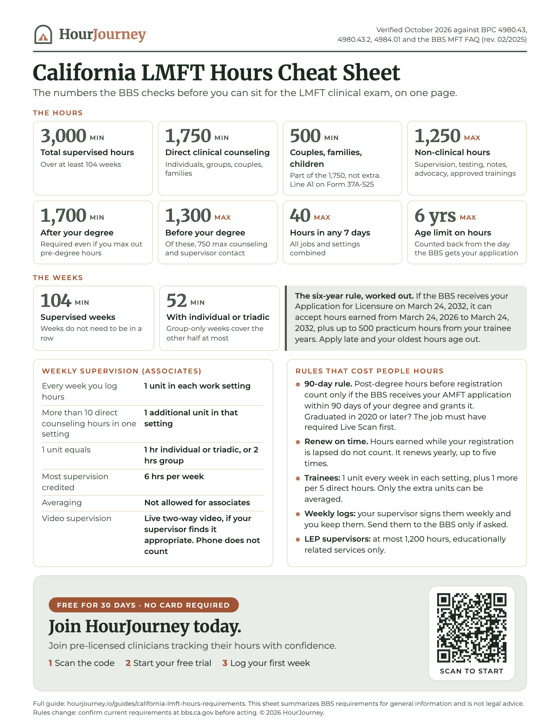
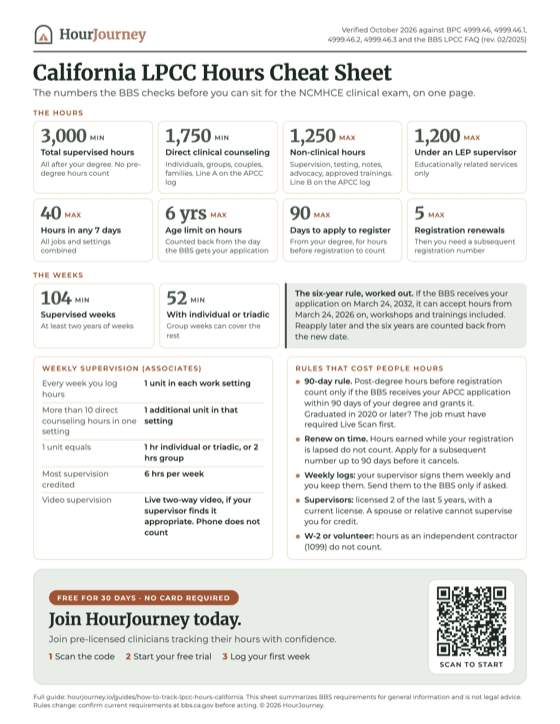
The hour structures for LMFT and LPCC share the same foundation but differ in important details. Both require 3,000 total supervised hours over at least 104 weeks, with a maximum of 40 hours in any seven consecutive days. Both require at least 52 weeks of individual or triadic supervision. But the internal composition of those hours is where the paths diverge.
Requirement
LMFT (AMFT)
LPCC (APCC)
| Total hours | 3,000 | 3,000 |
| Min. weeks | 104 weeks | 104 weeks |
| Direct client hrs | 1,750 minimum | 1,750 minimum |
| Specialty direct | 500 hrs CFC (Couples, Families, Children) | None |
| Pre-degree hours | Up to 1,300 as MFT Trainee | None allowed |
| Post-degree min. | 1,700 hours minimum | 3,000 (all must be post-degree) |
| Non-clinical max | 1,250 hours | 1,250 hours |
| Supervision ratio | 1 unit per week per setting; 2 units over 10 direct hrs | 1 unit per week per setting; 2 units over 10 direct hrs |
| Indiv. supervision | 52 weeks (individual or triadic) | 52 weeks (individual or triadic) |
| Weekly cap | 40 hours in any 7 days | 40 hours in any 7 days |
| Weekly log form | BBS Form 37A-525 | BBS Form 37A-638 |
| 90-day rule | Applies | Applies |
The most impactful difference in this table is pre-degree hours. LMFTs can enter the associate period with up to 1,300 hours already banked from their MFT Trainee experience during grad school. LPCCs start from zero after graduation: they need 3,000 post-degree hours, versus a 1,700-hour post-degree minimum for LMFT.
The LMFT path also requires 500 hours of Couples, Families, and Children (CFC) work as a subset of the 1,750 direct hours. The LPCC path has no equivalent specialty subset requirement. This is not because LPCCs are barred from couples and family work — since January 1, 2022 (AB 462) they can do it without any extra coursework or hours — but simply because the LPCC hour structure does not carve out a dedicated CFC minimum. The LMFT CFC requirement is a feature, not a burden: it ensures you are prepared for the relational work your license authorizes.
Both paths are subject to the 90-day rule if you begin accruing hours before your BBS registration is issued. For the complete LMFT hour breakdown, see our California LMFT hours requirements guide. For LPCC-specific tracking details, see how to track LPCC hours in California. For supervision requirements that apply to both paths, see our BBS supervision requirements guide.
The Exams
Both paths require a California Law and Ethics Exam (L&E), but each license has its own: the LMFT Law and Ethics Examination and the LPCC Law and Ethics Examination. If you pursue both licenses, you take both.
The clinical exams differ significantly, and the difference has implications beyond just study material.
LMFT Clinical Exam: This is a California exam developed by the Department of Consumer Affairs' Office of Professional Examination Services and delivered by Pearson VUE. Its content areas are clinical evaluation, developing a diagnostic impression, managing crisis situations, case conceptualization and planning, treatment, and managing legal and ethical obligations.
NCMHCE (National Clinical Mental Health Counseling Examination): This is the clinical exam for LPCC: a national exam offered by the National Board for Certified Counselors (NBCC).
License Portability
Out-of-state portability depends on each state's board. Every state sets its own exam, hour, and degree rules, so check the board of any state you might move to before choosing a license for portability (BBS APCC FAQ, Q24).
Dual Licensure: LMFT and LPCC
If you cannot decide between the two, you may not have to. Dual licensure, holding both an LMFT and an LPCC license, is possible in California. Here is how it works.
Your degree must qualify for both. This is the first and most important requirement. If your graduate program meets the coursework requirements for both LMFT and LPCC licensure, you are eligible to pursue both paths. If your program only meets the requirements for one license type, dual licensure will require additional coursework.
Register as both AMFT and APCC. After graduation, you can register with the BBS as both an Associate Marriage and Family Therapist (AMFT) and an Associate Professional Clinical Counselor (APCC), with separate applications and fees. Keep both registrations active while you gain hours. Under the 90-day rule, submit both applications so the BBS receives them within 90 days of your degree award date.
The same hours can count toward both. This is the key efficiency gain. Hours count toward both licenses when they are within the scope of both and fit the categories, minimums, and maximums of both (BBS APCC FAQ, Q42). You do not need 6,000 hours total; you need 3,000 hours that satisfy both license types. Any supervisor who is eligible to supervise associates can supervise both tracks, subject to the 1,200-hour limit on hours under a licensed educational psychologist.
You will need to pass both sets of exams. Dual licensure requires the LMFT Clinical Exam and the NCMHCE, plus the California Law and Ethics Exam for each license type (separate applications, fees, and exams).
HourJourney tracks AMFT and APCC hours on one account
Switch between your AMFT and APCC tracks at the top of the app. The same logged hours are counted against each license's own requirements, and each track exports its own weekly log.
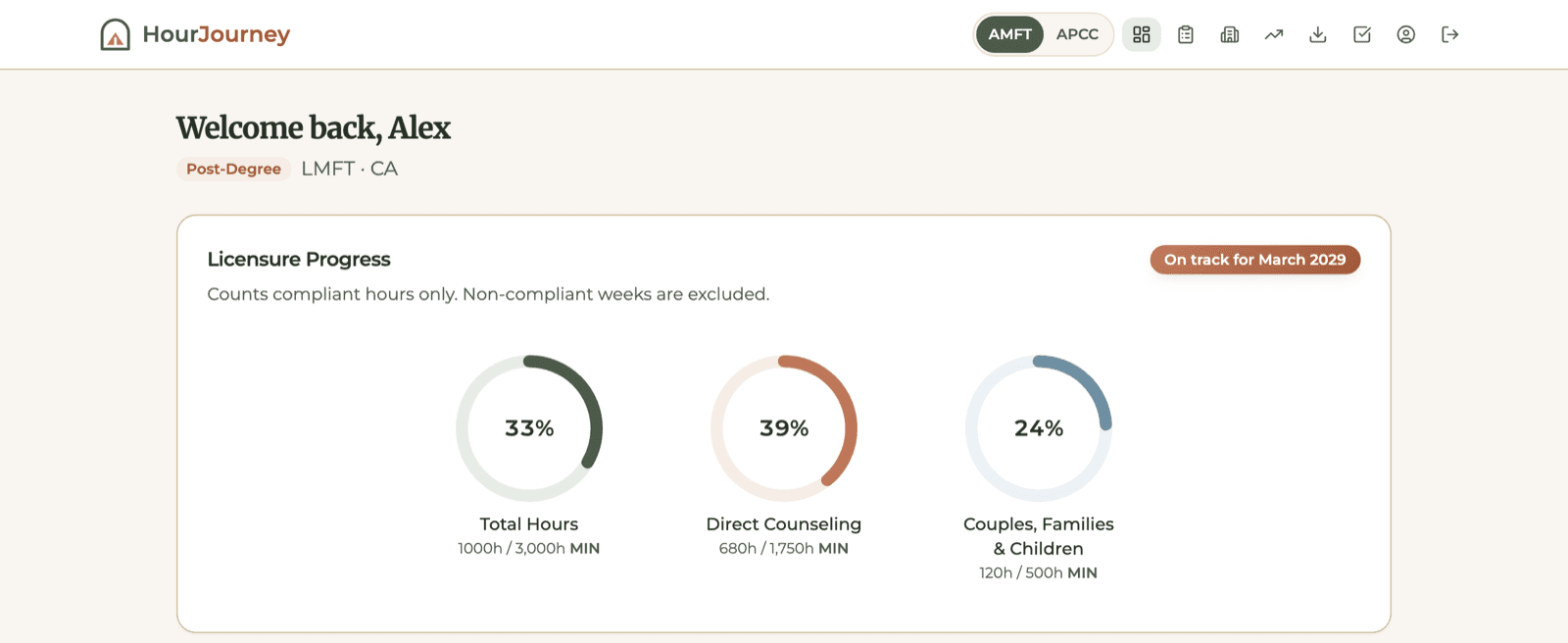
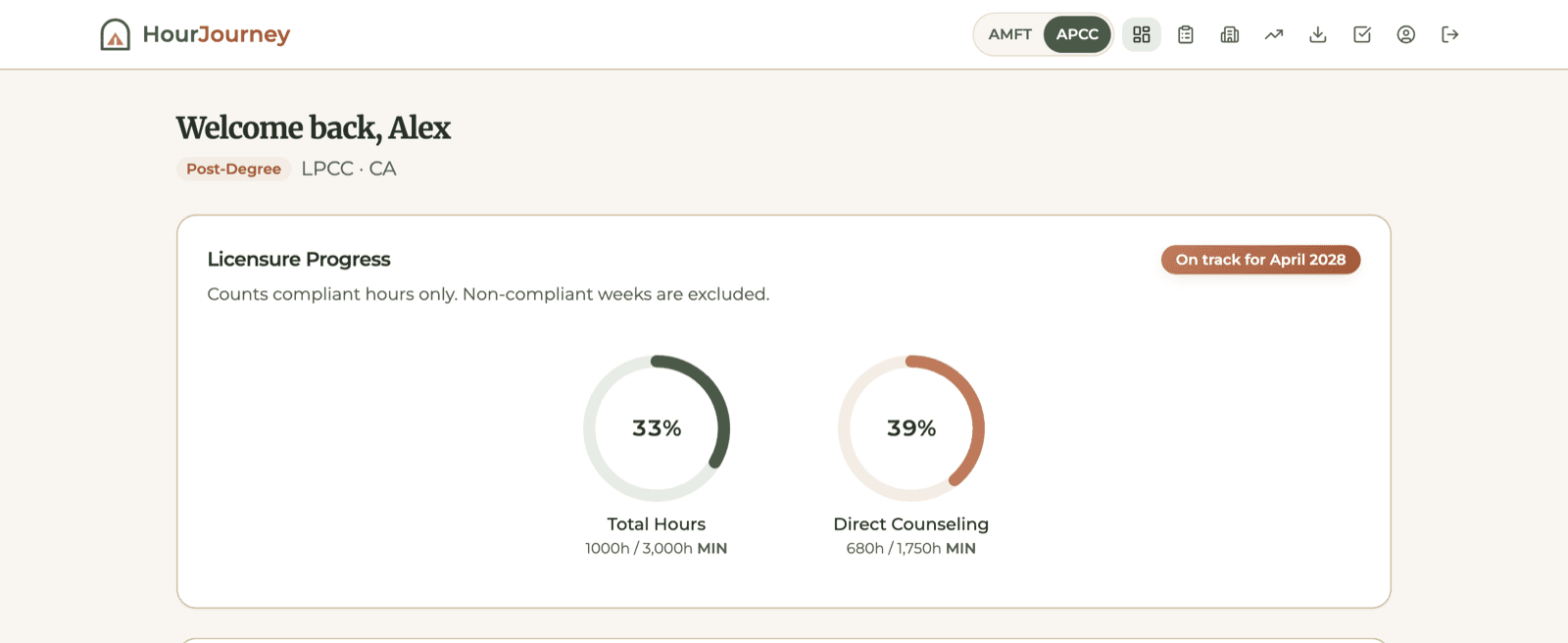
Dual licensure broadens your training across both systemic and counseling traditions. (Note that an LPCC alone can already treat couples and families since AB 462 took effect on January 1, 2022, so dual licensure is no longer needed to remove a scope barrier.) The trade-off is studying for and passing two clinical exams instead of one. For many clinicians, that trade-off is worth it.
Which Is Right for You?
Choose LMFT if you...
tends to be a strong fit if you...
Are drawn to couples and family therapy as a primary modality
Think in terms of relational patterns, attachment styles, and family systems
Want training and a 500-hour requirement centered on couples, families, and children
Value the pre-degree hours advantage (up to 1,300 hours during grad school)
Plan to build a private practice focused on relationships
Are confident you will practice in California long-term
Choose LPCC if you...
tends to be a strong fit if you...
Are drawn to individual counseling, human development, and wellness-oriented work
Think in terms of personal growth, developmental stages, and client empowerment
Prefer a national clinical exam (NCMHCE) over a California-only one
Are focused on individual counseling
Are drawn to the counseling profession's identity and philosophical tradition
Consider dual licensure (LMFT + LPCC) if you...
Want both training traditions and both clinical exam paths
Have a graduate program that qualifies for both license types
Are willing to study for and pass two clinical exams in exchange for long-term flexibility
FAQ: LMFT vs LPCC California
What is the difference between LMFT and LPCC in California?+
Both licenses authorize independent clinical practice, including diagnosing, treating, and running a private practice. The core difference is theoretical tradition: LMFTs are trained in systemic/relational theory (couples, families, attachment), while LPCCs are trained in humanistic counseling traditions (person-centered, developmental, wellness). Both can treat couples and families: LMFTs have it built into their scope, and as of January 1, 2022 (AB 462) LPCCs can too, with no additional coursework or extra supervised hours. The practical difference is one of training emphasis, not a legal scope restriction.
Can an LPCC do couples therapy in California?+
Yes. As of January 1, 2022, LPCCs in California can assess, evaluate, and treat couples and families with no additional coursework or extra supervised hours. Before 2022, LPCCs had to complete additional coursework in couples and family therapy plus 500 supervised hours to add that scope, but AB 462 (Stats. 2021, Ch. 440) repealed that requirement. Today both LMFTs and LPCCs can practice couples and family therapy; the difference is one of training emphasis rather than legal scope.
Which is easier to get, LMFT or LPCC in California?+
Neither is clearly easier. Both require 3,000 supervised hours over at least 104 weeks, with 1,750 direct client hours. LMFTs can count up to 1,300 pre-degree hours, giving a significant head start. LPCCs cannot count any pre-degree hours. The LPCC clinical exam is the NCMHCE, a national exam offered by NBCC; the LMFT Clinical Exam is a California exam. Different advantages, not easier or harder.
Can I get both LMFT and LPCC licenses in California?+
Yes, if your degree qualifies for both license types. Register as both an AMFT and an APCC (separate applications and fees), keep both registrations active while you gain hours (or submit both applications within 90 days of your degree award date under the 90-day rule), make sure the hours fit the scope, categories, minimums, and maximums of both licenses, and take the California Law and Ethics Exam for each license type (BBS APCC FAQ, Q42). You also pass both clinical exams: the LMFT Clinical Exam and the NCMHCE.
Do pre-degree hours count for LPCC licensure?+
No. Unlike the LMFT path, which allows up to 1,300 pre-degree hours earned as an MFT Trainee, the LPCC path requires all 3,000 supervised hours to be earned after the degree is awarded. LPCC candidates need 3,000 post-degree hours, versus a 1,700-hour post-degree minimum for LMFT.
What exam do I need for LPCC licensure in California?+
LPCC candidates must pass the LPCC California Law and Ethics Exam and the National Clinical Mental Health Counseling Examination (NCMHCE), a national exam offered by the National Board for Certified Counselors (NBCC). The LMFT path has its own Law and Ethics Exam and the California LMFT Clinical Exam.
Is LPCC or LMFT better for private practice in California?+
Both licenses have full independent practice rights once fully licensed. Both can diagnose, treat, bill insurance, and operate a private practice. Since January 1, 2022 (AB 462), couples and family work is within both scopes, so the choice rests on training emphasis and clinical fit.
BBS Disclaimer: Requirements reflect BBS guidance current as of 2025-2026. The California Board of Behavioral Sciences (BBS) is the sole authority on licensure requirements. Information in this guide is for educational purposes only and does not constitute legal or professional advice. Requirements, fees, and procedures are subject to change. Always verify current requirements at bbs.ca.gov before making decisions about your licensure path.
Licensing in Texas instead? Our guide to how to become an LPC in Texas walks the counseling path under BHEC, from the LPC Associate application through the upgrade that costs nothing.
Related guides
BBS Form 37A-638: The APCC Weekly Log of Experience Hours
How to fill out the APCC weekly log column by column, and where to download it.
LMFT vs LCSW in California: Which Path Is Right for You?
A full comparison of the LMFT and LCSW paths in California.
LPCC vs LCSW in California: Which Path Is Right for You?
How the counseling and social work clinical licenses compare.
California LMFT Hours Requirements: The Complete 2026 Guide
Every hour minimum, maximum, and deadline in plain English.
How to Track LPCC Hours in California
The APCC hour structure, supervision requirements, and BBS forms.
The 90-Day Rule for AMFTs in California
What counts, what doesn't, and how to protect your hours.
BBS Supervision Requirements in California
Ratios, qualifications, and weekly documentation rules.
LMFT Hours Calculator
Estimate your LMFT timeline with our interactive calculator.
LPCC Hours Calculator
Estimate your LPCC timeline with our interactive calculator.
All Guides
Browse every HourJourney guide for California pre-licensed clinicians.