What the California Law & Ethics Exam Is
The California Law & Ethics Exam is a standardized exam required of every associate registered with the California Board of Behavioral Sciences. Each license has its own exam (the LMFT, LPCC, and LCSW Law and Ethics Examinations). They are delivered by Pearson VUE, which publishes the official Candidate Handbook at home.pearsonvue.com/cabbs.
Each associate registration type takes the exam for its license:
- Associate Marriage and Family Therapists (AMFTs): the LMFT Law and Ethics Examination
- Associate Clinical Social Workers (ASWs): the LCSW Law and Ethics Examination
- Associate Professional Clinical Counselors (APCCs): the LPCC Law and Ethics Examination
Regardless of which path you are on, the Law & Ethics Exam is part of your associate years. For an overview of where it fits in the bigger picture, see our guides on how to become an MFT in California, how to become an LPCC in California, and the ASW-to-LCSW path.
This guide explains the process — how the exam fits into your associate years and how to request it. It is not exam-prep material and does not cover exam content or strategy. We do not recommend prep vendors.
When You Have to Take It
There are two separate timing rules to understand, and they work independently of each other.
1. Until you pass it, you take it during each renewal cycle to renew
If you have not yet passed the California Law & Ethics Exam, you must take it during each renewal cycle in order to renew your associate registration. You do not need to pass it to renew; taking it during the cycle is what counts. Once you pass the exam, it is not part of future renewals.
2. You must pass it before the BBS issues a subsequent registration
Associates can hold a registration for a limited number of years; when no more renewals are possible they may apply for a new (subsequent) registration number. The BBS will not issue a subsequent (second or third) associate registration until you have passed the Law & Ethics Exam. So even though you can renew an existing registration just by taking the exam, you cannot move to a fresh registration cycle without passing it.
The BBS says to apply early in your renewal cycle and schedule well before your expiration date: exam applications can take up to 6 weeks to process. Passing it sooner removes the renewal-cycle obligation and keeps the door open to a subsequent registration if you need one.
Registration renewal runs on its own clock
Your associate registration expiration and renewal dates are separate from your supervised-hour milestones. Check your expiration and renewal dates in BreEZe.
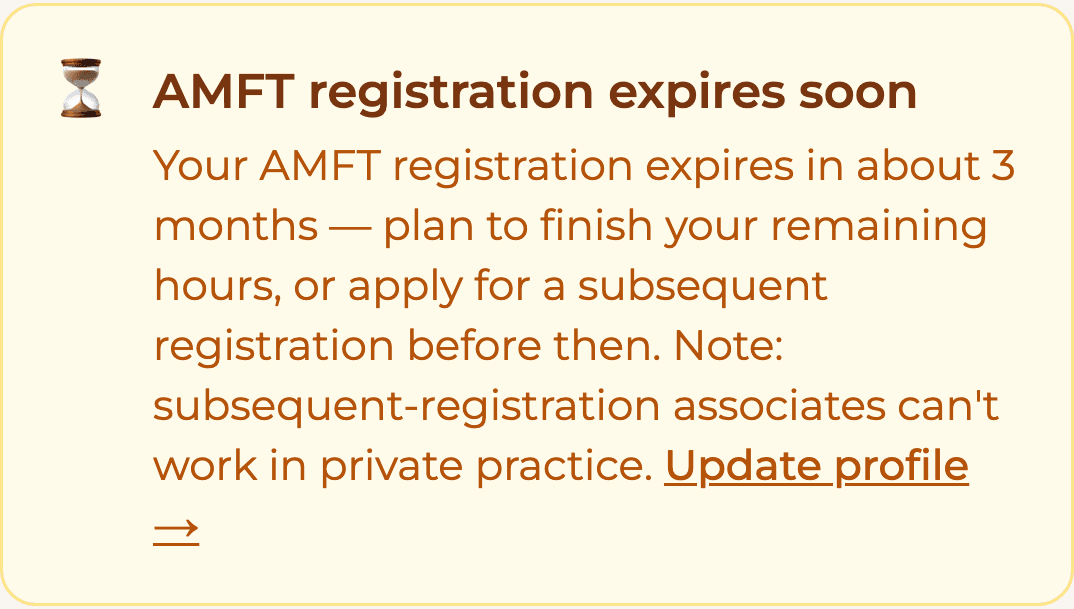
HourJourney warns you before your registration expires
Your dashboard shows a banner as your registration's six-year end approaches. It does not schedule the exam or file your renewal.

How to Request the Exam: Initial vs. Re-Examination
There are two routes to the exam, depending on whether you are taking it for the first time or retaking it.
Taking it the first time
You submit an initial Law and Ethics exam application to the BBS. Registrants can submit it online at breeze.ca.gov; paper applications are on bbs.ca.gov:
- AMFTs and ASWs: use the online form at bbs.ca.gov/exams/initial_lawethics_app.html
- APCCs: use the form
registrant_initial_law-ethic_exam_request.pdffrom the BBS
Once the application is approved, Pearson sends you an Authorization to Test, and you schedule your appointment with Pearson VUE. The Candidate Handbook covers how scheduling works, what to bring, and the testing experience itself.
Retaking it
If you do not pass, you apply for re-examination online in BreEZe or on paper (see bbs.ca.gov/exams/re_exam_acknowledge.html). After approval, Pearson sends an Authorization to Test and you schedule with Pearson VUE. There is a 90-day wait between attempts.
The Law and Ethics Examination FAQ
The BBS publishes a Law and Ethics Examination FAQ at bbs.ca.gov/pdf/publications/law_ethics_faq.pdf. Check it before submitting any exam request.
The Exam vs. the 3-Hour Law & Ethics CE Requirement
These are two separate requirements.
| Law & Ethics Exam | 3-Hour Law & Ethics CE | |
|---|---|---|
| What it is | A standardized exam administered by Pearson Vue. | A continuing education course (3 hours of California law and ethics content). |
| When | Until you pass, take it during each renewal cycle to renew; after you pass, not again. | Complete it during each renewal period, before renewing. Effective January 1, 2023. |
| Who | Associates who have not yet passed it (AMFTs, ASWs, APCCs), each on their license's exam. | All registered associates — whether or not you have passed the Law & Ethics Exam. |
| Source | Pearson VUE Candidate Handbook & BBS Law and Ethics Examination FAQ. | BBS Registrant continuing education brochure. |
In short: passing the exam does not exempt you from the CE requirement, and completing the CE hours does not satisfy the exam requirement. They live on the same renewal cycle but are checked independently.
The 3-hour Law & Ethics CE applies to every registered associate during every renewal period, even after you have passed the exam. Don't assume passing the exam takes care of it.
Exam Details and Fees
For question counts, time limits, content outlines, accommodations, scheduling, and fee policies, see the Candidate Handbook (Pearson VUE, at home.pearsonvue.com/cabbs). Current fees are on the BBS fee page at bbs.ca.gov.
We do not reproduce those figures here. Exam parameters and fees change, and the official sources are the ones to rely on. This guide does not endorse or rank exam-prep companies, and prep strategy is outside its scope.
Exam details and fees change. Confirm current requirements directly with the BBS at bbs.ca.gov and with Pearson VUE before you plan around any number you read online, including older versions of the official handbook.
A Simple Way to Stay On Top of It
The risk is waiting too long: exam applications can take up to 6 weeks to process. Here is a short checklist.
Plan to take it early in your associate years
Passing the exam sooner removes the take-it-to-renew obligation and keeps a subsequent registration available if you need one.
Submit the right request form
First time: the initial exam application. Retaking: the re-examination application, after the 90-day wait. Both can be submitted online in BreEZe or on paper.
Read the Pearson Vue Candidate Handbook before scheduling
It covers question counts, time limits, content outlines, accommodations, scheduling, and fee policies.
Keep the exam and the 3-hour CE separate in your planning
Both ride the renewal cycle; both are checked independently. Passing the exam does not cover the CE, and the CE applies even after you pass.
Re-confirm requirements before each renewal
Check bbs.ca.gov and the Law and Ethics Examination FAQ each renewal period. Fees and rules change.
How HourJourney Fits In
HourJourney does not administer the Law & Ethics Exam (Pearson VUE does). It logs your weekly hours and keeps your licensure steps in one place. For where the exam fits in the broader licensure path, see our guide on the AMFT registration process in California.
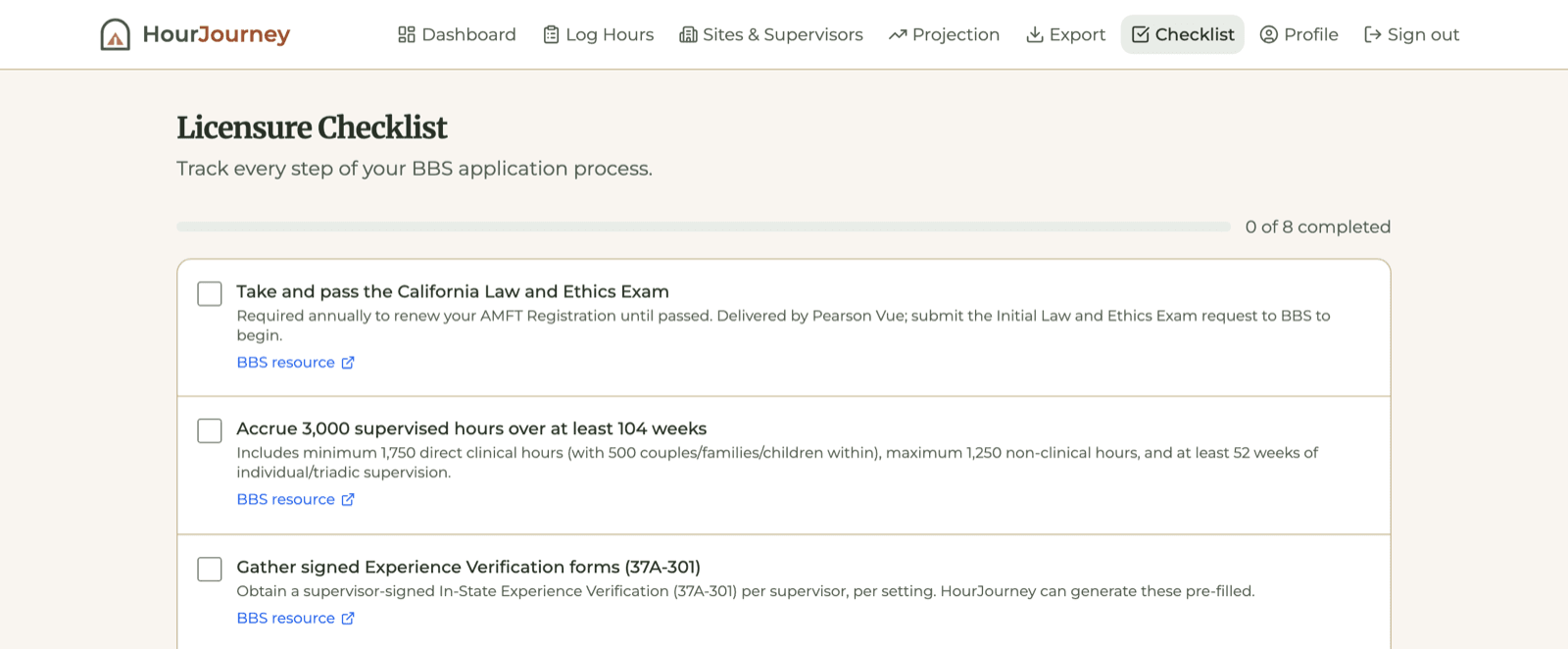
HourJourney keeps your licensure checklist
The checklist lists each step to licensure, starting with the Law and Ethics Exam, and you check each one off as you finish it.
FAQ: California Law & Ethics Exam
Who has to take the California Law & Ethics Exam?+
All three associate registration types issued by the California BBS take a Law and Ethics Exam, and each license has its own: AMFTs take the LMFT Law and Ethics Examination, APCCs the LPCC exam, and ASWs the LCSW exam.
When do I have to take the Law & Ethics Exam?+
You must take the exam each year in order to renew your associate registration until you pass it. Once you pass, you do not take it again. Separately, you must pass the exam before the BBS will issue you a subsequent (second or third) associate registration number.
How do I request the Law & Ethics Exam for the first time?+
Submit an initial Law and Ethics exam application to the BBS, online in BreEZe or on paper from bbs.ca.gov (AMFTs and ASWs: bbs.ca.gov/exams/initial_lawethics_app.html; APCCs: the registrant_initial_law-ethic_exam_request.pdf form). Once it is approved, Pearson sends an Authorization to Test and you schedule with Pearson VUE.
How do I retake the Law & Ethics Exam if I do not pass?+
Apply for re-examination online in BreEZe or on paper (see bbs.ca.gov/exams/re_exam_acknowledge.html). After approval, Pearson sends an Authorization to Test and you schedule with Pearson VUE. There is a 90-day wait between attempts.
Is the Law & Ethics Exam the same as the 3-hour Law & Ethics CE requirement?+
No. They are two separate requirements. You take the exam during each renewal cycle until you pass it, and after you pass you do not take it again. The 3-hour California Law & Ethics continuing education requirement, effective January 1, 2023, must be completed by every registered associate during each renewal period before renewing, whether or not you have passed the exam.
What is the passing score and how many questions are on the Law & Ethics Exam?+
The Pearson VUE Candidate Handbook (home.pearsonvue.com/cabbs) covers question counts, time limits, content outlines, accommodations, scheduling, and fee policies. Current fees are on the BBS fee page at bbs.ca.gov. This guide explains the process, not the exam content.
Related guides
How to Become an MFT in California: Step-by-Step
The complete path from MFT degree to LMFT license.
How to Become an LPCC in California
Education, the APCC years, hours, and exams for the LPCC path.
From ASW to LCSW in California
How the social work associate years work, from registration to licensure.
AMFT Registration Process in California: Step-by-Step
Live Scan, the application, fees, and the full timeline.
The BBS 90-Day Rule for AMFTs, APCCs, and ASWs
How to protect post-degree hours earned before your number arrives.
Start tracking your hours free
Log direct, non-clinical, and supervision hours in separate fields for each supervisor and site.
This guide explains the process: how the California Law & Ethics Exams fit into your associate years and how to request them. It is not exam-prep material and does not cover exam content or strategy. For question counts, time limits, content outlines, accommodations, scheduling, and fee policies, see the Candidate Handbook (Pearson VUE, at home.pearsonvue.com/cabbs); current fees are on the BBS fee page. Exam details and fees change, so confirm current requirements directly with the BBS and with Pearson VUE.
This guide is for informational purposes only. Always verify requirements directly with the BBS at bbs.ca.gov.