The Answer by Track
| Track | Do practicum or internship hours count? | Cite |
|---|---|---|
| LPC Associate | No. Hours obtained by an unlicensed person do not count toward the supervised experience requirements. | 681.91(c), 681.93(f)(1) |
| LMFT Associate | Not as a rule. Two provisions: excess internship hours for programs begun before September 1, 2025, with two caps; and practicum or internship in a doctoral program after the master's degree is conferred. | 801.142(4), (9) |
| LCSW (LMSW under a plan) | No pre-degree credit is stated. Field placement is a degree requirement, and the 3,000 hours are earned under a supervision plan. | 781.401(a)(1)(B), 781.405(a) |
The boards use different words for the same stage of training. The LPC rules say practicum, and the application includes a Practicum Documentation Form (22 TAC 681.72(a)(6)). The LMFT rules require a supervised clinical internship inside the degree (801.114(b)(8)), and the board's form for it is titled Supervised Clinical Practicum Form. The LCSW rules say field placement (781.102(24)).
LPC: Hours Before the Associate License Do Not Count
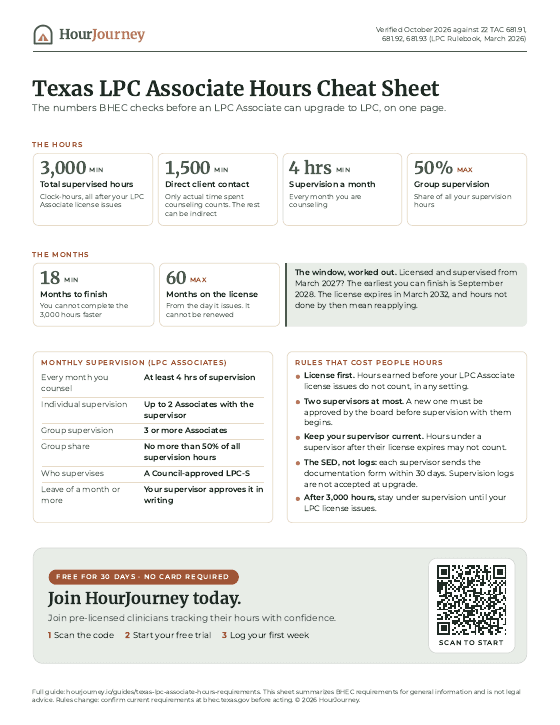
The Texas State Board of Examiners of Professional Counselors sets the LPC Associate experience at 3,000 clock-hours under a Council-approved supervisor (22 TAC 681.92(a)). The rule on what counts is one sentence: "Hours obtained by an unlicensed person in any setting will not count toward the supervised experience requirements" (681.91(c)). The practicum is documented on the Practicum Documentation Form (681.72(a)(6)), and it does not count toward the 3,000: the supervisor must ensure the experience was earned after the Associate license was issued (681.93(f)(1)).
The Associate license expires 60 months from the date of issuance (681.91(g)), so the clock runs from issuance and not from the first day of practicum. Related pages: the 60-month LPC Associate limit and what an LPC Associate is in Texas.
The two documentation forms go in at different times. The Practicum Documentation Form is part of the Associate application (681.72(a)(6)). It records direct and indirect clock-hours, dates and setting, one form per site, and BHEC lists it on the LPC Forms and Publications page. The post-license hours are reported later, on the Supervised Experience Documentation Form, when you apply for the upgrade. See upgrading from LPC Associate to LPC and Texas LPC Associate hours requirements.
How much practicum the degree must contain is a separate question, and the answer depends on the degree. A counseling degree is "presumed to have satisfied" the course content (681.83(a)). For an applicant whose graduate degree is in a counseling-related field, the rule requires "supervised practicum experience primarily counseling in nature" of "at least 300 clock-hours, of which at least 100 hours must be direct client counseling," with credit or other acknowledgment on the official graduate transcript (681.83(b)(10)).
The 300 and 100 figures are not the Texas practicum requirement for every applicant. They are the practicum rule for counseling-related degrees (681.83(b)(10)). A counseling degree carries the presumption in 681.83(a).
Rule 681.92(a)(2) sets who may supervise an Associate's internship physically completed outside Texas: a person "licensed or certified by that jurisdiction in a profession that provides counseling" with the academic training and experience to supervise, documented to the Council. Chapter 681 uses "internship" for the Associate's supervised experience after licensure (681.91(c), (d)), so this is a supervisor-qualification rule. It does not credit graduate practicum. Once the license issues, supervision is governed by the monthly rule in Texas LPC supervision requirements and the full path is in how to become an LPC in Texas.
What "Counselor Intern" Means in Occupations Code 503.052
The statute reads: "This chapter does not apply to an activity or service of a student, intern, or trainee in counseling pursuing a course of study in counseling in a regionally accredited institution of higher education or training institution if: (1) the activity or service is a part of the supervised course of study; and (2) the person is designated as a 'counselor intern.'"
This is an exemption from the LPC Act for a student in a supervised course of study who is designated a counselor intern. It is a different thing from the post-degree LPC Associate license. The LPC Associate is a license that lets a person practice counseling under a Council-approved supervisor (681.2(19)), and 503.052 creates no license. The text also does not say that practicum hours count toward the 3,000, and this page does not infer that it does.
The same two words appear on another path. The Texas Health and Human Services Commission, not BHEC, registers Counselor Intern (CI) applicants on the way to the Licensed Chemical Dependency Counselor credential (26 TAC Chapter 562). That is a separate agency, statute and set of forms, and it is outside this page.
LMFT: The Degree Internship and the Excess-Hours Exception
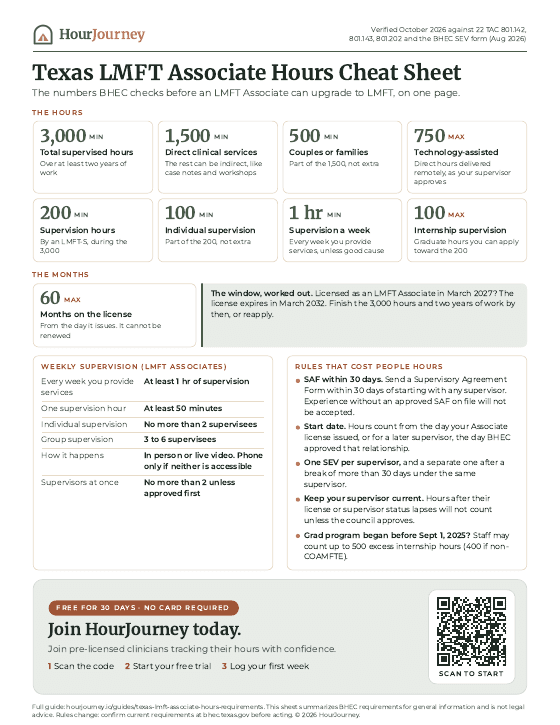
The Texas State Board of Examiners of Marriage and Family Therapists requires the degree program to include a supervised clinical internship of 12 months or nine semester hours with 300 hours of experience, at least 150 of them direct client contact, and at least 75 of those with couples and families, for programs begun on or after August 1, 2017 (22 TAC 801.114(b)(8)). Outside the provisions below, LMFT experience counts from the date the LMFT Associate license was issued or, for a later supervisor, the date BHEC staff approved that supervisory relationship (Supervised Experience Verification Form, Section IV). The Supervisory Agreement Form says: "Experience accrued without an approved SAF on file will not be accepted."
The exception is in 801.142(4). For applicants who begin the graduate degree program before September 1, 2025, staff may count graduate internship hours that exceed the 801.114(b)(8) requirements toward the 3,000 hours of supervised clinical practice. Two caps apply, and they depend on the program's accreditation.
| Program | Most excess hours counted | Of those, most couples or families | Cite |
|---|---|---|---|
| COAMFTE | 500 | 250 | 801.142(4)(A) |
| Not COAMFTE | 400 | 200 | 801.142(4)(B) |
Arithmetic from the rule, with hypothetical numbers. A student in a COAMFTE program that began before September 1, 2025 completes 720 internship hours. The degree requirement is 300, so 420 hours exceed it (720 - 300 = 420). That is under the 500 cap, so up to 420 hours could count toward the 3,000, leaving 2,580 (3,000 - 420 = 2,580). The same 720 hours in a non-COAMFTE program also exceed the requirement by 420, but the cap is 400, so up to 400 count and 2,600 remain (3,000 - 400 = 2,600). Both cases assume the excess couples and family hours stay within the 250 or 200 limit. The rule says staff "may" count the hours, so the credit is not automatic.
A separate provision covers supervision hours. Up to 100 graduate internship supervision hours may be applied toward the 200 supervision hours (801.142(3)(C)). That pool is different from the exception above: the 801.142(4) hours count toward the 3,000, and the 801.142(3)(C) hours count toward the 200.
A second provision is in 801.142(9). An applicant with a master's degree that qualifies under 801.112 and 801.113 "may count any supervision and experience (e.g., practicum, internship, externship) completed after conferral of the master's degree and as part of a doctoral program" toward the requirements of 801.142. The doctoral program must lead to a degree that qualifies under 801.112 and 801.113 before the Council awards credit.
The university completes the board's Supervised Clinical Practicum Form, separately for master's-degree courses and for doctoral-degree courses, and once for each school. Post-license hours are reported per supervisor on the Supervised Experience Verification Form. The hour categories and totals are in Texas LMFT Associate hours requirements.
LCSW: Field Placement Is a Degree Requirement
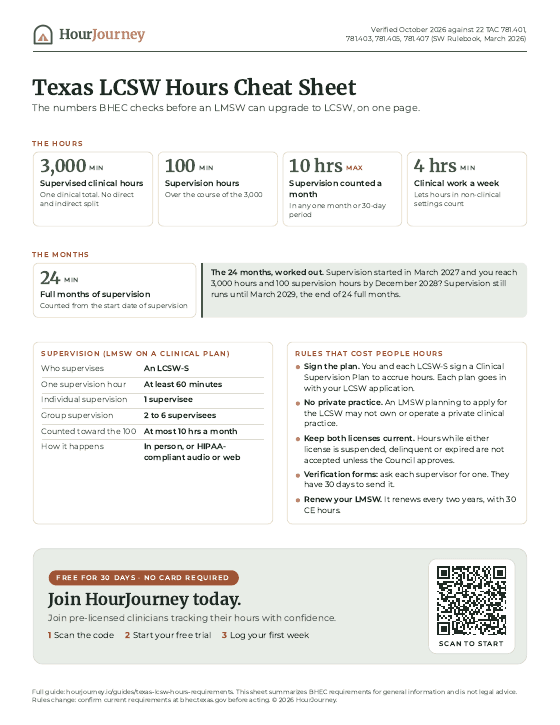
The Texas State Board of Social Worker Examiners has no Associate license on this track. The pre-license status is an LMSW, a Council license that renews biennially (22 TAC 883.1(a)), working under a supervision plan. The degree must be a master's or doctoral degree in social work from a CSWE-accredited program, or a doctoral degree in social work from an accredited institution the Council accepts (781.401(a)(1)(A)), with a university transcript showing a successfully completed field placement in social work (781.401(a)(1)(B)). The rule defines a field placement as "A formal, supervised, planned, and evaluated experience in a professional setting under the auspices of a CSWE-accredited social work program and meeting CSWE standards" (781.102(24)).
The LCSW experience is separate: 3,000 hours of supervised professional clinical experience over a period of at least 24 months (781.401(a)(1)(C)), with supervision running "not less than 24 full months" (781.403(b)(7)), with a supervision plan completed by the LMSW and the LCSW supervisor on a Council form or one with substantially equivalent information, signed by both (781.405(a)). Chapter 781 does not state any credit for hours before the degree. The practicum-style hours sit in the degree; the 3,000 sit under the plan.
Related pages on this track: Texas LCSW hours requirements, what counts as clinical hours for the LCSW, Texas LCSW supervision requirements, Clinical Supervision Plan and Verification Form, the Texas LMSW license, LMSW to LCSW in Texas, and how to become an LCSW in Texas.
Keep Practicum Hours Apart From Post-License Hours
Each board asks for post-license totals per supervisor. The LPC Supervised Experience Documentation Form, the LMFT Supervised Experience Verification Form and the LCSW Clinical Supervision Verification Form are each completed per supervisor, and the LMFT form needs a separate copy after a break of more than 30 days in accrual under the same supervisor. The practicum forms are separate documents: the LPC Practicum Documentation Form goes in with the Associate application, and the LMFT practicum form is completed by the university.
Record practicum and internship hours in a different place from the hours you earn after the license or plan is in place, and add an LMFT excess-hours figure to the 3,000 only if 801.142(4) or (9) applies to you and staff approve it. For changes of supervisor, see the Texas supervisor change form guide.
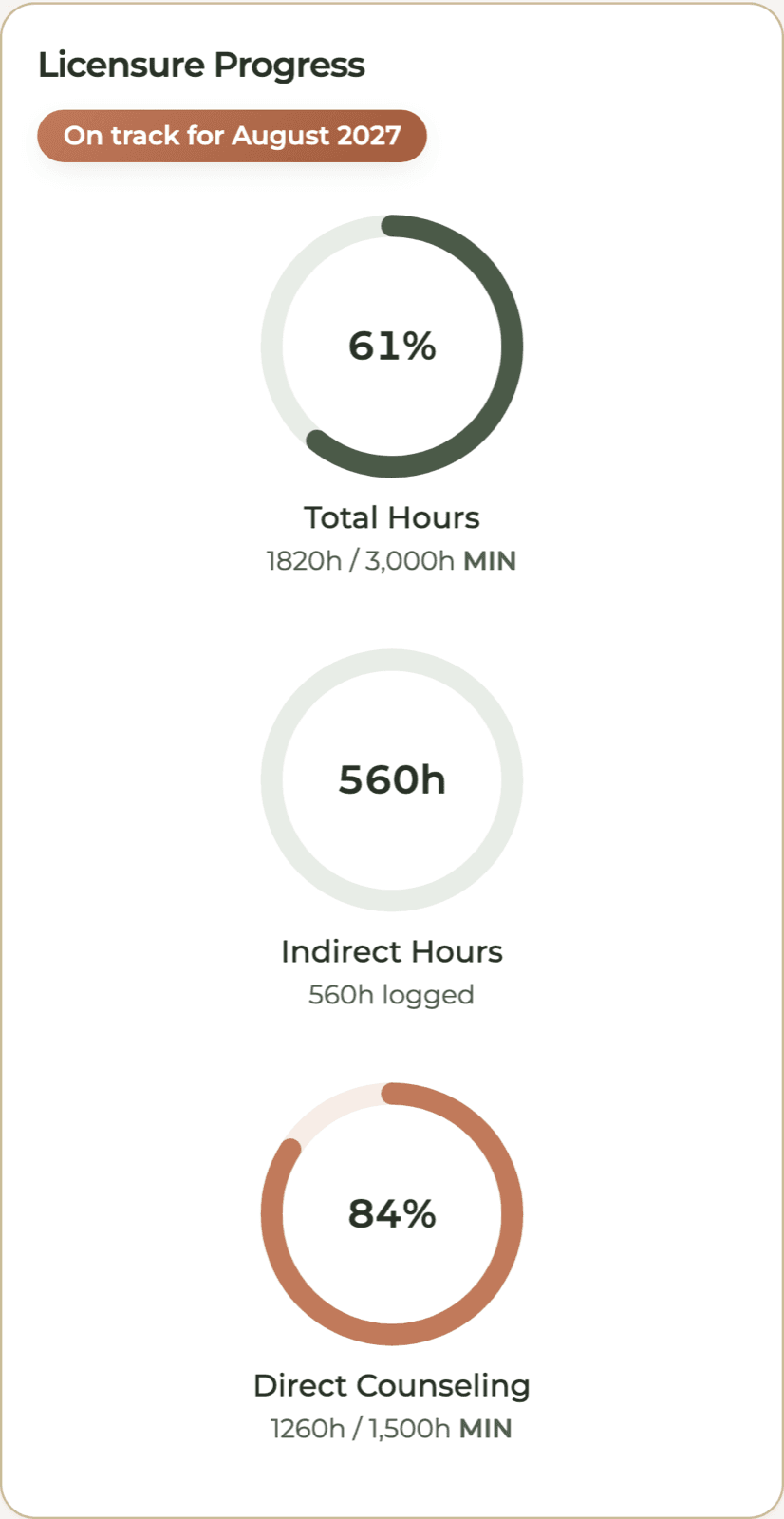
HourJourney shows how close you are
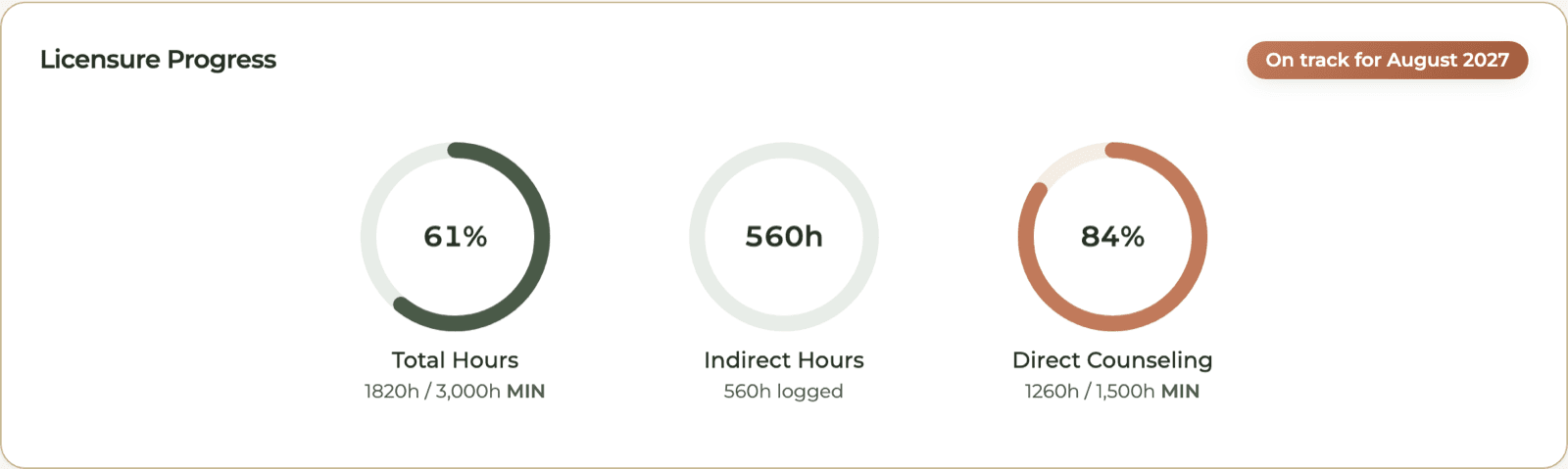
Your dashboard tracks total hours and direct client contact against the 3,000 and 1,500 BHEC requires.
Errors to Avoid With Practicum Hours in Texas
Each of these misreadings is answered by a rule cite.
Adding practicum hours to the LPC 3,000
Hours obtained by an unlicensed person do not count toward the supervised experience requirements (681.91(c)). Practicum is documented on its own form, and supervised experience must be earned after the license issues (681.93(f)(1)).
Reading "counselor intern" as the LPC Associate
Occupations Code 503.052 exempts a student in a supervised course of study who is designated a counselor intern. It is not the post-degree license, and it does not say practicum hours count toward the 3,000.
Using 300 and 100 as the practicum rule for every LPC applicant
Those figures are in 681.83(b)(10) and apply to a counseling-related degree. A counseling degree is presumed to have satisfied the course content (681.83(a)).
Counting all LMFT internship hours instead of the excess
The exception counts only hours exceeding the 801.114(b)(8) requirements, capped at 500 (COAMFTE) or 400 (non-COAMFTE), with couples and family sub-limits of 250 and 200 (801.142(4)).
Skipping the start-date condition
The LMFT exception is written for applicants who begin the graduate degree program before September 1, 2025. Check the date your program began, not the date you graduate.
Applying the excess-hours exception to supervision hours
The 801.142(4) exception counts toward the 3,000 hours of supervised clinical practice. Internship supervision hours are a separate provision, up to 100 toward the 200 (801.142(3)(C)).
Assuming LCSW field placement hours count
Chapter 781 does not state any pre-degree credit. Field placement is a degree requirement (781.401(a)(1)(B)), and the 3,000 hours are earned under a supervision plan (781.405(a)).
Keep Your Post-License Hours in One Place
HourJourney is an hours tracker for pre-licensed clinicians. It covers the record-keeping side:
- ✓Log hours by week
- ✓Running totals kept per supervisor
- ✓Running totals by category
- ✓An export history
Built for pre-licensed clinicians.
Related Guides
Texas Supervisor Change Form
Changing or adding a supervisor, by track
Texas LPC Associate Hours Requirements
The LPC Associate track
What Is an LPC Associate?
The LPC Associate license
How to Become an LPC in Texas
The LPC path
Texas LMFT Associate Hours Requirements
The LMFT Associate track
Texas LCSW Hours Requirements
The LCSW track
What Counts as Clinical Hours for the LCSW
LCSW clinical hours
Texas LMFT Hours Calculator
Estimate your finish date against the 3,000 hours, 200 supervision hours and two-year minimum.
Texas LCSW Hours Calculator
Estimate your finish date against the 3,000 hours, 100 supervision hours and 24-month minimum.
All Texas Guides
The Texas guides hub
FAQ: Practicum and Internship Hours in Texas
Do practicum hours count toward LPC hours in Texas?▾
No. The LPC Associate rule says "Hours obtained by an unlicensed person in any setting will not count toward the supervised experience requirements" (22 TAC 681.91(c)). The Practicum Documentation Form goes in with the Associate application (681.72(a)(6)). The supervisor must ensure the supervised experience was earned after the LPC Associate license was issued (681.93(f)(1)), so your 3,000 hours start counting after the license issues.
How many practicum hours does Texas require for an LPC?▾
It depends on the degree. For a graduate degree in a counseling-related field, the rule requires a supervised practicum "primarily counseling in nature" of at least 300 clock-hours, at least 100 of them direct client counseling, with credit or other acknowledgment on the official graduate transcript (22 TAC 681.83(b)(10)). A counseling degree is "presumed to have satisfied" the course content (681.83(a)). The 300 and 100 figures are not a rule for every applicant.
What is a counselor intern in Texas?▾
In Occupations Code 503.052, the LPC chapter does not apply to the activity or service of a student, intern, or trainee in counseling pursuing a course of study in counseling at a regionally accredited institution of higher education or training institution, if the activity is part of the supervised course of study and the person is designated as a "counselor intern." It is an exemption from the LPC Act. It is not the post-degree LPC Associate license, and the text does not say practicum hours count toward the 3,000.
Do graduate internship hours count toward LMFT hours in Texas?▾
Not as a rule. The degree must include a supervised clinical internship of 12 months or nine semester hours with 300 hours of experience, for a program begun on or after August 1, 2017 (22 TAC 801.114(b)(8)). For applicants who begin the graduate degree program before September 1, 2025, staff may count internship hours that exceed those requirements toward the 3,000: no more than 500 from a COAMFTE program (no more than 250 couples or families) or no more than 400 from a non-COAMFTE program (no more than 200) (801.142(4)(A)-(B)). Practicum or internship done in a doctoral program after a qualifying master's degree is a separate provision (801.142(9)).
My graduate program started after September 1, 2025. Can I use the LMFT excess-internship exception?▾
No. The exception is written for applicants who begin the graduate degree program before September 1, 2025 (22 TAC 801.142(4)). If your program began on or after that date, the excess-hours credit does not apply to you. Your degree internship still has to meet 801.114(b)(8), and your supervised hours start no earlier than the date the LMFT Associate license was issued or, for a later supervisor, the date BHEC staff approved that supervisory relationship (Supervised Experience Verification Form, Section IV).
Do LMFT internship supervision hours count toward the 200 supervision hours?▾
Up to 100 graduate internship supervision hours may be applied toward the 200 supervision hours (22 TAC 801.142(3)(C)). That is a separate provision from the excess-hours exception in 801.142(4), which counts toward the 3,000 hours of supervised clinical practice. Arithmetic from the rule: if 100 internship supervision hours apply, 100 of the 200 remain.
Does field placement count toward LCSW hours in Texas?▾
Chapter 781 does not state any credit for pre-degree hours. A field placement is a degree requirement: the applicant needs a university transcript showing a successfully completed field placement in social work (22 TAC 781.401(a)(1)(B)). The rule defines it as "A formal, supervised, planned, and evaluated experience in a professional setting under the auspices of a CSWE-accredited social work program and meeting CSWE standards" (781.102(24)). The 3,000 hours are supervised professional clinical experience under a supervision plan (781.405(a)).
Requirements verified against 22 TAC Chapters 681, 801 and 781 and Occupations Code 503.052, as printed in the March 2026 rulebooks: the LPC Rulebook, the MFT Rulebook and the SW Rulebook. Where a rulebook and the Texas Administrative Code differ, the Code controls. Statutes and regulations can change. Always confirm current requirements at bhec.texas.gov before making decisions about your hours. This guide is for informational purposes only and does not constitute legal or professional advice.