What the SEV Form Is
The Supervised Experience Verification Form is the file MFT-Supervised-Experience-Verification20260826sf.pdf, last revised August 26, 2026, on the MFT Forms and Publications page. A supervisor completes it before the LMFT Associate they supervised applies to upgrade to a full LMFT license, ideally as or right after the supervisory relationship ends.
Two facts about it catch Associates off guard. First, it is a flat PDF: zero AcroForm fields across its two pages, so nothing on it can be typed into a browser form or an Adobe fillable field. A supervisor fills it out by hand or with a PDF editor that places text directly on the page, the same way the LPC track's Supervised Experience Documentation form works, though that form does carry a handful of addressable fields the SEV does not. Second, a break of more than 30 days in accrual of supervised experience under the same supervisor needs its own separate SEV rather than one form spanning the gap.
Below is what the SEV actually collects, why it is organized per supervisor, and the numbers behind each field.
One Form Per Supervisor, and Why
An LMFT Associate may have no more than two concurrent supervisors unless given prior approval by the council or its designee (22 TAC 801.142(8)). The Texas LPC Associate hours requirements track has the same two-supervisor limit without a stated exception. Each supervisor can only verify the hours, dates, and categories they personally supervised, so an Associate who worked under two supervisors over their 3,000 hours needs two separate SEV forms at upgrade, one from each.
That per-supervisor structure is why the form asks for dates, months, and every hour category as a set for one supervisor rather than a career total. An Associate who kept a single combined number instead of totals split by supervisor has to reconstruct months of records before either form can be filled out correctly.
For experience accrued in Texas, the SEV comes from an LMFT-S, an LMFT with at least 3,000 hours of LMFT practice over at least three years plus a supervision course (22 TAC 801.143(a)); the form also has a route for supervisors licensed outside Texas. The supervisor cannot be the Associate's employee, and cannot be related to the Associate within the second degree of affinity or the third degree of consanguinity (801.143(b)-(c)). Those restrictions apply to every supervisor named on a form, which is one more reason the SEV travels per supervisor instead of as one combined document.
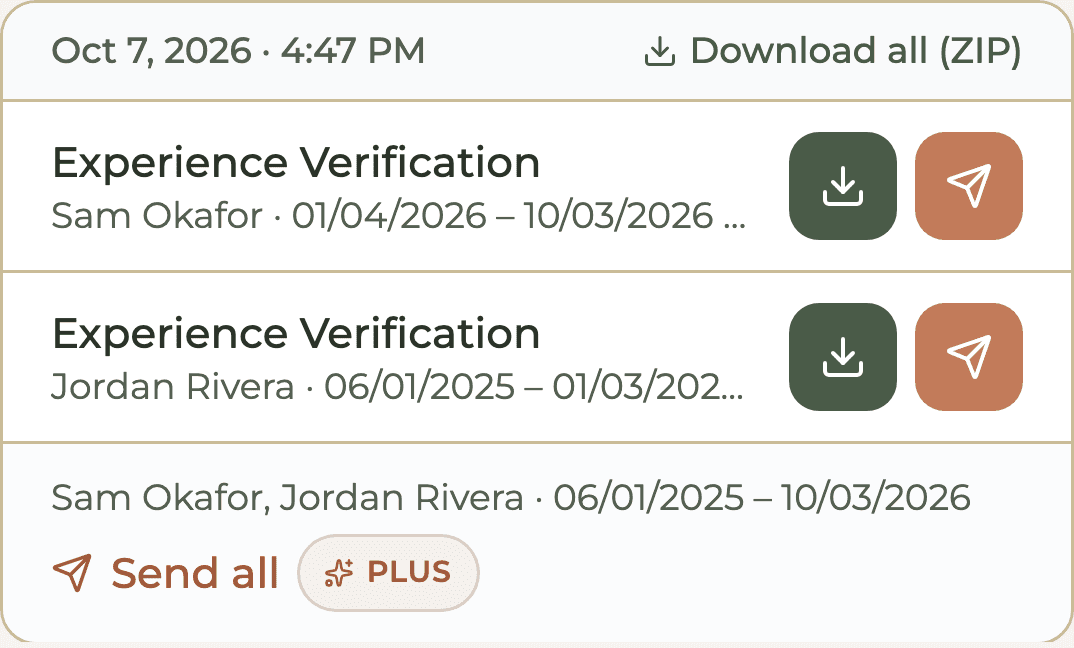
HourJourney keeps a separate form for each supervisor
Your export lists one form per supervisor, each with its own dates and hours.

What the SEV Collects, Field by Field
Here is every category of information on the form, grouped by what it checks. The couples/families field carries an exact definition behind it: direct clinical services to couples or family means professional services delivered with two or more individuals simultaneously, or two or more individuals from the same family system in the same session, where those individuals share an ongoing relationship beyond the therapeutic one itself (22 TAC 801.2(8)). The SEV quotes that definition directly, because it is the line every couples or family session has to clear to count toward the couples/families sub-minimum below.
| Field | What It Captures |
|---|---|
| Supervisee identity | Name, Texas license number, email, phone |
| Supervisor identity | Name, license number, email, phone |
| Supervision hours | Individual, group, and total supervision hours under this supervisor |
| Duration | Dates from and to, plus total years and full months |
| Direct clinical hours total | All direct clinical services under this supervisor |
| Direct to couples and families | The portion of direct hours meeting the couples/family definition (22 TAC 801.2(8)) |
| Direct to individuals | The portion of direct hours with one client |
| Direct to groups | Direct hours in groups that do not meet the couples or families definition |
| Indirect hours | Workshops, public relations, case notes, consulting with referral sources (22 TAC 801.142(2)) |
| Total practice hours | Direct plus indirect hours under this supervisor |
| Virtual-practice direct hours | The portion of direct hours delivered by technology-assisted means (22 TAC 801.2(28)) |
| Recommendation | A Yes/No box from the supervisor |
| Affidavit and signatures | A sworn statement plus both the supervisor's and Associate's signatures |
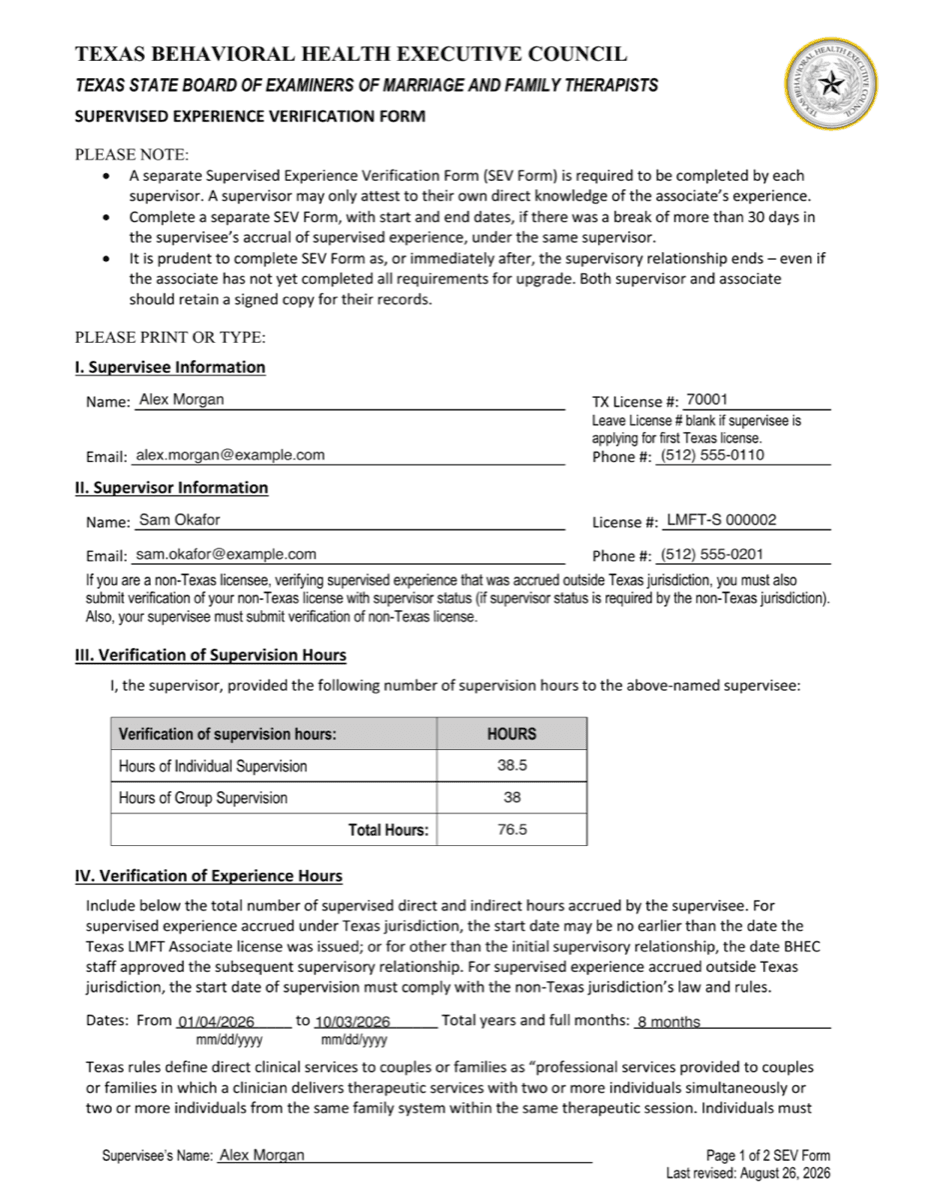
HourJourney fills in your SEV form
One Supervised Experience Verification form per supervisor, with the supervision and experience hours from your log, ready for signature.
The Numbers Behind the Fields, and Where They Come From
This is the section that earns the form its shape. The couples/families, individuals, and groups split exists because at least 500 of the 1,500 direct hours in the Texas LMFT Associate hours requirements must be with couples or families (22 TAC 801.142(1)(B)). The virtual-practice line exists because technology-assisted direct hours are capped at 750 of the direct hours (801.142(1)(A)). The supervision line splits individual and group because at least 100 of the 200 required supervision hours must be individual (801.142(3)). An Associate who kept one combined direct-hours number, instead of separate totals for couples/families, individuals, and groups, cannot fill in this form without reconstructing their records after the fact.
The supervision-hours field carries its own mechanics. A supervision hour under Texas MFT rules is 50 minutes (22 TAC 801.2(26)); the SAF words it as no less than 50 minutes, individual supervision covers no more than two supervisees at a time, and group supervision runs from three to six (801.2(12), (14)). Supervision has to happen at least once a week while the Associate is providing services, except for good cause shown, delivered in person or by live video, with telephone allowed only if the supervisor determines neither option is accessible (801.142(3)(A)-(B)). Up to 100 hours of graduate internship supervision can apply toward the 200-hour total, which is worth asking a program director about before assuming an Associate starts the 200 hours from zero (801.142(3)(C)).
Here is a worked example with two supervisors over the required two years, whose totals add to the full 3,000 hours, 1,500 direct, 500 couples/families, 200 supervision, and 100 individual:
| Supervisor | Months | Supervision (Individual) | Direct Total | Couples/Families | Total Practice |
|---|---|---|---|---|---|
| First supervisor | 12 | 100 (50) | 750 | 250 | 1,500 |
| Second supervisor | 12 | 100 (50) | 750 | 250 | 1,500 |
| Combined | 24 | 200 (100) | 1,500 | 500 | 3,000 |
Twenty-four months clears the two-year minimum duration (801.142(1)). 200 combined supervision hours meets the total, with 100 individual meeting that sub-minimum exactly. 500 combined couples/families hours meets its sub-minimum exactly, out of 1,500 direct hours that meets the direct minimum exactly, out of 3,000 total practice hours that meets the overall requirement. Each supervisor's indirect hours are their total practice hours minus their direct hours, 750 apiece, for 1,500 indirect combined. None of that arithmetic works if an Associate only kept one running number instead of totals split by supervisor and by category from the first week.
Where the SEV Goes, and When
The form says to email the completed SEV to bhecmft@bhec.texas.gov. It travels with the rest of the upgrade file: the upgrade application and its $90 fee, a jurisprudence exam certificate no more than six months old, and an NPDB self-query.
The Other MFT Forms an Associate Touches
The SEV is not the only paperwork in an LMFT Associate's file. Here is the rest of it, with the revision on file as of this writing.
| Form | Revision | Notes |
|---|---|---|
| Supervisory Agreement Form (SAF) | June 16, 2026 | One per supervisor; approval visible on Verify-a-License; due within 30 days of initiating supervision (801.142(7)) |
| Supervised Clinical Practicum Form | June 16, 2026 | Completed by the university, separately for master's and doctoral courses and once per school; same hour buckets as the SEV |
| Documentation Checklist for MFT Licensure | March 17, 2026 | Printable checklist for the full licensure file |
BHEC revises these on its own schedule. The SEV file is dated August 26, 2026, and the SAF and practicum files June 16, 2026. Pull the current file from the MFT Forms and Publications page each time you need one rather than reusing a saved copy from a prior year.
The SAF states: "Experience accrued without an approved SAF on file will not be accepted." The rule sets the deadline: within 30 days of initiating supervision with any LMFT supervisor (22 TAC 801.142(7)). Section IV of the SEV dates experience under a later supervisor from the date BHEC staff approved that supervisory relationship.
Common Mistakes With the SEV
These are the errors that turn a straightforward upgrade into a delayed one.
Trying to type into a fillable field that does not exist
The SEV is a flat PDF with zero AcroForm fields. A supervisor fills it out by hand or with a PDF editor that places text on the page directly, not by tabbing through form fields.
Keeping one combined direct-hours number
The form asks for direct hours split into couples/families, individuals, and groups. An Associate who never separated those totals has to reconstruct months of history before their supervisor can file the SEV.
Not splitting totals by supervisor
Each SEV certifies one supervisor's numbers. An Associate who worked under two supervisors needs two separate forms, and each one only covers that supervisor's own dates and hours.
Letting a break in supervision pass without documenting the dates
A break of more than 30 days under the same supervisor needs its own SEV. Write down the exact start and end dates of any break as it happens, rather than estimating them at upgrade.
Using an old saved copy of the form
The SEV changed in August 2026. A copy saved from a prior year, or forwarded by a colleague who upgraded earlier, may already be outdated.
How HourJourney Tracks This for Texas LMFT Associates
HourJourney generates the Supervised Experience Verification Form, rev 8/26/2026, one per supervisor:
- ✓Couples/families, individuals, groups, and virtual-practice splits already totalled
- ✓Direct, indirect, and supervision hours tracked separately per supervisor, not as one combined total
- ✓Whole-month counts per supervisor, matching how the SEV asks for duration
- ✓The recommendation and signatures left blank for your supervisor to complete
Built for Texas pre-licensed clinicians.
Related Guides
Texas LMFT Associate Hours Requirements
The full 3,000-hour breakdown the SEV's numbers feed into.
Texas LPC Associate Hours Requirements
The comparable 3,000-hour path on the counseling track.
Texas LPC Supervised Experience Documentation Form
The LPC track's own upgrade form, filed by each supervisor.
Texas LMFT Hours Calculator
Estimate your finish date against the 3,000 hours, 200 supervision hours and two-year minimum.
Hours Tracking for Texas Associates
How HourJourney logs and totals your Texas supervision hours.
Texas Supervisor Change Form
How LPC and LMFT handle a supervisor change, and what the LCSW rule leaves out.
FAQ: The Texas LMFT Supervised Experience Verification Form
What is the Supervised Experience Verification Form?▾
The Supervised Experience Verification Form, or SEV, is the file MFT-Supervised-Experience-Verification20260826sf.pdf, last revised August 26, 2026, on the Texas Behavioral Health Executive Council's MFT Forms and Publications page. A Council-approved supervisor completes one SEV per supervisor, before the LMFT Associate applies to upgrade to a full LMFT license and ideally as or right after the supervisory relationship ends.
Who fills out the LMFT SEV form?▾
The supervisor completes the SEV, and both the supervisor and the Associate sign it. The Associate's job is to keep accurate running totals throughout supervision, split by supervisor, so the supervisor has correct numbers to enter: supervision hours, direct clinical hours by category, indirect hours, and the dates and months of supervision.
Is the Texas LMFT SEV form fillable?▾
No. The current SEV is a flat, two-page PDF with zero AcroForm fields. Nothing on it can be typed into a browser or Adobe form field the way a fillable PDF works. A supervisor fills it out by hand or by editing the PDF directly with an editor that can place text on a flat page.
Do you need one form per supervisor?▾
Yes. BHEC requires one SEV per Council-approved supervisor. An LMFT Associate may have no more than two concurrent supervisors unless pre-approved (22 TAC 801.142(8)), and each supervisor can only verify the hours, dates, and categories accumulated under their own supervision.
What happens if you take a break from supervision?▾
If there is a break of more than 30 days in your accrual of supervised experience under the same supervisor, the supervisor completes a separate SEV with its own start and end dates. Note the exact start and end dates as they happen rather than reconstructing them later.
Where do you send the LMFT SEV form?▾
The form says to email the completed SEV to bhecmft@bhec.texas.gov. It travels with the rest of the upgrade file: the upgrade application and its $90 fee, a jurisprudence exam certificate no more than six months old, and an NPDB self-query.
What is the Supervisory Agreement Form?▾
The Supervisory Agreement Form, or SAF, is a separate document filed at the start of supervision, one per supervisor, due within 30 days of initiating supervision with that supervisor (22 TAC 801.142(7)). Its approval is visible on Verify-a-License. The SEV comes later, at upgrade, and verifies what happened during the supervision the SAF opened.
Requirements verified against the consolidated MFT Rulebook (March 2026) and the BHEC MFT Forms and Publications page, current as of September 2026. Rules and forms can change. Always confirm current requirements at bhec.texas.gov before making decisions about your licensure path. This guide is for informational purposes only and does not constitute legal or professional advice.