What the Jurisprudence Exam Is, and Who Has to Take It
The Texas jurisprudence exam is an examination on the laws and rules that govern your profession, not a test of clinical skill. Every application to the Texas Behavioral Health Executive Council (BHEC), the agency behind the Texas State Board of Examiners of Professional Counselors and its counterpart boards for marriage and family therapy and social work, requires a passing certificate from it (22 TAC 882.5).
That puts it in a different category from the clinical exam each board also requires: the NCE or NCMHCE for counseling, the AMFTRB exam (or the California MFT licensure exam) for marriage and family therapy, the ASWB exam for social work. Those test what you know about the work. The jurisprudence exam tests what you know about the rules you practice under.
The certificate it produces has a shelf life, and the fee is fixed: $39, regardless of which board's application it accompanies (22 TAC 885.1). The shelf life is the part to plan around.
The Six-Month Window on Your Certificate
The LPC rules measure the six months to the date the application is received (22 TAC 681.72(a)(4), (b)(3)); council-wide 882.5 says no more than 6 months prior to submitting an application. Keep the certificate well under six months old so that both readings are satisfied.
Sequence the file so the certificate does not age out. Someone sits the jurisprudence exam in January while an official transcript and an NPDB self-query are still working their way through the mail and a records office. By the time the rest of the file is actually ready to go out in August, the January certificate has aged past the 6-month window. BHEC's rules describe no grace period for this. The fix is a second exam and a second $39 fee, not an appeal.
Applicants who work backward from a target filing date, ordering the transcript and the NPDB self-query first and treating the jurisprudence exam as the last box to check rather than the first, avoid this entirely.
Assemble the file first, sit the exam last. Transcripts, the NPDB self-query, fingerprints, and any exam scores you are waiting on should all be in hand before you take the jurisprudence exam. Sit it in the same week you plan to mail or submit the application, so the certificate is as fresh as possible on the day BHEC opens the file.
On the LPC Track, You Take It Twice
LPC applicants sit the jurisprudence exam twice, not once. The first certificate goes with the LPC Associate application. The second goes with the application to upgrade from LPC Associate to LPC, because the same 6-month freshness rule applies at that filing as well: a certificate that was current when you first licensed as an Associate does not carry forward years later when you apply to upgrade. Our guide to upgrading from LPC Associate to LPC covers the rest of that filing, including the Supervised Experience Documentation Form BHEC requires from every supervisor you worked under.
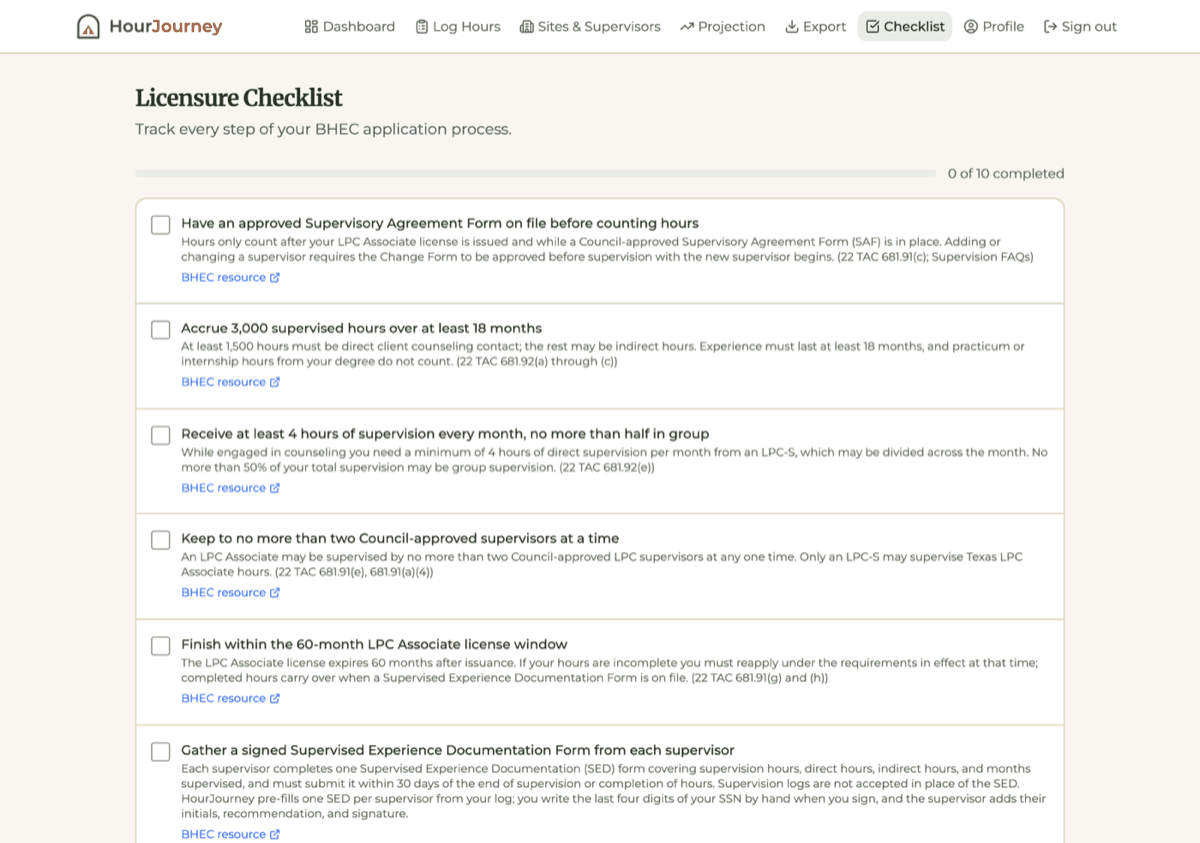
HourJourney keeps your BHEC checklist
Every step from the Supervisory Agreement Form to the upgrade application, in one list you can check off.
Full LPCs Take It Again at Every Renewal
The exam does not stop once you hold the full LPC license. A licensee must complete the Texas jurisprudence examination each renewal period (22 TAC 681.140(b)(2)), and BHEC's LPC renewal page says licensees may claim 1 hour of ethics credit for passing it.
That sits inside a larger continuing-education load: LPCs need 24 hours of continuing education per renewal period, with at least 6 of those hours in ethics and at least 3 in distinct populations and competency. An LPC Supervisor must also complete 6 hours of continuing education in supervision, and those hours may be counted toward the 24 (22 TAC 681.140(b)(3)). Every LPC also completes the jurisprudence exam each renewal period. CE hours are reported through CE Broker.
None of this renewal cycle touches an LPC Associate. Associate licenses expire 60 months from issuance and are not renewed, so there is no continuing education requirement and no repeat jurisprudence exam beyond the one at Associate application and the one at upgrade.
Social Workers and MFTs Take the Same Exam
The jurisprudence exam is not an LPC-only requirement. It is required for social work applications (22 TAC 781.401(b)) and for marriage and family therapy applications (22 TAC 801.174(f)), with the same council-wide 6-month rule (882.5) and the same $39 fee (885.1) that apply on the LPC track. If you are headed toward LCSW, see how to become an LCSW in Texas; if you are on the LMFT Associate track, see Texas LMFT Associate hours requirements.
MFT supervisors carry the same combined obligation LPC supervisors do at renewal: BHEC's MFT renewal page requires a supervisor to complete 6 hours of continuing education in supervision and pass the jurisprudence exam.
Taken Online
The LPC jurisprudence exam is an online exam (22 TAC 681.2(15)). What comes out the other end is a completion certificate carrying a date, and that date, not the fact that you passed, is what the rest of your application depends on. Start at bhec.texas.gov for how to take the exam. If you are also logging supervised hours while you wait on the rest of your file, see hours tracking for Texas associates.
Skip the Answer Keys
Do not rely on answer keys or question banks. The exam is based on the statutes and rules relating to the practice of counseling (22 TAC 681.2(15)), and the rulebook you would need to study is the same rulebook that governs your conduct once you are licensed. BHEC's Statutes and Rules hub carries the consolidated rulebooks, dated March 2026, for every board it oversees.
Common Mistakes With the Jurisprudence Certificate
These are sequencing errors that can force a second exam and a second fee.
Sitting the exam before the rest of the file is ready
A certificate dated months before your transcript, NPDB self-query, or fingerprints clear can age out before BHEC receives the completed application.
Confusing your submission date with BHEC's receipt date
The LPC rules measure the 6 months to the date the application is received; 882.5 says prior to submitting. Keep the certificate well under six months old.
Assuming the Associate-track certificate carries over to the upgrade
It does not. The upgrade to full LPC needs its own certificate, current within 6 months of that filing, even if you passed the exam years earlier as an Associate.
Forgetting the exam comes back at renewal
Full LPCs pass the jurisprudence exam every renewal period, not just once at licensure. Budget it into the same cycle as your continuing education hours.
Studying answer keys instead of the rulebook
Study the rules, not an answer key. The consolidated March 2026 rulebooks on BHEC's Statutes and Rules page are the real material.
HourJourney Does Not Administer the Exam. It Keeps the Rest of Your File Ready.
HourJourney does not prepare you for the jurisprudence exam or administer it. What it does:
- ✓Keeps your direct, indirect, and supervision hours current per supervisor while you finish the rest of your file
- ✓Fills in the board's Supervised Experience Documentation form, one per supervisor, ready when the exam and everything else line up
- ✓Keeps your per-supervisor totals visible so a stale jurisprudence certificate is never the only thing holding up an otherwise-complete application
Built for Texas pre-licensed clinicians.
Related Texas Guides
How to Become an LPC in Texas
The full path from degree to license, including exams and applications.
Texas LPC Associate Hours Requirements
The 3,000-hour requirement, the 18-month floor, and the 60-month license window.
Upgrading From LPC Associate to LPC
The upgrade application, the fee-free filing, and what BHEC checks for.
How to Become an LCSW in Texas
The LMSW-to-LCSW path under a Clinical Supervision Plan.
Texas LMFT Associate Hours Requirements
The 3,000-hour, 200-hour-supervision path to full LMFT.
Hours Tracking for Texas Associates
How HourJourney tracks direct, indirect, and supervision hours for Texas tracks.
Texas LPC Hours Calculator
Estimate your finish date against both the hour count and the 18-month floor.
FAQ: The Texas Jurisprudence Exam
How much is the Texas jurisprudence exam?▾
The Texas jurisprudence exam costs $39, the same fee no matter which board's application it accompanies (22 TAC 885.1). It is required for every application to the Texas Behavioral Health Executive Council, across the counseling, marriage and family therapy, and social work boards (22 TAC 882.5).
How long is the Texas jurisprudence exam certificate good for?▾
Six months. The LPC rules require a completion certificate dated no more than 6 months before the application is received (22 TAC 681.72(a)(4) for the Associate application, 681.72(b)(3) for the upgrade), while council-wide 882.5 says no more than 6 months prior to submitting an application. Keep the certificate well under six months old on both counts. If the rest of your file is not ready when that window closes, the certificate ages out and you retake the exam.
Do you take the Texas jurisprudence exam more than once?▾
Yes, at least twice on the LPC path: once with the LPC Associate application and again with the application to upgrade to full LPC, because the 6-month certificate rule applies at each filing. LPCs then take it again at every renewal once they hold the full license.
Do LPCs take the jurisprudence exam at renewal?▾
Yes. A licensee must complete the Texas jurisprudence examination each renewal period (22 TAC 681.140(b)(2)), and BHEC's LPC renewal page says licensees may claim 1 hour of ethics credit for passing it. That sits inside the broader 24-hour continuing-education requirement LPCs carry each renewal period.
Is there a jurisprudence exam for social workers in Texas?▾
Yes. The jurisprudence exam is required for social work applications (22 TAC 781.401(b)) and for marriage and family therapy applications (801.174(f)). The fee is $39 (885.1), and council-wide 882.5 sets the 6-month limit.
Where do you take the Texas jurisprudence exam?▾
The LPC jurisprudence exam is an online exam (22 TAC 681.2(15)). What you receive at the end is a completion certificate showing a date, and that date is what your application depends on. Start at bhec.texas.gov for how to take it.
Do LPC Associates need continuing education?▾
No. BHEC's continuing education FAQ states it plainly: "No, licenses that do not renew, such as LMFT and LPC associates or provisional psychologists, are not required to complete continuing education." LPC Associate licenses expire 60 months from issuance and are not renewed, so no CE cycle ever applies to them, only the jurisprudence exam at Associate application and again at upgrade.
What happens if your jurisprudence certificate expires before you apply?▾
BHEC's rules describe no grace period for a certificate that ages past 6 months before the application is received. The practical result is that you retake the exam, pay the $39 fee again, and file the new certificate with the rest of your application. This is why the exam belongs at the end of your sequencing, not the beginning.
Requirements verified against the LPC Rulebook (March 2026) and the BHEC LPC renewal, continuing education FAQ, and Statutes and Rules pages. Statutes and regulations can change. Always confirm current requirements at bhec.texas.gov before making decisions about your licensure path. This guide is for informational purposes only and does not constitute legal or professional advice.